
Industrial Waste Drying Equipment: What Problem Does It Actually Solve?
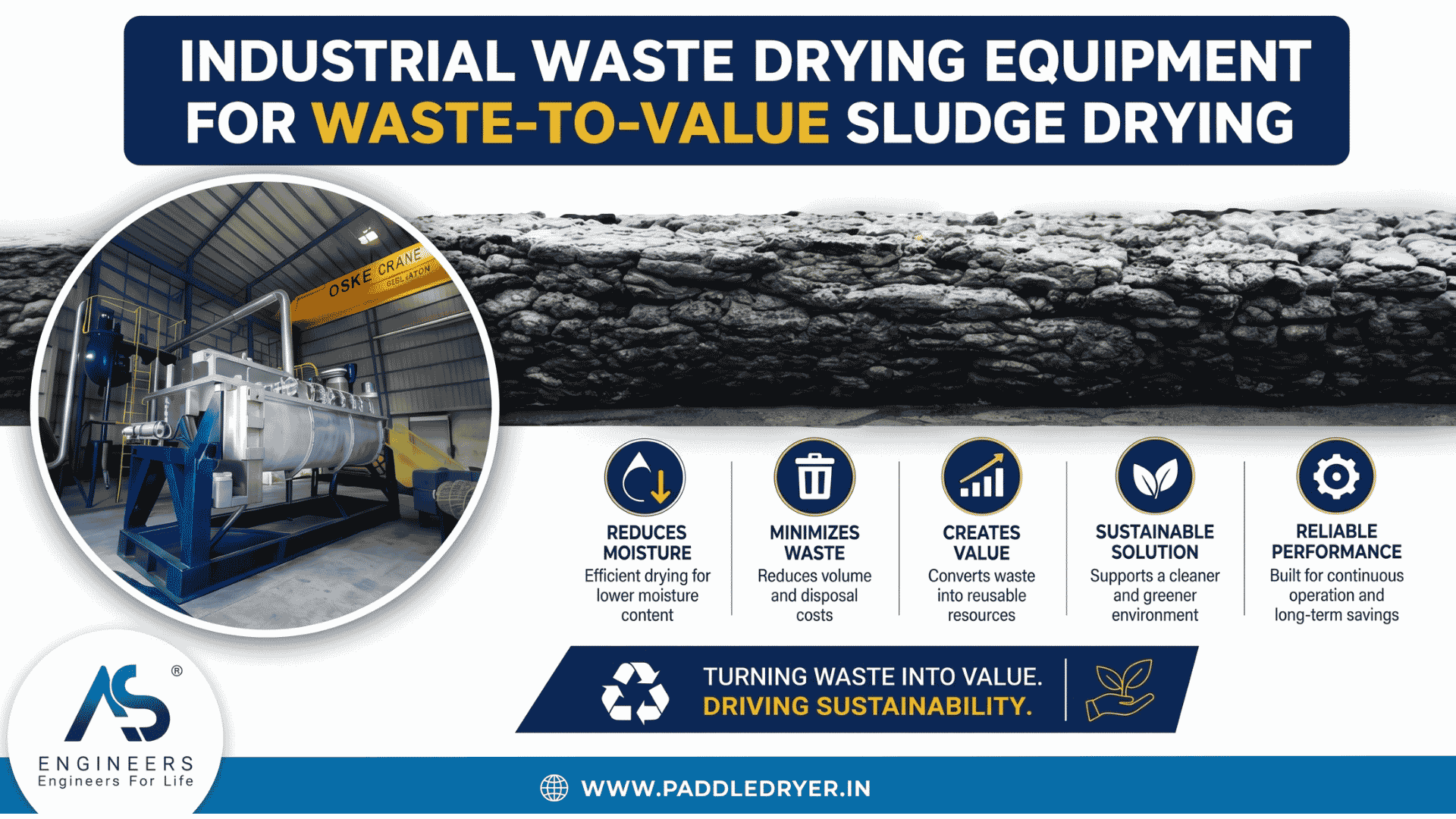
Industrial waste drying equipment reduces moisture from ETP, STP, CETP, and ZLD sludge so the waste becomes easier to store, transport, handle, and evaluate for reuse. For many plants, the real goal is not only drying. It is waste to value sludge drying, where wet disposal liability becomes a controlled dry output for possible fuel, cement, fertilizer, brick, or incineration routes.
Wet sludge is expensive because water adds weight, storage volume, odor risk, handling difficulty, and disposal cost. A well-selected sludge drying guide should therefore start with the disposal route, not only the dryer price.
For AS Engineers, the paddle dryer is designed for wet, sticky, pasty, cake-like, granular, and powder materials. Heat transfers indirectly through the jacket and hollow shafts, while dual counter-rotating shafts and wedge-shaped paddles mix, shear, and move the sludge toward the outlet.
Why Is Wastewater Treatment Sludge Disposal Becoming a Bigger Cost Issue?
Wastewater treatment sludge disposal becomes costly when plants keep moving water instead of solids. Wet sludge increases transport weight, requires larger storage areas, creates hygiene concerns, and makes compliance harder when disposal vendors or regulators demand better consistency.
This is why many ETP and ZLD operators now compare waste management sludge drying against repeated wet sludge disposal. Drying can reduce the physical burden before the waste leaves the plant.
According to AS Engineers’ sludge drying data, a reference case shows 10 tons per day of wet sludge becoming 2 tons per day after drying, reducing disposal quantity by 5:1. The same material may still require testing, but the buyer gets a smaller, drier, more manageable output instead of a heavy wet stream.
ETP sludge disposal is not the same in every industry. Textile, chemical, pharmaceutical, paper, food, dye, and ZLD plants can have very different solids, salts, organics, and contaminants. The dryer must be selected around feed behavior, not only plant capacity.
How Does Paddle Drying Support Waste-to-Value Sludge Drying?
Paddle drying supports waste-to-value sludge drying by creating a more stable dry solid that can be tested for reuse or safer downstream treatment. It does not magically make sludge valuable. It gives the plant a controlled dry form that can be evaluated for value routes.
In an AS Engineers paddle dryer, indirect heat enters through the jacket and hollow shafts. The intermeshing paddles break lumps, expose wet surfaces, and help prevent material buildup. This is useful for sticky sludge because the process combines heat transfer with mechanical agitation.
A paddle sludge dryer can be integrated with feeding, scavenging, pollution control, solvent or vapor management, and dried product handling. That matters because waste-to-value is not only a drying step. It needs controlled feeding, vapor handling, dry discharge, conveying, bagging, and safe storage.
Which Circular Economy Sludge Drying Route Fits Your Material?
Circular economy sludge drying only works when the dried output matches the acceptance criteria of the next user. Sludge drying for alternative fuel, cement plant use, fertilizer, brick manufacturing, or incineration all require different checks. The safest approach is to test the feed first, then select the drying system.
| Waste-to-value route | What drying must achieve | Key risk to verify | Buyer decision note |
|---|---|---|---|
| Sludge drying for alternative fuel | Consistent dry solids and easier handling | Calorific value, ash, chlorine, sulfur, metals | Requires lab testing and buyer acceptance |
| Sludge drying for cement plant | Stable dry feed for co-processing or material use | Inorganics, ash chemistry, hazardous contaminants | Cement plant specification controls suitability |
| Sludge drying for fertilizer | Dry, manageable organic or nutrient-bearing material | Pathogens, heavy metals, salts, local rules | Only suitable for compliant sludge |
| Sludge drying for brick manufacturing | Dry solids that can blend with clay or mineral feed | Ash, shrinkage, strength, emissions | Application-specific trial is essential |
| Sludge drying for incineration | Lower moisture load before thermal destruction | Emissions, ash disposal, energy balance | Useful when final reuse is not permitted |
For plants targeting energy recovery, paddle dryer for WTE selection should focus on stable dryness, safe vapor handling, and downstream fuel logistics. For agriculture or fertilizer use, the discussion must start with sludge composition and legal approval, not dryer marketing claims.
Where Does a ZLD Sludge Dryer Need Extra Attention?
A ZLD sludge dryer needs extra attention because ZLD residues can contain concentrated salts, chemicals, and difficult solids. The drying system must consider corrosion, material of construction, feed consistency, vapor handling, and discharge behavior. A normal sludge dryer selection checklist may not be enough.
In ZLD plants, sludge or salt-rich cake often comes after evaporation, crystallization, filtration, or other concentration stages. A ZLD paddle dryer application needs proper review of temperature limits, alloy selection, scaling tendency, and product handling after drying.
For ETP operators, ETP sludge management should also include upstream dewatering. If the feed is too inconsistent, the dryer may still work, but operating cost and outlet moisture control can suffer. Better dewatering usually improves drying economics.
What Should Buyers Check Before Selecting Industrial Waste Drying Equipment?
Buyers should check feed moisture, inlet consistency, target outlet moisture, heat source, material of construction, emission control, layout, operator skill, and end-use route before selecting industrial waste drying equipment. The right dryer is not the cheapest machine. It is the system that produces the required dry output safely and repeatedly.
Start with sludge characterization: moisture, solids, stickiness, particle behavior, salts, organics, hazardous components, odor, and variability. Then compare drying methods using sludge dewatering and drying logic instead of treating every dryer as interchangeable.
AS Engineers supports steam heating up to 14.06 kg/cm² and thermal oil heating up to 400°C, with options for atmospheric, vacuum, or pressurized operation. Per AS Engineers’ FAQ basis of 80% initial moisture to 20% final moisture, fuel reference values include 1 kg wood for 5 kg sludge, 1 kg coal for 8.25 kg sludge, 1 Nm³ gas for 22.5 kg sludge, and 1 kg LDO for 21 kg sludge.
Pilot testing is the strongest way to reduce selection risk. AS Engineers offers a 50 kg/hr pilot trial machine at its works or client site, with the trial fee waived upon order placement. Buyers can use the paddle dryer pilot trial route to validate drying behavior before committing to full-scale equipment.
What Mistakes Stop Sludge Drying from Becoming a Circular Economy Project?
The biggest mistake is assuming dry sludge automatically becomes valuable. Drying reduces moisture, but it does not remove all contaminants or guarantee acceptance by cement plants, fertilizer users, brick makers, or incineration facilities. Waste-to-value planning must include laboratory testing and offtake approval.
Another mistake is selecting a dryer without planning product handling. Dry material may need a screw conveyor, silo, bagging system, bucket elevator, or truck loading arrangement. If this is ignored, the plant solves moisture but creates a new handling problem.
Buyers also compare only capital cost and ignore utilities, maintenance access, off-gas treatment, and downtime. A proper thermal sludge drying methods comparison should consider lifecycle cost, disposal reduction, plant layout, and whether the dryer can handle real sludge variation.
Why Consider AS Engineers for Sludge Drying and Waste-to-Value Projects?
AS Engineers manufactures paddle dryers from GIDC Vatva, Ahmedabad, Gujarat, India, and positions itself as The Leading Name in Paddle Dryer Industry. The company brings 25+ years of experience, ISO 9001:2015 TUV India certification, CE certification, 500+ clients, 1500+ projects, and 500+ dryers operational.
For paddle dryer for wastewater treatment applications, AS Engineers can support the dryer as part of a broader system: feeding, drying, scavenging, pollution control, solvent or vapor management, and product handling. This is important for ETP sludge disposal, ZLD sludge drying system planning, and circular economy sludge drying projects.
The practical advantage is buyer risk reduction. Instead of choosing a dryer only from a catalogue, plants can evaluate moisture reduction, material behavior, dryness target, utility choice, and end-use feasibility through engineering review and pilot testing.
FAQs
1. What is industrial waste drying equipment used for?
Industrial waste drying equipment is used to reduce moisture in sludge, filter cake, slurry, paste, and other wet industrial residues. In wastewater plants, it supports ETP sludge disposal, ZLD sludge dryer applications, lower transport load, and possible waste-to-value routes.
2. Can dried sludge be used as alternative fuel or in cement plants?
Yes, but only when the dried sludge meets the buyer’s chemical, calorific, ash, emission, and regulatory requirements. Sludge drying for alternative fuel and sludge drying for cement plant use both require lab testing and offtake approval.
3. Is sludge drying for fertilizer always possible?
No. Sludge drying for fertilizer depends on nutrients, organic content, pathogen control, heavy metals, salts, and local agricultural rules. Drying improves handling, but it does not automatically make the material fertilizer-grade.
4. Why is ZLD sludge drying system selection more sensitive?
A ZLD sludge drying system often handles concentrated salts, chemicals, and difficult solids. Buyers must check corrosion risk, scaling behavior, material of construction, vapor handling, and discharge consistency before finalizing the dryer.
5. Does drying reduce sludge disposal cost?
Drying can reduce disposal cost when charges are linked to weight, volume, transport, or handling difficulty. AS Engineers’ reference data shows 10 tons per day of wet sludge reducing to 2 tons per day after drying, but actual savings depend on moisture, disposal rate, fuel cost, and end-use route.
Closing
If your plant is evaluating industrial waste drying equipment for ETP sludge disposal, ZLD sludge drying, alternative fuel, cement, fertilizer, brick manufacturing, or incineration, start with feed testing and end-use clarity. Share your sludge type, moisture level, daily quantity, current disposal method, and target route with AS Engineers Contact for a practical drying-system discussion.

Karan Dargode leads operations and environmental health & safety at AS Engineers, an Ahmedabad-based manufacturer with over 25 years of experience in centrifugal blowers, industrial fans, paddle dryers, sludge dryers, and air pollution control equipment. He joined AS Engineers in July 2019 and has spent over six years building operational systems that support the company’s engineering and manufacturing work. His role spans business strategy execution, operational process design, EHS compliance, and policy development. Day to day, that means keeping manufacturing output consistent, ensuring workplace and environmental standards are met, and supporting the company’s growth across domestic and export markets. Education and Qualifications Karan holds a Bachelor of Engineering in Mechanical Engineering from Silver Oak College of Engineering and Technology, Ahmedabad, affiliated with Gujarat Technological University (GTU), completed in 2018. He later pursued a Post Graduate Diploma in Business Administration (PGDBA) with a focus on Operations Management from Symbiosis Centre for Distance Learning, Pune, strengthening his understanding of manufacturing strategy and industrial operations. What He Writes About The articles and posts on this site reflect what Karan works with directly. He covers: Paddle dryer selection, working principles, and industrial applications Sludge drying technology for ETP and CETP operators Centrifugal blower engineering and maintenance Industrial drying process optimization EHS compliance for industrial manufacturing units His writing is technical without being academic. The goal is straightforward: give plant engineers, ETP operators, and procurement managers the specific information they need to make good equipment decisions. At AS Engineers AS Engineers has manufactured industrial equipment since 1997, serving clients across chemicals, pharmaceuticals, food processing, wastewater treatment, and heavy industry. The Ahmedabad facility at GIDC Vatva handles design, fabrication, and testing in-house. Karan’s work at the operations level puts him directly involved with product delivery quality, production planning, and customer-facing timelines. If you have questions about any article on this site or want to discuss a specific application for blowers, dryers, or air pollution control equipment, you can reach the AS Engineers team through the contact page. Contact AS Engineers