
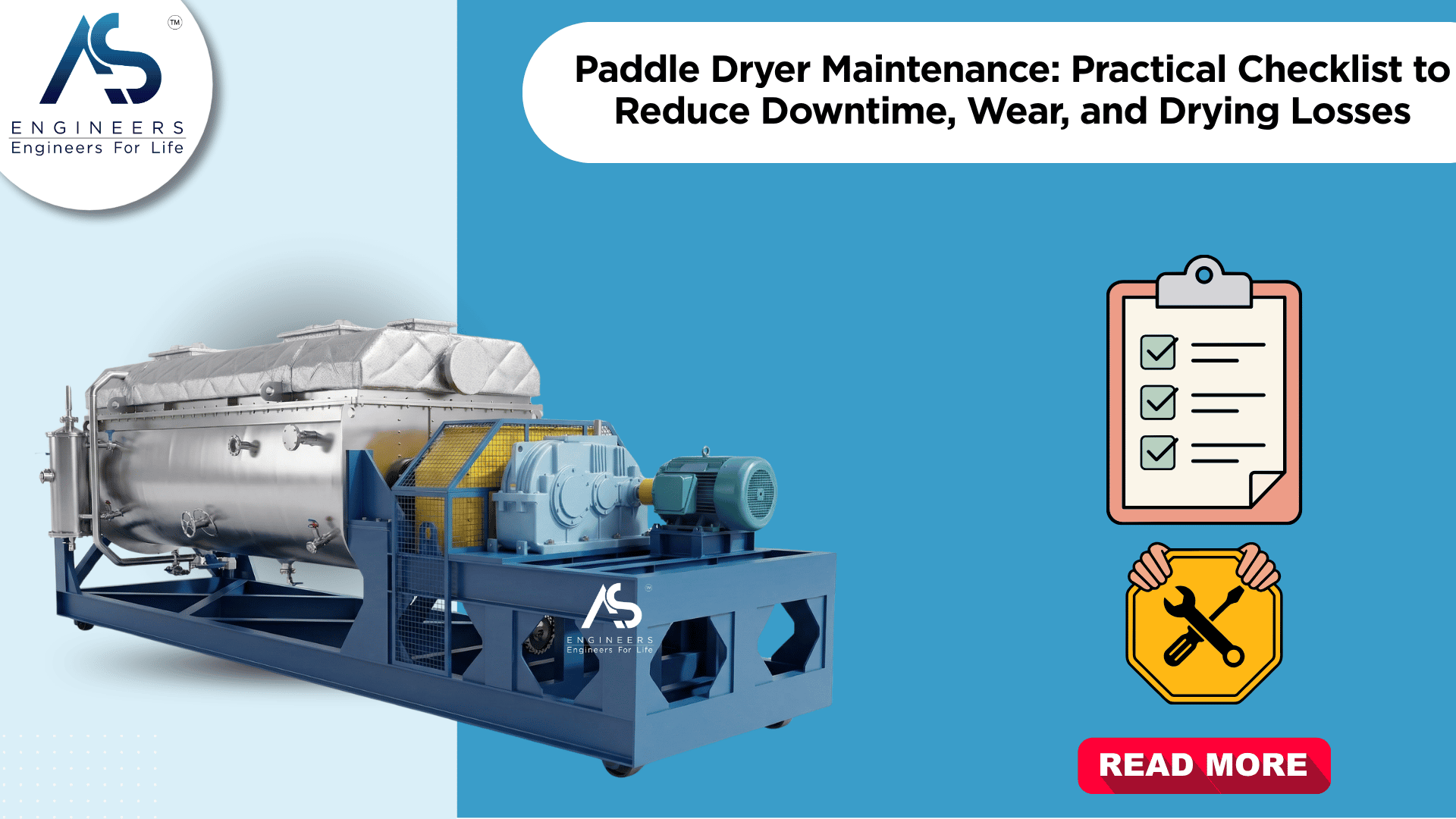
What Does Paddle Dryer Maintenance Really Mean?
Paddle dryer maintenance is the planned inspection, cleaning, lubrication, alignment, heating-system checking, and spare-part management needed to keep an indirect dryer stable. A well-maintained paddle dryer protects heat transfer, outlet moisture control, and uptime. It also reduces sudden gearbox, bearing, seal, shaft, feed, discharge, and off-gas problems.
A paddle dryer is not just a rotating vessel. Hollow shafts, jacketed surfaces, wedge paddles, feed control, vapor handling, and product discharge must work together. For a buyer or plant engineer, maintenance should be treated as part of process reliability, not only as mechanical repair after failure.
AS Engineers designs paddle dryers for wet, sticky, pasty, cake-like, granular, and powder materials, including sludge and industrial process streams. The machine’s self-cleaning paddle action helps reduce buildup, but “self-cleaning” does not mean “no inspection.” A plant still needs disciplined checks around material buildup, shaft rotation load, scraper zones, seals, condensate or thermal oil lines, and downstream handling.
For plants still comparing technology, the basic working concept is covered in the dedicated Paddle Dryer page, and the practical design background is explained in hollow paddle dryer technology.
Why Maintenance Starts With Feed Control
Most paddle dryer maintenance problems begin before material enters the dryer. If feed moisture, feed rate, lumps, grit, or foreign particles are uncontrolled, the dryer receives uneven load and the mechanical system works harder than required. Stable feeding is one of the simplest ways to reduce wear and drying variation.
For sludge drying, poor upstream dewatering often creates sticky surges. These surges increase torque, slow drying, and may create localized buildup. In chemical, mineral, food, or polymer applications, the problem may come from hard agglomerates, abrasive particles, or temperature-sensitive material.
A good maintenance program should therefore include feed observation. Operators should record whether the feed is pumpable, pasty, crumbly, sticky, or unusually abrasive. They should also watch whether moisture changes during shift change, batch change, filter press discharge, centrifuge operation, or ETP/STP load variation.
This is why paddle dryer selection and maintenance should not be separated. If the feed is difficult, a pilot trial and proper dryer sizing can prevent repeated site problems. AS Engineers supports a paddle dryer pilot trial program for evaluating drying behavior before full-scale decision-making.
Which Paddle Dryer Parts Need the Most Attention?
A maintenance team should focus on parts that directly affect rotation, heat transfer, sealing, vapor removal, and product discharge. The highest-risk areas are usually shafts and paddles, bearings, gearbox, seals, feed/discharge points, heating-medium connections, and pollution-control equipment.
| Maintenance Area | Early Warning Sign | Practical Check | Risk If Ignored | Action Priority |
|---|---|---|---|---|
| Shaft and paddles | Higher load, uneven discharge, knocking sound | Inspect buildup, paddle wear, abnormal vibration | Poor mixing, mechanical stress | High |
| Bearings and seals | Heat, leakage, noise, grease contamination | Check temperature, lubrication, seal condition | Shutdown or shaft damage | High |
| Gearbox and drive | Abnormal sound, jerky rotation, oil leakage | Check oil level, coupling, alignment | Drive failure and production loss | High |
| Heating jacket and hollow shaft | Slow drying, unstable outlet moisture | Check steam, condensate, thermal oil flow | Lower evaporation efficiency | High |
| Feed and discharge system | Bridging, choking, inconsistent flow | Check screw feeder, pump, conveyor, outlet path | Dryer overload or underfeeding | Medium to High |
| Cyclone, scrubber, bag filter, ID fan | Dust carryover, odor, poor vapor pull | Check pressure drop, blockage, fan operation | Unsafe vapor handling and compliance risk | High |
| Instrumentation | Wrong temperature or moisture response | Verify sensors and control signals | Wrong operating decisions | Medium |
How Often Should a Plant Inspect a Paddle Dryer?
Inspection frequency should be based on duty severity, operating hours, material abrasiveness, feed variability, and safety risk. Variable ETP sludge needs different attention than a clean, predictable powder.
Daily checks should focus on abnormal noise, vibration, temperature behavior, feed flow, discharge consistency, leakage, and motor load. Weekly checks can cover lubrication condition, fasteners, gear drive observation, seal area cleaning, instrument review, and off-gas line cleanliness. Monthly or planned-shutdown checks should include deeper inspection of paddles, shaft condition, bearing housing, heating-medium lines, condenser or scrubber equipment, and discharge conveyors.
Plants handling industrial sludge should also monitor how upstream treatment affects dryer load. If the ETP produces highly variable sludge, the maintenance schedule must be more conservative. The article on ETP sludge management is useful for understanding why feed quality and disposal strategy affect dryer operation.
For wastewater and municipal sludge buyers, a paddle dryer is often selected because it reduces handling burden after dewatering. The difference between upstream dewatering and thermal drying is explained in sludge dewatering and drying.
What Are the Most Common Paddle Dryer Maintenance Mistakes?
The biggest maintenance mistake is waiting for failure before inspecting the dryer. Paddle dryers usually give early signals through torque, outlet moisture, vibration, leakage, discharge behavior, and vapor handling performance. Ignoring those signals turns a manageable adjustment into a shutdown.
A second mistake is assuming self-cleaning paddles remove every risk of material buildup. Sticky sludge, polymeric feed, oily material, or poor feed control can still create deposits in zones where temperature, moisture, and shear are not balanced.
A third mistake is focusing only on the main dryer and ignoring auxiliary systems. A dryer may be mechanically sound, but poor vapor removal, blocked cyclone discharge, weak scrubber performance, faulty ID fan operation, or poor bag filter maintenance can disturb the entire process. For plants using cyclone separators, scrubbers, or filters, AS Engineers also provides pollution control equipment as part of the broader system approach.
The fourth mistake is buying non-OEM spare parts only because they are locally available. In a paddle dryer, incorrect material grade, poor fitment, or weak fabrication tolerance can affect shaft life, sealing, and heat transfer performance. Spare strategy should be planned before breakdown, not after the dryer is already stopped.
How Should Maintenance Change for Sludge, Chemical, Food, and Mineral Applications?
Maintenance must follow the material, not only the machine model. Sludge applications create hygiene, odor, stickiness, and disposal-pressure challenges. Chemical and mineral applications may create corrosion, abrasion, dust, solvent, or temperature-control concerns. Food and agricultural applications may need stronger cleaning discipline and contamination control.
For sludge, the maintenance team should pay close attention to feed moisture, smell, discharge dryness, sludge buildup, and vapor treatment. For chemicals, focus on compatibility of material of construction, seals, vapors, and solvent handling. For minerals, watch abrasion on paddles and discharge parts. For food-related drying, cleaning access and batch contamination risk matter more.
AS Engineers’ paddle dryers support applications such as drying, solvent stripping, heating, calcining, roasting, and cooling. They can be configured for atmospheric, vacuum, or pressurized operation, and heating can be through steam or thermal oil, depending on the process requirement. For sludge-focused readers, paddle sludge dryer explains how sludge handling changes after drying, while sludge drying technology gives broader process context.
When Should You Call OEM Service Instead of Local Repair?
Call OEM service when the issue affects shaft alignment, gearbox health, bearing replacement, seal leakage, heating-medium performance, structural wear, retrofitment, or process output. Local repair may solve a small visible problem but miss the root cause. For critical equipment, wrong repair can become more expensive than planned OEM service.
According to AS Engineers, support can include shaft, gearbox, and bearing replacement, system repair and upgrades, retrofitment solutions, OEM spare parts, on-site alignment, on-site balancing, AMC, operator training, and process optimization. This matters because a paddle dryer is a process machine, not a standalone fabrication item.
Plants should involve the OEM when they see repeated outlet moisture variation, frequent overload trips, abnormal gearbox noise, repeated seal failure, heating inefficiency, vibration increase, discharge choking, or major change in feed material. Buyers planning a service strategy can review AS Engineers’ paddle dryer training and spare parts and OEM spare parts options.
How Does Maintenance Planning Affect Buying Decisions?
Maintenance cost starts at the purchase stage. A plant that buys only on initial price may later pay through downtime, difficult cleaning, wrong heating medium, poor access, weak discharge design, or non-available spares. A better buying question is: “Will this dryer be maintainable under our real feed condition?”
Before ordering, buyers should confirm material characteristics, inlet moisture, desired outlet moisture, heating medium, duty hours, dust or vapor load, discharge method, available utilities, and cleaning access. They should also ask how spare parts, training, AMC, retrofitment, and emergency support will be handled.
AS Engineers, based at GIDC Vatva, Ahmedabad, Gujarat, India, manufactures paddle dryers with 25+ years of experience, ISO 9001:2015 TUV India certification, CE certification, 500+ clients, 1500+ projects, and 500+ dryers operational. The company positions itself as “The Leading Name in Paddle Dryer Industry” and supports buyers from selection to service.
For new projects, maintenance planning should be included in the technical discussion before final quotation. The main industrial paddle dryer page is a good starting point for buyers who want to connect equipment selection with lifecycle support.
FAQs
1. How often should paddle dryer maintenance be done?
Paddle dryer maintenance should be divided into daily operating checks, weekly mechanical checks, and planned shutdown inspections. Frequency depends on material type, operating hours, stickiness, abrasiveness, moisture variation, and safety risk. Sludge and abrasive applications normally need closer monitoring than clean, consistent feeds.
2. Does a self-cleaning paddle dryer still need cleaning?
Yes. Self-cleaning paddle action helps reduce buildup between intermeshing paddles, but it does not remove the need for inspection. Sticky sludge, oily feed, polymeric material, and poor feed control can still create deposits in certain zones.
3. What are the warning signs of poor paddle dryer maintenance?
Common warning signs include abnormal noise, vibration, seal leakage, gearbox heating, repeated overload trips, unstable outlet moisture, poor discharge flow, weak vapor removal, and higher drying time. These signals should be investigated before they become major breakdowns.
4. Which spare parts should a paddle dryer user plan for?
Typical spare planning should consider seals, bearings, lubrication items, drive-related parts, feed/discharge components, and application-specific wear parts. Critical spares should be finalized with the OEM because material, size, MOC, and operating duty vary by project.
5. Can maintenance improve dryer efficiency?
Yes, maintenance can improve effective heat transfer, stable rotation, vapor removal, discharge flow, and moisture control. It cannot compensate for a wrongly sized dryer or unsuitable feed preparation, but it can protect performance when the dryer is correctly selected.
Paddle dryer maintenance is easiest when the dryer is selected, operated, and serviced as one complete system. If your plant is facing repeated drying variation, buildup, seal leakage, drive issues, or spare-part uncertainty, discuss the application with AS Engineers through their paddle dryer services team before the issue becomes a shutdown.

Karan Dargode leads operations and environmental health & safety at AS Engineers, an Ahmedabad-based manufacturer with over 25 years of experience in centrifugal blowers, industrial fans, paddle dryers, sludge dryers, and air pollution control equipment. He joined AS Engineers in July 2019 and has spent over six years building operational systems that support the company’s engineering and manufacturing work. His role spans business strategy execution, operational process design, EHS compliance, and policy development. Day to day, that means keeping manufacturing output consistent, ensuring workplace and environmental standards are met, and supporting the company’s growth across domestic and export markets. Education and Qualifications Karan holds a Bachelor of Engineering in Mechanical Engineering from Silver Oak College of Engineering and Technology, Ahmedabad, affiliated with Gujarat Technological University (GTU), completed in 2018. He later pursued a Post Graduate Diploma in Business Administration (PGDBA) with a focus on Operations Management from Symbiosis Centre for Distance Learning, Pune, strengthening his understanding of manufacturing strategy and industrial operations. What He Writes About The articles and posts on this site reflect what Karan works with directly. He covers: Paddle dryer selection, working principles, and industrial applications Sludge drying technology for ETP and CETP operators Centrifugal blower engineering and maintenance Industrial drying process optimization EHS compliance for industrial manufacturing units His writing is technical without being academic. The goal is straightforward: give plant engineers, ETP operators, and procurement managers the specific information they need to make good equipment decisions. At AS Engineers AS Engineers has manufactured industrial equipment since 1997, serving clients across chemicals, pharmaceuticals, food processing, wastewater treatment, and heavy industry. The Ahmedabad facility at GIDC Vatva handles design, fabrication, and testing in-house. Karan’s work at the operations level puts him directly involved with product delivery quality, production planning, and customer-facing timelines. If you have questions about any article on this site or want to discuss a specific application for blowers, dryers, or air pollution control equipment, you can reach the AS Engineers team through the contact page. Contact AS Engineers