
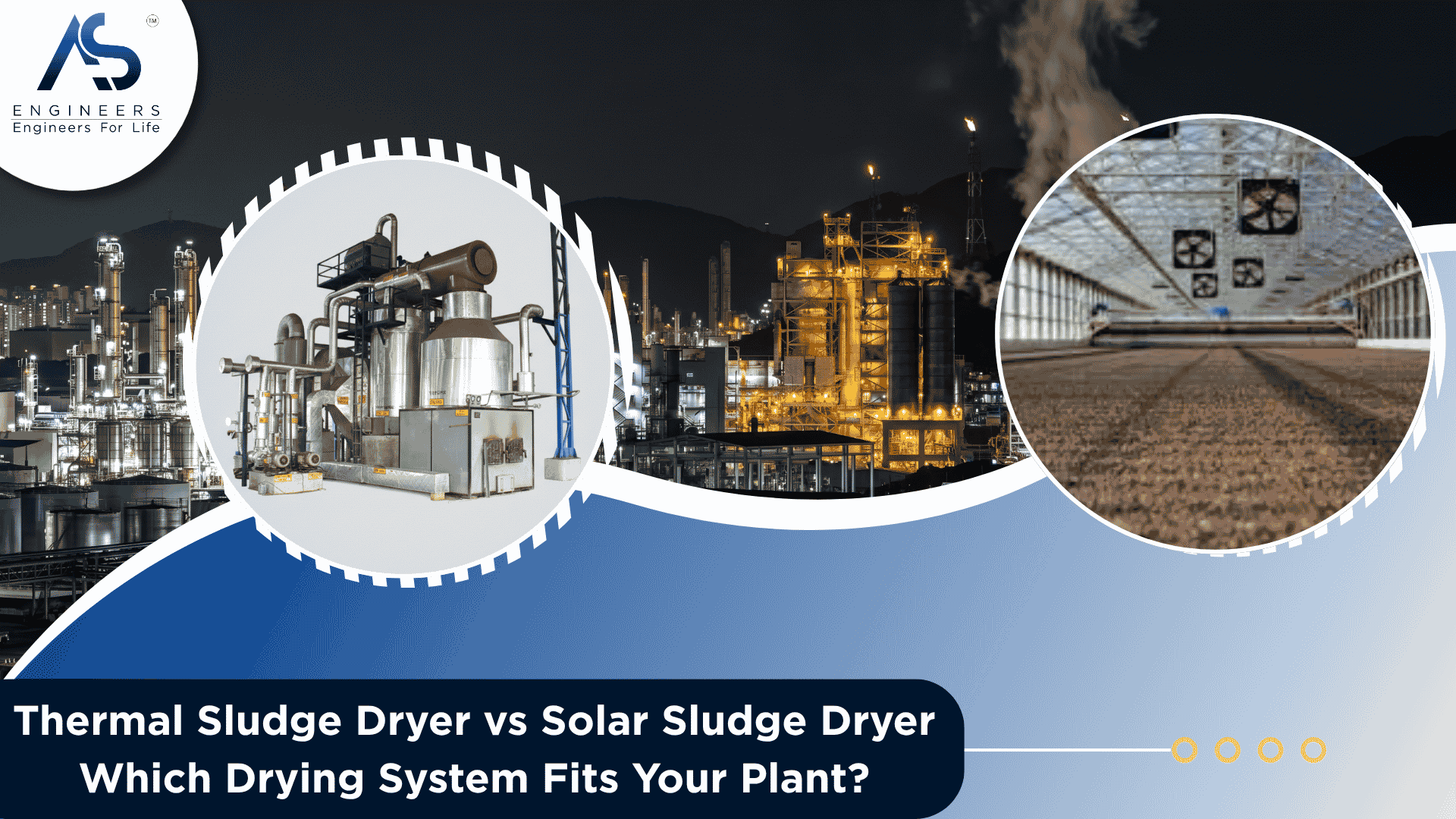
What Is the Real Difference Between a Thermal Sludge Dryer and a Solar Sludge Dryer?
A thermal sludge dryer uses controlled heat to remove moisture from sludge in an engineered process. A solar sludge dryer uses sunlight, airflow, and greenhouse-style drying conditions to evaporate moisture more gradually. The practical difference is not only “fuel versus sunlight”; it is control, land requirement, drying consistency, and how fast a plant must reduce sludge disposal load.
For a plant comparing thermal sludge dryer vs solar sludge dryer, the first question should be: “Do we need predictable output every day, or can we accept weather-dependent drying?” Thermal drying is normally selected when sludge flow is continuous, space is limited, disposal cost is high, or final dryness must be controlled. Solar drying may suit sites with large available land, favorable climate, lower urgency, and flexibility in drying time.
For a broader base on sludge drying, see sludge drying with paddle dryer technology and the existing comparison on thermal drying and solar drying.
How a Thermal Sludge Dryer Works in Industrial Sludge Handling
A thermal sludge dryer removes moisture by applying heat through a controlled drying system. In AS Engineers’ paddle dryer design, heat is transferred indirectly through hollow shafts and a jacket while paddles mix, shear, and move the sludge forward. This helps wet sludge change from sticky or plastic form into a drier, more manageable product.
In a paddle-type thermal dryer, the material is not simply exposed to hot air. The sludge is continuously agitated, heated, and advanced through the equipment. AS Engineers’ system can be configured with steam up to 14.06 kg/cm² or thermal oil up to 400°C, depending on the application and site utility. The same platform can support atmospheric, vacuum, or pressurized operation.
This is why thermal drying is often preferred for ETP, STP, CETP, chemical, pharma, textile, paper, and industrial wastewater sludge where moisture reduction is tied to compliance, transport cost, hygiene, and space. For sludge-specific equipment selection, review paddle sludge dryer selection and AS Engineers’ sludge dryer manufacturer page.
How a Solar Sludge Dryer Works and Where It Makes Sense
A solar sludge dryer relies on solar radiation, ventilation, and exposed drying area to reduce sludge moisture. It is generally a slower and more climate-sensitive method than thermal drying. The strongest fit is usually where land is available, climate is favorable, daily output pressure is lower, and the plant can tolerate seasonal variation.
Solar drying is not automatically “free drying.” Even when sunlight supplies the main evaporation energy, the plant still has to consider land cost, covered structure cost, sludge turning, odor control, ventilation, rain protection, operator handling, and long drying residence time. For facilities handling variable sludge quality, sticky cake, rainy seasons, or strict daily disposal targets, solar drying can become operationally uncertain.
A serious buyer should evaluate solar drying as a site-dependent method, not as a universal replacement for thermal sludge drying. It can be useful in the right climate and land situation, but it is weaker where predictable throughput, compact layout, or controlled final moisture is required.
Which System Gives Better Control Over Final Moisture?
Thermal drying gives better process control because heat input, residence time, agitation, feed rate, and discharge condition can be engineered. Solar drying depends more heavily on weather, sunlight, humidity, airflow, and available drying area. This makes thermal drying stronger for buyers who need repeatable outlet dryness.
AS Engineers’ paddle dryer can be designed to reach a specific moisture target and, where the application allows, up to 99% dryness. That does not mean every sludge should be dried to maximum dryness. The correct target depends on disposal route, reuse route, calorific value, handling requirement, and regulatory expectation.
Solar sludge drying can reduce moisture, but the final condition is harder to guarantee without long residence time and favorable climate. In a plant where disposal trucks arrive daily, or where the downstream user needs consistent dry solids, this uncertainty can create bottlenecks.
For buyers focused on controlled moisture reduction, hollow paddle dryer thermal drying technology is usually a more relevant reference than general sun-drying concepts.
Thermal Sludge Dryer vs Solar Sludge Dryer: Buyer Decision Table
This table is designed for engineering and procurement screening, not final equipment sizing. The correct selection still depends on sludge analysis, moisture level, feed rate, climate, site layout, fuel availability, and disposal route. Use it to identify which option deserves deeper technical evaluation.
| Decision Factor | Thermal Sludge Dryer | Solar Sludge Dryer | Buyer Interpretation |
|---|---|---|---|
| Drying control | High | Medium to Low | Thermal is stronger when final moisture must be predictable. |
| Footprint requirement | Low to Medium | High | Solar drying usually needs more land area. |
| Weather dependency | Low | High | Solar performance changes with sunlight, rain, humidity, and season. |
| Throughput reliability | High | Application-specific | Thermal suits continuous industrial sludge loads. |
| Utility dependency | Requires heat source | Requires sunlight and ventilation | Thermal needs fuel or utility planning; solar needs site and climate confidence. |
| Odor and hygiene control | Better in enclosed systems | Depends on enclosure and handling | Wet open handling can create site issues. |
| Capital decision driver | Equipment and utility system | Land, structure, handling system | Lowest energy source does not always mean lowest total cost. |
| Best fit | Space-limited, regulated, high-volume plants | Large land, favorable climate, flexible timing | Match technology to disposal pressure, not only energy cost. |
What Mistakes Do Buyers Make When Comparing These Two Systems?
The most common mistake is comparing only energy cost. A solar sludge dryer may look attractive because sunlight is available, but the full decision includes land, drying time, monsoon or rainy periods, operator handling, odor risk, and disposal deadlines. A thermal dryer may require fuel, but it can reduce uncertainty when disposal cost and daily sludge load are serious.
The second mistake is ignoring sludge behavior. Sludge is not a uniform material. Industrial sludge, biological sludge, paper sludge, textile sludge, and chemical sludge can behave differently during drying. Sticky, thixotropic, oily, fibrous, or high-salt sludge may require pilot testing before final selection.
The third mistake is selecting a technology before deciding the end-use of dried sludge. If the dry output is going to landfill, the target moisture may be different from sludge intended for co-processing, fuel, bricks, fertilizer, or other value recovery routes. AS Engineers’ database identifies dried sludge reuse possibilities such as alternative fuel, cement production, agriculture, and bricks, but the actual suitability depends on sludge composition and local acceptance.
For disposal-focused planning, see sludge dewatering and drying for waste management and ETP sludge management.
Which Dryer Reduces Disposal Cost More Reliably?
A thermal sludge dryer is usually more reliable for disposal cost reduction when the plant has steady sludge generation and high wet-sludge handling cost. The reason is simple: it gives controlled volume and moisture reduction regardless of sunlight. Solar drying may reduce cost too, but the result depends strongly on weather, drying area, and time available.
According to AS Engineers, one sludge drying example shows 10 tons/day of wet sludge reduced to 2 tons/day of dry sludge, with disposal cost moving from ₹1,00,000/day to ₹20,000/day at the same ₹10,000/ton disposal basis. This is a plant economics example, not a universal guarantee. The real saving depends on feed moisture, final moisture, disposal rate, fuel, power, labor, maintenance, and whether dried sludge has reuse value.
This is where pilot testing becomes important. A spreadsheet comparison cannot fully predict how a sludge cake will behave inside a dryer. AS Engineers offers a 50 kg/hr pilot trial option at its facility or client site, with the trial cost waived upon order placement. Buyers evaluating thermal drying can use paddle dryer pilot trial before committing to final sizing.
When Should a Plant Choose Thermal Drying Over Solar Drying?
Choose thermal drying when the plant needs predictable output, compact equipment, controlled final moisture, enclosed operation, and daily sludge reduction. This is especially relevant for ETP, STP, CETP, chemical, pharma, paper, textile, food, and industrial wastewater plants where sludge disposal is a recurring operational burden.
Thermal drying is also stronger when sludge cannot wait for long drying cycles. If wet sludge storage creates odor, hygiene issues, large storage demand, or transport cost pressure, a controlled dryer can become part of the plant’s compliance and cost-control strategy. A thermal system also fits better when the dried product must feed a downstream handling system, bagging system, silo, truck disposal route, or reuse pathway.
For equipment-level details, refer to AS Engineers’ paddle dryer and sludge thermal drying resources.
When Can Solar Sludge Drying Be a Practical Option?
Solar sludge drying can be practical where the site has enough land, favorable sunlight, lower rainfall risk, and flexibility in drying time. It may suit lower-pressure sludge handling situations where the plant can store and manage sludge safely during the drying period. It is more difficult when land is expensive, climate is inconsistent, or the plant has strict daily sludge disposal targets.
Solar drying also needs careful planning for odor, insects, leachate, ventilation, operator movement, sludge turning, and rain protection. Buyers sometimes treat it as a simple civil structure, but it still needs operational discipline. If sludge quality changes frequently, performance can become less predictable.
A useful screening question is: “What happens during a cloudy week, rainy season, or sudden sludge load increase?” If the answer creates a disposal backlog, thermal drying should be evaluated seriously.
Why Pilot Testing Should Decide the Final Dryer Choice
Pilot testing protects the buyer from wrong sizing, wrong final moisture assumptions, and unrealistic operating expectations. Sludge drying performance depends on moisture, solids, stickiness, particle behavior, heat sensitivity, odor, and discharge handling. A test gives better answers than brochure-level comparison.
For thermal paddle drying, a pilot trial can help confirm feed behavior, moisture reduction, handling condition, and process feasibility. It also helps the plant understand whether the dried sludge becomes granular, powdery, sticky, dusty, or suitable for the intended disposal route. This matters for screw conveyors, bagging, storage, truck loading, pollution control, and operator safety.
If your plant is comparing thermal sludge dryer vs solar sludge dryer, shortlist both only after checking land, climate, sludge volume, disposal urgency, and moisture target. Then test the thermal route before finalizing equipment size. For lifecycle support, AS Engineers also provides paddle dryer services including repair, upgrades, OEM spare parts, alignment, balancing, AMC, training, and process optimization.
FAQs
1. Is a thermal sludge dryer better than a solar sludge dryer?
A thermal sludge dryer is better when the plant needs controlled final moisture, compact footprint, predictable daily operation, and lower weather dependency. A solar sludge dryer can be suitable where land, sunlight, and time are available. The better option depends on sludge volume, climate, disposal urgency, and moisture target.
2. Is solar sludge drying cheaper than thermal sludge drying?
Solar drying may reduce fuel dependency, but it is not automatically cheaper in total cost. Land, structure, long residence time, sludge turning, odor control, ventilation, and seasonal performance must be included. Thermal drying has utility cost, but it can reduce disposal uncertainty and wet sludge handling burden.
3. Which sludge drying system is better for ETP and STP sludge?
For ETP and STP sludge with continuous generation and strict disposal pressure, thermal sludge drying is often the safer engineering choice. It gives better control over drying rate, final moisture, and handling. Solar drying may work only when the site has enough land and flexible drying time.
4. Can dried sludge be reused after thermal drying?
Dried sludge may be considered for routes such as alternative fuel, cement, agriculture, or brick production, depending on composition and local acceptance. Reuse should never be assumed without sludge testing and regulatory review. Moisture reduction improves handling, but end-use suitability depends on chemistry and contaminants.
5. Should I run a pilot trial before buying a sludge dryer?
Yes, pilot testing is strongly recommended for industrial sludge. It helps confirm drying behavior, discharge form, moisture reduction, handling risk, and equipment sizing assumptions. This is especially important for sticky, chemical, biological, oily, or variable sludge.
If your plant is comparing thermal sludge dryer vs solar sludge dryer, start with the operating problem: land, climate, sludge quantity, target moisture, disposal cost, and daily reliability. For controlled industrial sludge drying, AS Engineers can evaluate your sludge, review the drying requirement, and support pilot testing before final equipment selection. Share your sludge details with AS Engineers to discuss the right drying route for your plant.

Karan Dargode leads operations and environmental health & safety at AS Engineers, an Ahmedabad-based manufacturer with over 25 years of experience in centrifugal blowers, industrial fans, paddle dryers, sludge dryers, and air pollution control equipment. He joined AS Engineers in July 2019 and has spent over six years building operational systems that support the company’s engineering and manufacturing work. His role spans business strategy execution, operational process design, EHS compliance, and policy development. Day to day, that means keeping manufacturing output consistent, ensuring workplace and environmental standards are met, and supporting the company’s growth across domestic and export markets. Education and Qualifications Karan holds a Bachelor of Engineering in Mechanical Engineering from Silver Oak College of Engineering and Technology, Ahmedabad, affiliated with Gujarat Technological University (GTU), completed in 2018. He later pursued a Post Graduate Diploma in Business Administration (PGDBA) with a focus on Operations Management from Symbiosis Centre for Distance Learning, Pune, strengthening his understanding of manufacturing strategy and industrial operations. What He Writes About The articles and posts on this site reflect what Karan works with directly. He covers: Paddle dryer selection, working principles, and industrial applications Sludge drying technology for ETP and CETP operators Centrifugal blower engineering and maintenance Industrial drying process optimization EHS compliance for industrial manufacturing units His writing is technical without being academic. The goal is straightforward: give plant engineers, ETP operators, and procurement managers the specific information they need to make good equipment decisions. At AS Engineers AS Engineers has manufactured industrial equipment since 1997, serving clients across chemicals, pharmaceuticals, food processing, wastewater treatment, and heavy industry. The Ahmedabad facility at GIDC Vatva handles design, fabrication, and testing in-house. Karan’s work at the operations level puts him directly involved with product delivery quality, production planning, and customer-facing timelines. If you have questions about any article on this site or want to discuss a specific application for blowers, dryers, or air pollution control equipment, you can reach the AS Engineers team through the contact page. Contact AS Engineers