
Sludge Drying Methods: What Should a Plant Actually Compare?
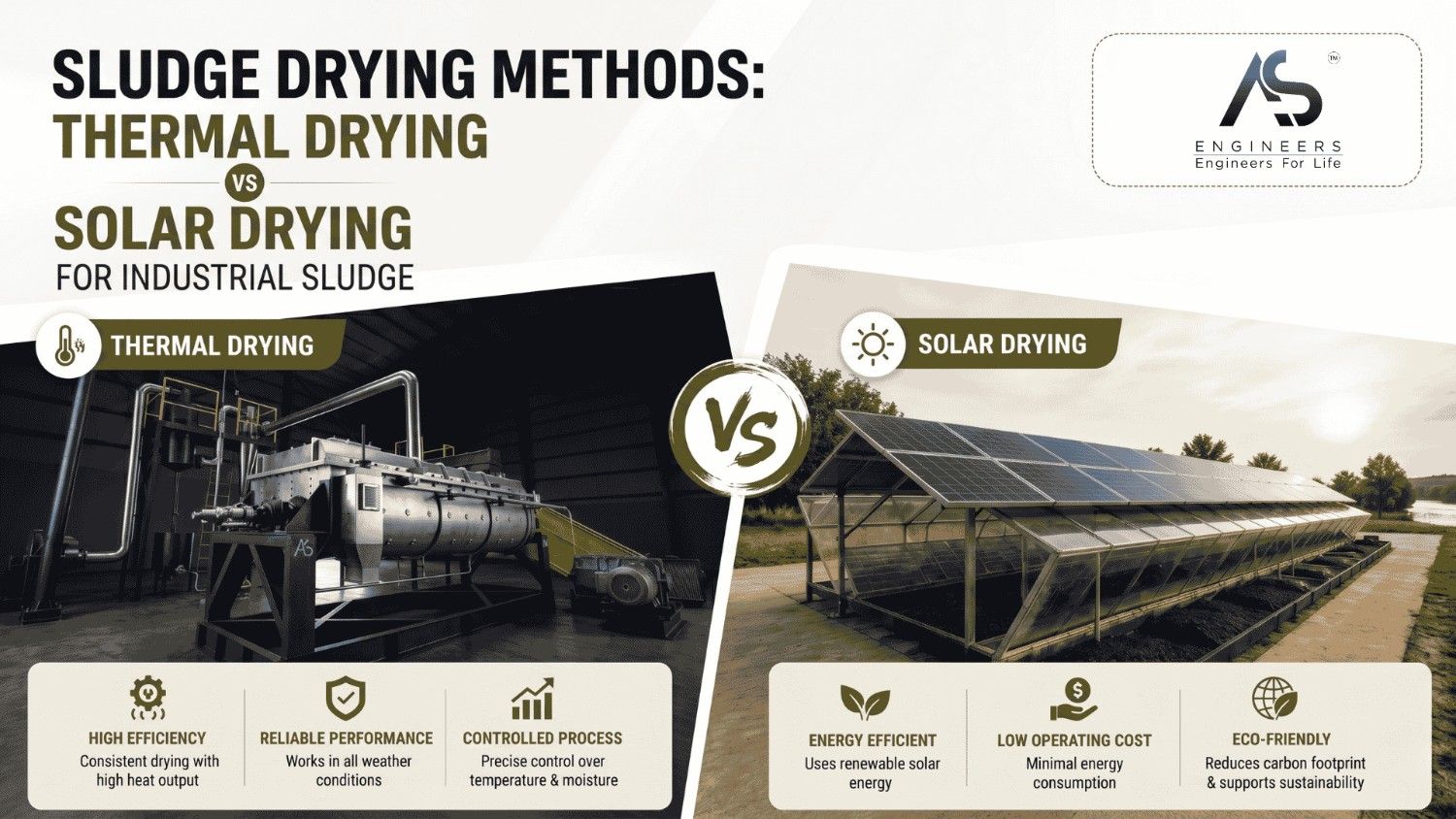
Sludge drying methods should be compared on moisture reduction, drying control, land requirement, weather dependence, odor risk, disposal cost, and compliance needs. Thermal drying is usually better for industrial plants that need predictable output, compact layout, and year-round operation. Solar drying can work where land is available, climate is favorable, and the plant can accept slower drying.
For ETP, STP, CETP, chemical, textile, food, pharma, paper, and municipal sludge, the drying decision should not be based only on energy cost. Wet sludge is expensive because it carries water, occupies space, smells, and increases handling difficulty. A good drying method reduces volume, improves hygiene, and makes downstream disposal or reuse more practical.
For a broader foundation, see this sludge drying guide before final equipment selection.
Why Does Sludge Drying Matter Before Disposal or Reuse?
Sludge drying matters because most sludge management problems are moisture problems. High moisture increases transport weight, storage area, odor, leachate risk, and disposal frequency. Reducing water content can turn a difficult waste stream into a more stable material for disposal, co-processing, fuel use, bricks, fertilizer, or other approved applications.
In many plants, sludge is first dewatered using a filter press, centrifuge, screw press, or belt press. That step reduces free water but still leaves wet cake that may be heavy, sticky, and costly to move. Drying handles the next stage by removing deeper moisture and improving material form.
This is why sludge dewatering and drying should be planned together instead of treated as separate decisions. Dewatering affects dryer load, dryer energy use, discharge quality, and final handling.
How Does Thermal Sludge Drying Work?
Thermal sludge drying uses heat to evaporate moisture from sludge under controlled plant conditions. The heat may come from steam, thermic fluid, hot air, electricity, gas, LDO, coal, wood, briquette, or other available site fuel systems. For industrial operations, the major advantage is predictable drying performance across seasons.
Thermal drying can be direct or indirect. In direct drying, hot air contacts the sludge. In indirect drying, heat transfers through a heated surface, which reduces the volume of off-gas compared with many direct systems. A paddle dryer is an indirect thermal dryer where hollow shafts and the jacket transfer heat into wet sludge while rotating paddles mix, shear, and move the material.
According to AS Engineers, its paddle dryer design can use steam up to 14.06 kg/cm² or thermal oil up to 400°C, depending on the application. For buyers comparing thermal drying of sludge with paddle sludge dryers, this matters because heating medium selection directly affects temperature control, utility integration, and operating economics.
How Does Solar Sludge Drying Work?
Solar sludge drying uses sunlight, ambient heat, airflow, and time to evaporate moisture from sludge. It is usually done on drying beds, paved platforms, or greenhouse-style solar drying areas. The method is simple in principle, but performance depends heavily on climate, monsoon or rainy seasons, humidity, available land, turning frequency, and odor control.
Solar drying can reduce purchased energy demand, which makes it attractive for municipal or low-throughput sites with enough open area. But it is not automatically the lowest-risk option. If sludge volume is high, moisture is inconsistent, weather is unstable, or the site is near sensitive surroundings, solar drying may create planning, odor, hygiene, and compliance challenges.
Solar drying is best treated as a site-condition method, not a universal industrial solution. It can be practical where drying speed is not urgent and where the plant can safely manage open or semi-open sludge exposure.
Which Sludge Drying Method Is Better for ETP, STP, and CETP Plants?
Thermal drying is generally stronger for ETP, STP, and CETP plants that need controlled output, lower land dependency, and more reliable compliance planning. Solar drying can be suitable for lower-risk sludge streams where the site has land, sunlight, time, and acceptable odor management. The better choice depends on sludge composition, daily load, final moisture target, and disposal route.
Industrial ETP and CETP sludge may contain chemicals, dyes, organics, salts, metals, or process residues. That makes open drying more sensitive because odor, dust, leachate, and rainwater contact can create secondary handling problems. Thermal systems are easier to enclose, automate, and connect with pollution control systems.
For buyers handling common industrial sludge streams, ETP sludge management should include a full route from sludge generation to dewatering, drying, storage, disposal, and possible reuse. The drying method should fit that route, not operate as an isolated machine.
Thermal Drying vs Solar Drying: Buyer Decision Table
This table gives a practical selection view for plant engineers and procurement teams. Exact results depend on feed condition, moisture content, climate, dryer design, operating discipline, and final disposal rules. Use it as a pre-selection guide before trials or detailed engineering.
| Decision Factor | Thermal Sludge Drying | Solar Sludge Drying | Buyer Interpretation |
|---|---|---|---|
| Drying control | High | Low to medium | Thermal is stronger when final moisture must be consistent. |
| Weather dependence | Low | High | Solar drying needs favorable climate and seasonal planning. |
| Land requirement | Low to medium | High | Solar drying can become difficult where land is costly. |
| Drying speed | Faster | Slower | Thermal suits continuous industrial sludge generation. |
| Energy purchase | Medium to high | Low | Solar saves fuel but may add land and handling cost. |
| Odor control | Easier to enclose | More exposed | Thermal is safer near sensitive plant boundaries. |
| Automation potential | High | Low to medium | Thermal fits controlled plant operations better. |
| CAPEX pattern | Equipment-driven | Land and civil-driven | Compare total system cost, not only machine cost. |
| Maintenance skill | Mechanical and utility skill needed | Civil, turning, and site upkeep needed | Both need discipline, but in different areas. |
| Best fit | Industrial, high-volume, compliance-focused sludge | Low-volume, climate-suitable, land-available sites | Selection should follow sludge risk and business objective. |
For plants comparing multiple mechanical options, the comparison between paddle dryers vs belt dryers can also help clarify footprint, off-gas, and handling differences.
What Are the Biggest Mistakes Buyers Make When Comparing These Methods?
The biggest mistake is comparing only energy cost and ignoring total sludge handling cost. A drying system affects transport, manpower, storage, odor, hygiene, disposal frequency, compliance risk, and reuse potential. A method that looks cheaper per unit of heat can become expensive if it needs large land, repeated handling, or long retention time.
The second mistake is assuming solar drying is always environmentally better. It may use less purchased fuel, but open exposure can create odor, dust, vector, and rainwater management concerns. The actual environmental result depends on site design and operating discipline.
The third mistake is underestimating feed variation. Sludge from biological treatment, chemical treatment, textile effluent, paper mills, food processing, or pharma plants behaves differently. Sticky sludge, oily sludge, high salt sludge, and fibrous sludge should be evaluated through testing before final selection.
Why Is a Paddle Dryer a Practical Thermal Drying Option?
A paddle dryer is practical when the buyer needs enclosed, indirect, compact, and controlled sludge drying. It uses heated hollow shafts and a heated jacket to transfer heat while paddles continuously mix and move the material. This makes it suitable for wet cakes, pastes, slurries, sticky materials, granules, and powders.
AS Engineers’ paddle dryer design includes dual counter-rotating shafts, wedge-shaped paddles, self-cleaning action, and plug-flow material movement. The system can be configured as a standard dryer, dual-zone dryer, or vacuum dryer based on process requirements. For sludge buyers, this flexibility helps when moisture target, material behavior, and temperature sensitivity vary.
The hollow paddle dryer technology approach is especially relevant where space is limited and off-gas volume needs to be managed carefully. AS Engineers also provides paddle dryers for sludge drying for industrial sludge applications where reliability and repeatable output are more important than open-air simplicity.
What Should You Test Before Selecting Thermal or Solar Drying?
Before selecting a drying method, test moisture content, stickiness, particle behavior, odor risk, heat sensitivity, disposal route, and final dryness requirement. A desktop comparison can shortlist options, but sludge behavior often decides the real answer. Pilot testing reduces the risk of buying a system that looks correct on paper but struggles at site.
For thermal drying, the buyer should confirm heating medium, utility availability, feed consistency, discharge handling, dust/fines management, and vapor treatment needs. For paddle dryers, review paddle dryer heating medium and fuel options before freezing the system design.
Per AS Engineers, a 50 kg/hr pilot trial machine is available at its facility or at the client site, with the minimal trial fee waived on order placement. This is useful for checking real sludge behavior before committing to a full-scale system. Buyers can start with a paddle dryer pilot trial when sludge variability or disposal cost is high.
Final Selection Logic for Industrial Buyers
For industrial buyers, thermal drying is usually the safer choice when production is continuous, land is limited, compliance is strict, and final moisture must be predictable. Solar drying is worth considering when the sludge is lower risk, the climate is favorable, the land is available, and time pressure is low. The decision should be based on lifecycle cost, not only fuel cost.
A practical selection flow is simple. First, reduce moisture through dewatering. Second, define final disposal or reuse. Third, compare drying methods based on site constraints. Fourth, validate the selected route through material testing.
If the sludge is difficult, sticky, high-volume, or disposal cost is rising, a paddle sludge dryer should be evaluated seriously. It may not be the simplest method, but for many industrial plants it gives the control needed to convert wet sludge into a manageable dried output.
FAQs
1. Is thermal sludge drying always better than solar drying?
No. Thermal sludge drying is better when a plant needs controlled, faster, year-round drying with lower weather dependency. Solar drying may be better where land is available, climate is favorable, sludge risk is low, and drying time is not critical. The correct choice depends on sludge type, volume, moisture target, and disposal route.
2. Is solar sludge drying suitable for industrial ETP sludge?
Solar drying can be suitable for some industrial ETP sludge, but it needs careful review. If the sludge has strong odor, chemical residues, oily behavior, high variability, or rainwater sensitivity, open drying can create operating and compliance problems. Industrial buyers should test sludge behavior before selecting solar drying.
3. Why do many plants choose paddle dryers for sludge drying?
Many plants choose paddle dryers because they offer indirect heating, enclosed operation, compact layout, and controlled moisture reduction. Paddle dryers are useful for wet, sticky, and difficult sludge where open drying or simple hot-air methods may struggle. They also integrate well with feeding, discharge, vapor handling, and pollution control systems.
4. Can dried sludge be reused instead of disposed of?
In some cases, dried sludge can be used as alternative fuel, in cement production, brick making, fertilizer, or other approved applications. Reuse depends on sludge composition, contamination level, calorific value, local regulations, and buyer acceptance. Testing and compliance clearance are necessary before treating dried sludge as a resource.
5. What is the safest first step before buying a sludge dryer?
The safest first step is a feed analysis and drying trial. A pilot trial shows how the sludge behaves under heat, how sticky it becomes, what moisture level is realistic, and how the dried product can be handled. This reduces technical and commercial risk before full-scale equipment investment.
Choosing between thermal and solar sludge drying is not only an equipment decision. It is a disposal cost, compliance, land, utility, and handling decision. If your plant needs predictable sludge drying with controlled output, discuss your sludge sample, fuel options, moisture target, and site constraints with AS Engineers Contact.

Karan Dargode leads operations and environmental health & safety at AS Engineers, an Ahmedabad-based manufacturer with over 25 years of experience in centrifugal blowers, industrial fans, paddle dryers, sludge dryers, and air pollution control equipment. He joined AS Engineers in July 2019 and has spent over six years building operational systems that support the company’s engineering and manufacturing work. His role spans business strategy execution, operational process design, EHS compliance, and policy development. Day to day, that means keeping manufacturing output consistent, ensuring workplace and environmental standards are met, and supporting the company’s growth across domestic and export markets. Education and Qualifications Karan holds a Bachelor of Engineering in Mechanical Engineering from Silver Oak College of Engineering and Technology, Ahmedabad, affiliated with Gujarat Technological University (GTU), completed in 2018. He later pursued a Post Graduate Diploma in Business Administration (PGDBA) with a focus on Operations Management from Symbiosis Centre for Distance Learning, Pune, strengthening his understanding of manufacturing strategy and industrial operations. What He Writes About The articles and posts on this site reflect what Karan works with directly. He covers: Paddle dryer selection, working principles, and industrial applications Sludge drying technology for ETP and CETP operators Centrifugal blower engineering and maintenance Industrial drying process optimization EHS compliance for industrial manufacturing units His writing is technical without being academic. The goal is straightforward: give plant engineers, ETP operators, and procurement managers the specific information they need to make good equipment decisions. At AS Engineers AS Engineers has manufactured industrial equipment since 1997, serving clients across chemicals, pharmaceuticals, food processing, wastewater treatment, and heavy industry. The Ahmedabad facility at GIDC Vatva handles design, fabrication, and testing in-house. Karan’s work at the operations level puts him directly involved with product delivery quality, production planning, and customer-facing timelines. If you have questions about any article on this site or want to discuss a specific application for blowers, dryers, or air pollution control equipment, you can reach the AS Engineers team through the contact page. Contact AS Engineers