
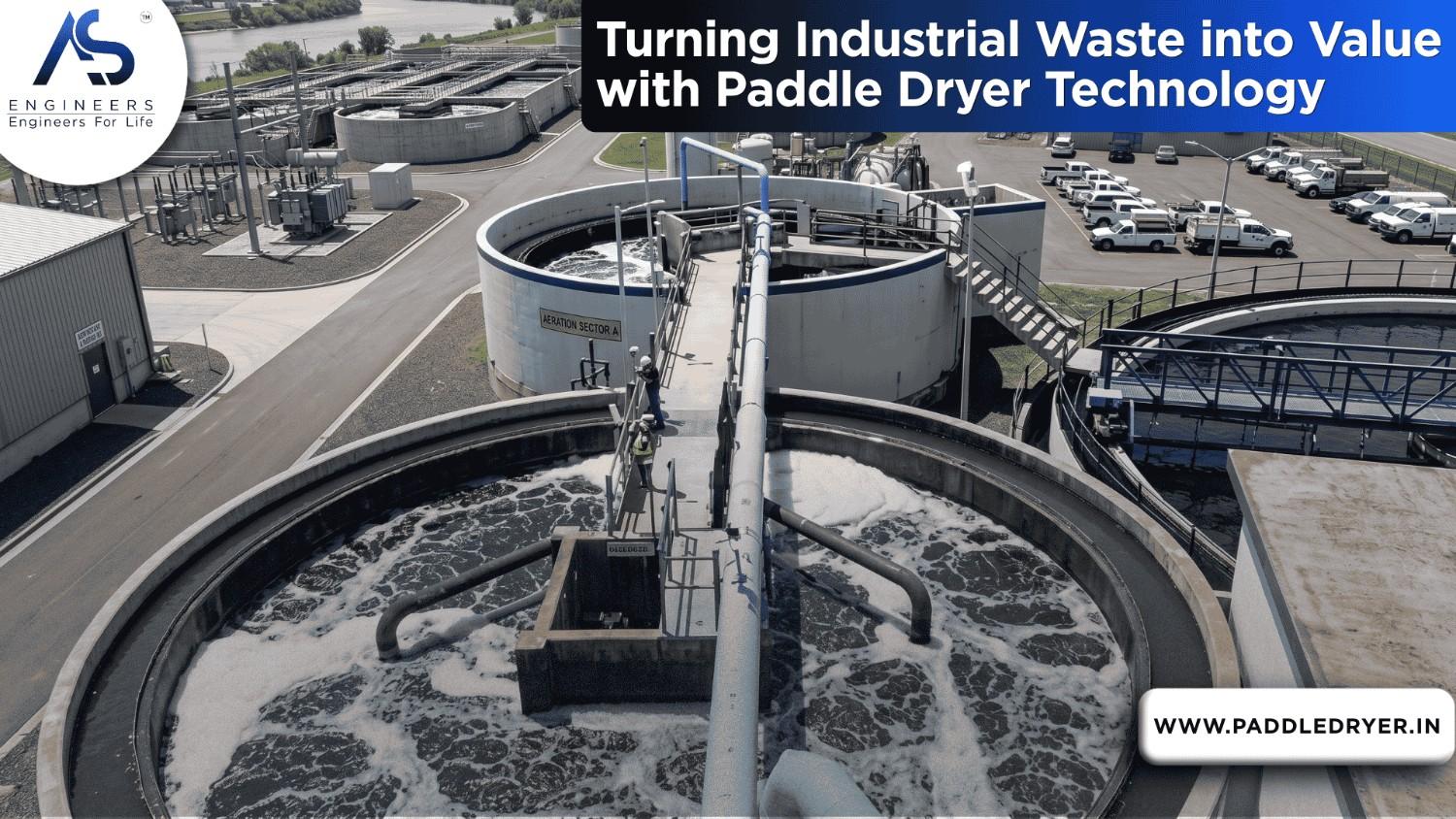
ETP sludge management is the process of reducing, stabilizing, drying, handling, and safely disposing or reusing sludge generated from an Effluent Treatment Plant. For many industrial plants, wet sludge is not only a compliance issue. It is a recurring cost because high moisture content increases storage, handling, transport, and disposal load. A paddle dryer helps by converting wet sludge into a lighter, drier, easier-to-handle material that can support disposal cost reduction and selected waste-to-value pathways.
Per AS Engineers, a paddle dryer can reduce sludge handling burden by using indirect heat transfer through hollow shafts, jacketed surfaces, and self-cleaning wedge paddles. The result is controlled drying, lower sludge volume, cleaner handling, and better preparation for compliant disposal or reuse.
Why is ETP sludge management important for industrial plants?
ETP sludge management is important because untreated or poorly handled sludge increases disposal cost, plant hygiene problems, storage demand, and compliance risk. Wet sludge is heavy because much of its mass is water, so the plant pays to move and dispose of moisture rather than useful dry solids. A structured sludge management plan helps EHS, operations, and procurement teams reduce risk before it becomes a regulatory or cost problem.
In Indian industrial plants, ETP sludge is commonly generated from wastewater treatment in textile, chemical, pharmaceutical, food, paper, dye, pigment, and other process industries. Its composition changes by industry, process chemistry, treatment method, and dewatering performance. That is why one universal disposal route is unsafe. A textile sludge, chemical sludge, paper mill sludge, and pharma sludge may require different testing, handling, and end-use decisions.
A practical ETP sludge management plan should answer five questions:
- What is the sludge source and composition?
- What is the inlet moisture after dewatering?
- Is the sludge hazardous or non-hazardous as per applicable rules?
- What final outlet moisture is needed for disposal, co-processing, or reuse?
- Which drying technology gives the best balance between compliance, operating cost, space, and reliability?
The original article covered compliance, disposal, and reuse, but it was too broad. This optimized version gives plant engineers and procurement heads a clearer decision path, especially where thermal drying and paddle dryer technology are being evaluated.
What is ETP sludge and why is it difficult to handle?
ETP sludge is the semi-solid residue separated during treatment of industrial wastewater. It can contain suspended solids, biomass, chemical precipitates, salts, dyes, metal compounds, process residues, and other contaminants depending on the plant. Its biggest operational problem is usually moisture, because wet sludge is heavy, sticky, difficult to store, and expensive to transport.
For many factories, sludge management does not fail because the ETP is absent. It fails because the sludge leaving the ETP is still too wet for economical handling. Dewatering equipment such as filter presses, centrifuges, belt presses, or screw presses can reduce free water, but the discharged cake may still contain substantial bound moisture. That is where drying becomes important.
Per AS Engineers, paddle dryers are designed to handle slurries, pastes, cakes, granules, and powders. This matters for ETP sludge because the material often passes through sticky and plastic phases before becoming granular. The dryer must keep material moving, prevent buildup, and transfer heat consistently across the mass.
For a deeper technology foundation, see Sludge Drying A Comprehensive Guide To Paddle Dryer Technology.
What are the main problems with wet ETP sludge?
Wet ETP sludge creates cost, space, hygiene, and compliance pressure. The more moisture the sludge contains, the more weight the plant must store, handle, transport, and dispose. In high-volume plants, this becomes a daily operating cost rather than an occasional waste problem.
The main problems are:
| Problem | What it means for the plant | Why drying helps |
|---|---|---|
| High transport cost | Wet sludge increases truck load and trip frequency | Lower moisture reduces weight |
| Storage pressure | Wet sludge occupies more space and may create odor | Dry sludge is easier to store and move |
| Handling difficulty | Sticky sludge is harder to convey, bag, or load | Granular output improves handling |
| Hygiene risk | Wet sludge can smell and create poor working conditions | Enclosed drying improves cleanliness |
| Disposal dependency | Plant remains dependent on third-party disposal schedules | Lower volume gives more flexibility |
| Compliance documentation | Poorly tracked sludge movement creates audit risk | Controlled drying supports measurable process records |
| Limited reuse options | Very wet material is difficult to use as fuel or raw material | Drying prepares sludge for qualified end-use testing |
Per AS Engineers, traditional sludge problems include high labour cost, expensive transport, difficult handling, strict regulations, large storage area, higher disposal cost, and deteriorated hygiene. The paddle dryer benefit is not only moisture removal. It is the conversion of wet, difficult sludge into a more manageable material.
How does a paddle dryer improve ETP sludge management?
A paddle dryer improves ETP sludge management by applying indirect heat through hollow shafts, heated paddles, and a jacketed trough while the material is continuously mixed and conveyed. The sludge does not need direct contact with hot combustion gas. This helps maintain controlled drying, lower off-gas volume, and cleaner operation compared with many direct drying methods.
Per AS Engineers, the paddle dryer uses dual counter-rotating shafts, wedge-shaped hammer paddles, self-cleaning intermeshing action, and plug flow movement. These design elements help break down wet feed, expose more material surface to heat, reduce buildup, and move the sludge toward the discharge end.
A typical system can include:
- Fuel resource system using natural gas, wood, coal, LDO, electricity, briquette, or another suitable option.
- Heating system using steam boiler, thermic fluid, or hot water generator.
- Feeding system with wet material silo, belt conveyor, screw feeder, or sludge pump.
- Paddle dryer body with hollow shafts, jacket, paddles, and discharge arrangement.
- Scavenging system with FD blower and heat exchanger or heat traced cover.
- Pollution control system using cyclone, scrubber, bag filter, or related equipment.
- Solvent or vapor management using ID blower, chimney, condenser, or solvent tank depending on material.
- Product handling system using screw conveyor, bagging system, silo, bucket elevator, or truck disposal system.
This full-system thinking is important. A paddle dryer should not be selected as a standalone machine only. It should be selected as part of the sludge handling, vapor handling, fuel, safety, and discharge strategy.
For process-level comparison, see Sludge Dewatering And Drying The Role Of Paddle Dryers In The Waste Management Industry.
What drying performance can AS Engineers support?
Per AS Engineers, the paddle dryer can achieve up to 99% dryness or a specific required outlet moisture, depending on sludge characteristics and process requirements. Heating options include indirect steam up to 14.06 kg/cm² or thermal oil up to 400°C. Material options include CS, SS304, SS316, Duplex Steel, and other alloys based on process need.
The key technical advantages are:
| Selection factor | AS Engineers paddle dryer capability |
|---|---|
| Heating medium | Steam, thermal oil, hot water depending on plant setup |
| Steam pressure | Up to 14.06 kg/cm² |
| Thermal oil temperature | Up to 400°C |
| Dryness target | Up to 99% dryness or defined outlet moisture |
| Feed form | Slurries, pastes, cakes, granules, powders |
| Operating condition | Atmospheric, vacuum, or pressurized |
| Dryer variants | Standard Dryer, Dual Zone Dryer, Vacuum Dryer |
| Material of construction | CS, SS304, SS316, Duplex Steel, other alloys |
| Surface finish | Buffing, hard facing, electropolishing |
| Emission control support | Enclosed system with suitable vapor and pollution control options |
The outlet moisture should not be guessed. It should be selected based on disposal route, end-use objective, safety, calorific value, storage requirement, and local compliance conditions.
For a product-level explanation, see Hollow Paddle Dryers Industrial Thermal Drying Technology.
How much sludge volume reduction is possible?
Sludge volume reduction depends on inlet moisture, outlet moisture, dry solids, volatile content, and sludge composition. Per AS Engineers’ official sludge drying ROI data, one example shows 10 ton/day wet sludge reducing to 2 ton/day dry sludge after paddle dryer processing. The same AS Engineers data states that dry sludge can take up 90% less space.
That example is powerful for decision-making because disposal cost usually follows tonnage, distance, classification, and authorized facility charges. If a plant sends wet sludge for disposal every day, reducing tonnage directly affects logistics and disposal planning.
Per AS Engineers’ example:
| Condition | Sludge quantity | Disposal cost assumption in example | Daily disposal cost |
|---|---|---|---|
| Before paddle dryer | 10 ton/day wet sludge | ₹10,000/ton | ₹1,00,000/day |
| After paddle dryer | 2 ton/day dry sludge | ₹10,000/ton | ₹20,000/day |
| Potential difference | 8 ton/day reduction | Same disposal basis | ₹80,000/day potential saving |
This is a representative AS Engineers example, not a universal guarantee. Actual savings require plant-specific calculation based on inlet sludge quantity, moisture, fuel cost, electricity cost, operating hours, disposal rate, and whether dried sludge has a permitted reuse route.
Can ETP sludge become a useful resource?
ETP sludge can become a useful resource only when its composition, moisture, contamination level, and regulatory approval allow it. Drying is an enabling step, not automatic permission for reuse. The plant must test sludge quality and confirm whether the dried output is suitable for cement production, alternative fuel, bricks, fertilizer, or another approved pathway.
Per AS Engineers, dried sludge end-use applications can include:
- Alternative fuel, if calorific value and regulatory conditions support it.
- Cement production, where approved co-processing or raw material use is possible.
- Agriculture, only when the sludge is safe, tested, and permitted.
- Brick production, where composition and approval allow use.
Internationally, the U.S. EPA explains that sewage sludge management routes include land application, landfilling, and incineration, and that biosolids intended for land application must meet applicable regulatory requirements. This supports the same core principle: sludge reuse must be based on treatment quality and compliance, not only on the fact that the material is dry.
India is also moving toward more formal sludge management. The Ministry of Jal Shakti listed National Guidelines on Sewage Sludge Management as a 2026 publication, focused on safe handling, treatment, utilization, and disposal. For plant owners, this is a market signal that sludge will increasingly be treated as a managed resource stream, not an afterthought.
For application-specific reading, see Paddle Sludge Dryer The Key To Effective Sludge Treatment.
How should ETP sludge be managed for compliance?
ETP sludge should be managed through testing, classification, documented handling, authorized transport where required, and approved disposal or utilization. Hazardous sludge must not be treated like ordinary solid waste. The correct route depends on the applicable Hazardous and Other Wastes rules, State Pollution Control Board authorization, and the specific sludge category.
The Hazardous and Other Wastes framework includes requirements around packaging, labelling, safe handling, storage, transport, and information provided to transporters. Official Form 10 is the hazardous and other waste manifest format used for waste movement documentation.
For industrial plants, the compliance workflow should be:
- Characterize sludge through laboratory testing.
- Identify whether sludge is hazardous or non-hazardous.
- Record daily or batch-wise sludge generation.
- Dewater sludge to reduce free water.
- Dry sludge if transport, storage, disposal, or reuse economics justify it.
- Route vapors, fines, and emissions through suitable control equipment.
- Maintain movement records, disposal receipts, and process logs.
- Review reuse only after testing and approval.
CPCB-linked guidance on co-processing states that authorization for co-processing or other utilization depends on rules, guidelines, and SOPs issued for environmentally sound use. This is why plants should avoid informal reuse claims unless the pathway is clearly approved.
Paddle dryer vs conventional sludge disposal methods
A paddle dryer is most suitable when wet sludge disposal cost, storage space, odor, moisture, or transport load has become a recurring problem. Landfilling, drying beds, composting, and incineration may still be relevant in certain cases, but each has limitations. The best choice depends on sludge chemistry, volume, site space, local rules, and economics.
| Method | Best fit | Limitation | When paddle dryer becomes stronger |
|---|---|---|---|
| Direct wet sludge disposal | Low sludge quantity, low disposal cost, simple compliance route | Ongoing transport and disposal cost remains high | When tonnage and moisture make disposal expensive |
| Sludge drying bed | Low-cost drying where land and climate are favorable | Slow, land-intensive, weather-dependent | When consistent year-round drying is needed |
| Mechanical dewatering only | First-stage moisture reduction | Cannot remove enough bound moisture for many reuse/disposal routes | When dewatered cake is still costly to move |
| Composting | Organic, non-hazardous sludge after safe stabilization | Not suitable for contaminated or hazardous sludge | When moisture must be reduced before further treatment |
| Incineration | Destruction of suitable wastes under controlled conditions | High fuel and emission-control burden | When drying is needed before thermal disposal |
| Paddle dryer | Continuous indirect drying of wet, sticky sludge | Requires proper sizing and fuel planning | When volume reduction, controlled handling, and reuse preparation are priorities |
For method comparison, see Sludge Drying Methods Comparing Thermal Drying And Solar Drying and Paddle Dryers Vs Belt Dryers A Comparison For Sludge Drying.
For plants already comparing dryer vendors, AS Engineers’ commercial sludge drying page, Paddle Dryers For Sludge Drying, is the right next step for evaluating equipment configuration.
Which industries need stronger ETP sludge management?
Industries with high wastewater load, chemical use, biological treatment, pigment load, fiber load, or hazardous residue need stronger ETP sludge management. The highest-priority industries are usually those where sludge is generated daily and disposal cost is already visible in monthly operating expenses.
Relevant sectors include:
- Textile and dyeing units.
- Chemical and specialty chemical plants.
- Pharmaceutical and API units.
- Paper and pulp mills.
- Food and beverage plants.
- CETP operators.
- Pigment and dye manufacturers.
- Petroleum and oil-related waste processors.
- Environmental and waste management operators.
For industry-specific sludge pages, use these supporting resources:
Textile Sludge A Comprehensive Guide
Chemical Sludge Treatment And Disposal
Paper Mill Sludge
Cetp Sludge Drying Paddle Dryers
How should a plant select an ETP sludge dryer?
A plant should select an ETP sludge dryer by testing sludge properties, calculating moisture load, defining the outlet moisture target, confirming compliance requirements, and comparing total cost of ownership. The lowest machine price is not the best basis for selection. A wrong dryer can fail on sticky feed, corrosion, vapor handling, fuel cost, or maintenance.
Before selecting a dryer, collect:
- Wet sludge generation in kg/hr or ton/day.
- Operating hours per day.
- Inlet moisture after filter press, centrifuge, or screw press.
- Target outlet moisture.
- Sludge pH, chloride, salt, solvent, oil, heavy metal, and abrasive content.
- Current disposal cost per ton.
- Available fuel or heating medium.
- Space available at site.
- Required material of construction.
- Pollution control and vapor handling requirement.
Per AS Engineers, fuel yield benchmarks from official FAQ data are:
| Fuel | Sludge drying yield |
|---|---|
| 1 kg wood | 5 kg sludge |
| 1 kg coal | 8.25 kg sludge |
| 1 Nm³ gas | 22.5 kg sludge |
| 1 kg LDO | 21 kg sludge |
Basis: 80% wt/wt initial moisture to 20% final moisture.
These figures should be used as initial benchmarks, not final guarantees. Final utility consumption depends on sludge chemistry, inlet moisture, outlet moisture, plant layout, heat losses, dryer size, and operating discipline.
For upstream dewatering context, see Filter Press Everything You Need To Know.
Why choose AS Engineers for ETP sludge drying?
AS Engineers is a paddle dryer and sludge drying equipment manufacturer based in GIDC Vatva, Ahmedabad, Gujarat. Per AS Engineers’ approved company documents, the company has 25+ years of experience, 500+ clients, 1500+ projects, ISO 9001:2015 certification from TUV India, CE certification, and 500+ dryers operational at group level. ISO describes ISO 9001 as a globally recognized quality management standard that helps organizations improve performance, meet customer expectations, and demonstrate commitment to quality.
Per AS Engineers, the paddle dryer is suitable for drying, solvent stripping, heating, calcining, roasting, and cooling. For ETP sludge management, the most relevant strengths are indirect heating, self-cleaning paddles, enclosed operation, compact footprint, specific outlet moisture control, and integrated vapor and product handling systems.
AS Engineers also offers a 50 kg/hr pilot trial machine at its facility or at the client site. The pilot trial is useful because sludge behavior cannot be judged from moisture percentage alone. Sticky behavior, phase change, odor, vapor load, discharge quality, and drying rate should be observed before full-scale commitment.
To validate material behavior before investment, use Paddle Dryer Pilot Trial.
Practical ETP sludge management checklist
Use this checklist before finalizing a dryer or disposal route:
- Test sludge composition and classify it correctly.
- Measure inlet moisture for at least multiple representative samples.
- Confirm whether current disposal cost is charged by wet weight.
- Identify available heating medium and fuel cost.
- Define outlet moisture based on disposal or reuse route.
- Confirm vapor, odor, and fines control requirements.
- Select MOC based on corrosion and abrasion risk.
- Compare drying cost against current disposal cost.
- Check whether dried sludge has a permitted waste-to-value route.
- Run a pilot trial if sludge behavior is uncertain.
This is the decision point where ETP sludge management becomes measurable. The plant can compare the cost of continuing wet sludge disposal against the cost of drying, handling, and reduced disposal quantity.
Conclusion
ETP sludge management should not stop at dewatering and disposal. For many industrial plants, the highest cost is hidden in moisture, transport weight, storage space, odor, handling difficulty, and repeated disposal dependence. Paddle dryer technology addresses these problems by converting wet sludge into a dry, reduced-volume material that is easier to handle and more suitable for compliant disposal or approved waste-to-value use.
Per AS Engineers, the strongest business case comes from volume reduction, fuel flexibility, controlled indirect heating, enclosed operation, and pilot-trial validation. The right next step is not to guess dryer size from a brochure. The right step is to test sludge, define outlet moisture, calculate disposal savings, and validate drying behavior.
FAQs
What is ETP sludge management?
ETP sludge management is the process of testing, classifying, dewatering, drying, storing, transporting, disposing, or reusing sludge generated from an Effluent Treatment Plant. A good system reduces sludge volume, improves handling, supports compliance, and helps convert suitable dried sludge into a useful resource.
Why is wet ETP sludge expensive to dispose of?
Wet ETP sludge is expensive because a large part of its weight is water. Plants often pay for transport and disposal based on wet tonnage, so high moisture increases truck movement, storage space, handling difficulty, and disposal bills. Drying reduces the weight and volume before final disposal or approved reuse.
How does a paddle dryer dry ETP sludge?
A paddle dryer dries ETP sludge through indirect heat transfer. Heated hollow shafts, jacketed surfaces, and wedge paddles transfer heat into the sludge while continuously mixing and conveying it. Moisture evaporates, vapors are routed to suitable downstream handling, and dried sludge exits as a more manageable material.
Can dried ETP sludge be reused?
Dried ETP sludge can be reused only when testing and regulatory approval confirm that it is safe and suitable for the intended use. Possible pathways include alternative fuel, cement production, brick production, or fertilizer use, but these depend on sludge composition, contamination levels, calorific value, and applicable permissions.
Does AS Engineers offer pilot trials for ETP sludge drying?
Yes. Per AS Engineers, a 50 kg/hr pilot trial machine is available at AS Engineers’ facility or at the client site. The pilot trial helps evaluate performance, identify material handling issues, optimize the process, and assess feasibility before full-scale equipment selection.
For plant-specific ETP sludge drying selection, start with sludge quantity, inlet moisture, outlet moisture target, and current disposal cost. AS Engineers can help evaluate these inputs and recommend a suitable paddle dryer configuration through Paddle Dryers For Sludge Drying.

Karan Dargode leads operations and environmental health & safety at AS Engineers, an Ahmedabad-based manufacturer with over 25 years of experience in centrifugal blowers, industrial fans, paddle dryers, sludge dryers, and air pollution control equipment. He joined AS Engineers in July 2019 and has spent over six years building operational systems that support the company’s engineering and manufacturing work. His role spans business strategy execution, operational process design, EHS compliance, and policy development. Day to day, that means keeping manufacturing output consistent, ensuring workplace and environmental standards are met, and supporting the company’s growth across domestic and export markets. Education and Qualifications Karan holds a Bachelor of Engineering in Mechanical Engineering from Silver Oak College of Engineering and Technology, Ahmedabad, affiliated with Gujarat Technological University (GTU), completed in 2018. He later pursued a Post Graduate Diploma in Business Administration (PGDBA) with a focus on Operations Management from Symbiosis Centre for Distance Learning, Pune, strengthening his understanding of manufacturing strategy and industrial operations. What He Writes About The articles and posts on this site reflect what Karan works with directly. He covers: Paddle dryer selection, working principles, and industrial applications Sludge drying technology for ETP and CETP operators Centrifugal blower engineering and maintenance Industrial drying process optimization EHS compliance for industrial manufacturing units His writing is technical without being academic. The goal is straightforward: give plant engineers, ETP operators, and procurement managers the specific information they need to make good equipment decisions. At AS Engineers AS Engineers has manufactured industrial equipment since 1997, serving clients across chemicals, pharmaceuticals, food processing, wastewater treatment, and heavy industry. The Ahmedabad facility at GIDC Vatva handles design, fabrication, and testing in-house. Karan’s work at the operations level puts him directly involved with product delivery quality, production planning, and customer-facing timelines. If you have questions about any article on this site or want to discuss a specific application for blowers, dryers, or air pollution control equipment, you can reach the AS Engineers team through the contact page. Contact AS Engineers