
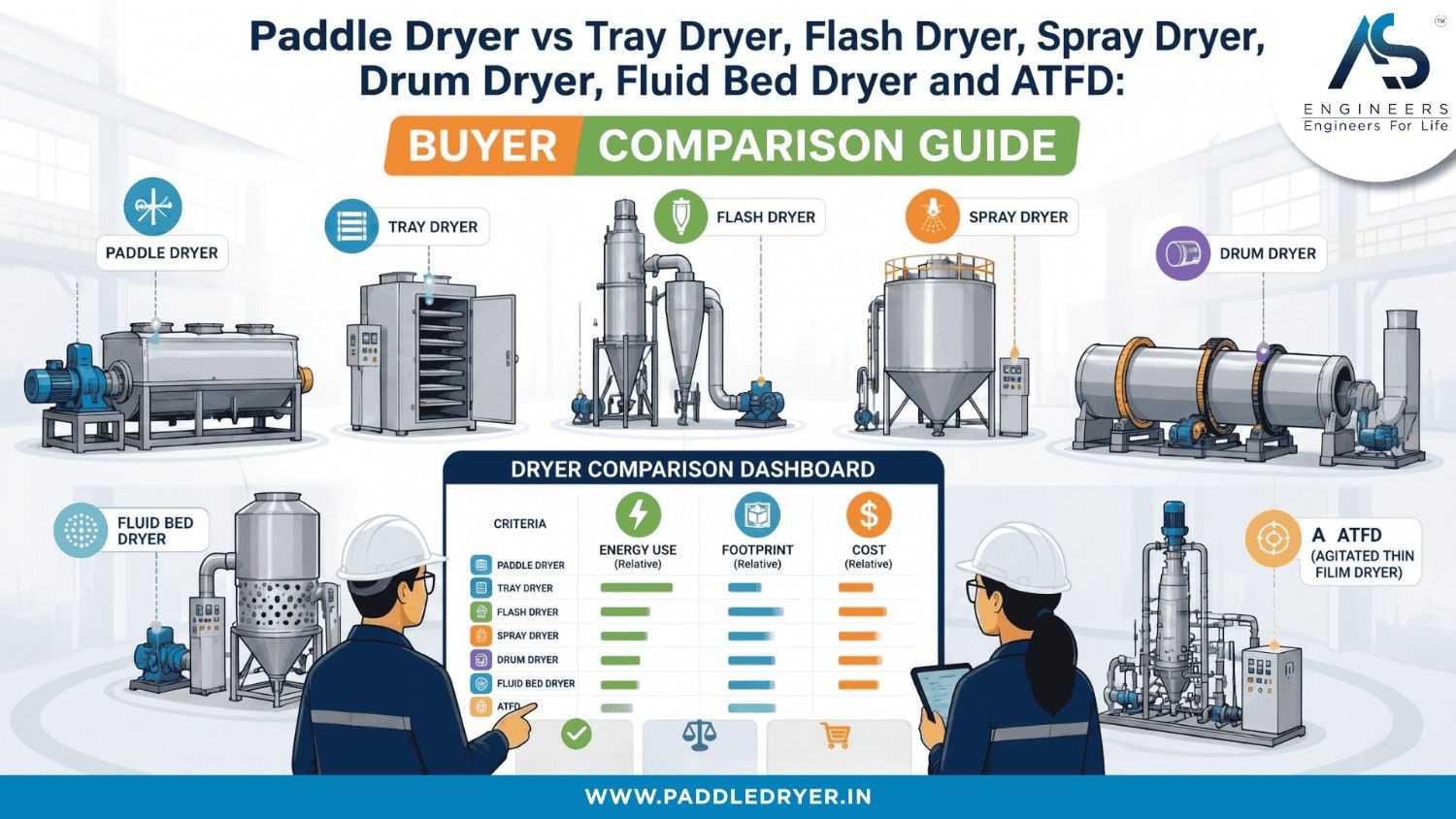
Quick Answer: Paddle Dryer vs Tray Dryer and Other Industrial Dryers
Paddle dryer vs tray dryer is mainly a question of automation, heat transfer, feed handling and batch versus continuous operation. A paddle dryer is usually stronger for wet sludge, sticky cake, paste, slurry and difficult industrial waste where indirect heat, agitation and enclosed drying matter more than simple batch drying.
The bigger comparison also includes flash dryer, spray dryer, drum dryer, fluid bed dryer and ATFD. Each technology has a valid place. The wrong decision happens when a buyer selects a dryer by name instead of feed behaviour, moisture target, heat sensitivity, dust risk, solvent handling, utilities, labour and downstream disposal.
AS Engineers designs paddle dryers as indirect thermal drying systems using hollow shafts, jacket heat transfer, dual counter-rotating shafts, wedge paddles, self-cleaning action and plug flow movement. According to AS Engineers, the system can be configured for steam up to 14.06 kg/cm², thermal oil up to 400°C, atmospheric, vacuum or pressurized operation, and dryness levels up to 99% depending on application and testing.
For a deeper base understanding, start with paddle dryer technology and sludge drying with paddle dryer technology.
How Does a Paddle Dryer Compare With Direct-Air Drying Systems?
A paddle dryer is an indirect contact dryer, so the heating medium does not need to directly contact the product in the same way as hot-air dryers. This is useful when the feed is sticky, pasty, dusty, solvent-bearing, odorous or difficult to fluidize.
In a paddle dryer, heat enters through the jacket, hollow shafts and paddles. The rotating paddles mix, shear and move the material forward while reducing moisture. This makes the equipment suitable for materials that move from plastic or sticky condition toward granular dry product.
Direct-air dryers such as flash dryers and fluid bed dryers depend heavily on air velocity, particle movement and gas-solid contact. They can be excellent for suitable powders and granules, but they may struggle when the feed is wet, sticky, lumpy or not easily dispersed.
This is why industrial buyers should not ask only, “Which dryer is faster?” The better question is, “Which dryer can handle my feed safely, repeatedly and economically at the required outlet moisture?”
Buyer Decision Table: Which Dryer Fits Which Feed?
This table gives a practical first-screening view. Final selection should still be validated through material testing, especially for sludge, high-moisture cakes, chemical pastes, solvent-bearing materials and heat-sensitive products.
| Dryer comparison | Paddle dryer is usually stronger when | Alternative dryer is usually stronger when | Buyer risk to check |
|---|---|---|---|
| Paddle dryer vs tray dryer | Continuous sludge, paste, filter cake or sticky waste drying is needed | Small batch quantity, simple manual handling and low automation are acceptable | Labour, uneven drying, long batch cycle |
| Paddle dryer vs flash dryer | Feed is sticky, pasty, lumpy or needs enclosed indirect heating | Feed can be dispersed quickly into hot gas as fine wet powder | Dust load, carryover, explosion risk |
| Paddle dryer vs spray dryer | Feed is cake, paste, sludge or non-pumpable slurry | Feed is pumpable liquid suitable for atomization | Wrong feed form, nozzle/blockage risk |
| Paddle dryer vs drum dryer | Feed needs agitation, enclosed drying and controlled residence | Feed forms a controlled thin film on a heated drum | Sticking, scraping, film control |
| Paddle dryer vs fluid bed dryer | Feed is wet, sticky, pasty or not free-flowing | Feed is free-flowing granule or powder | Agglomeration, air volume, dust control |
| Paddle dryer vs ATFD | Bulk drying, sludge drying or cake drying is required | Concentrated liquid/viscous stream needs thin-film evaporation | Overloading ATFD as a bulk solids dryer |
For related comparison reading, see paddle dryers vs belt dryers and sludge drying methods comparison.
When Is Paddle Dryer vs Tray Dryer the Right Question?
Paddle dryer vs tray dryer is most relevant when a plant wants to move from manual batch drying to more controlled thermal drying. Tray dryers can work for small batches and simple materials, but they become limiting when labour, hygiene, handling and consistency become important.
A tray dryer generally needs trays, loading, unloading and batch supervision. Drying may vary across tray depth, loading pattern and airflow distribution. For wet sludge, sticky cake or industrial waste, this can create handling problems and inconsistent discharge quality.
A paddle dryer is more suitable when the buyer needs continuous operation, enclosed drying, better mixing and easier dried material handling. It is especially useful for ETP sludge, STP sludge, CETP sludge, filter cake, slurry and chemical paste applications.
The practical mistake is choosing a tray dryer because the initial equipment cost looks lower. If labour, space, odour, rework, batch time and disposal handling are included, the real operating cost may tell a different story.
Paddle Dryer vs Flash Dryer, Spray Dryer, Drum Dryer and Fluid Bed Dryer
Paddle dryer vs flash dryer, spray dryer, drum dryer and fluid bed dryer is not a single winner-takes-all comparison. These technologies solve different drying problems, so the best choice depends on feed form and product behaviour.
A flash dryer is suited to materials that can be dispersed into a hot gas stream and dried very quickly. It is not the first choice for heavy sticky sludge or pasty feed unless preconditioning makes the material dispersible.
A spray dryer is usually selected for pumpable liquid feed that can be atomized into fine droplets. If the feed is filter cake, thick paste or non-pumpable sludge, a spray dryer may require major upstream dilution or process changes, which can defeat the purpose of drying.
A drum dryer works by forming a film on a heated rotating drum. It can suit certain slurries and pastes, but film formation, scraping behaviour and product quality must be checked carefully.
A fluid bed dryer performs well when particles can fluidize. Free-flowing granules and powders are better candidates than sticky sludge or deformable wet cake. When feed fluidization is poor, the buyer may face channeling, lumping, dust load or unstable drying.
For sludge-focused selection, paddle sludge dryer guidance is usually more relevant than a general powder-dryer comparison.
Paddle Dryer vs ATFD and Agitated Thin Film Dryer
Paddle dryer vs ATFD is a frequent question in ZLD, chemical, effluent and waste concentration projects. ATFD, or agitated thin film dryer, is useful where a thin film of concentrated liquid or viscous material must be processed on a heated surface.
A paddle dryer is generally better suited when the feed behaves like sludge, wet cake, paste, slurry or bulk moist solid. It provides agitation, residence time and indirect heat transfer across a larger material bed rather than relying on thin-film spreading.
The mistake is treating ATFD and paddle dryer as interchangeable. ATFD is often closer to a final concentration or thin-film evaporation duty, while a paddle dryer is often closer to bulk drying, sludge volume reduction and dry solids handling duty.
AS Engineers is backed by Acmefil Engineering Systems, established in 1992, with wider drying and process equipment experience. For buyers comparing multiple drying technologies, that group context is useful when discussing paddle dryers alongside ZLD-linked systems. You can also review AS Engineers’ industrial paddle dryer and Acmefil background through AS Engineers’ parent company.
Which Feed Conditions Should Decide the Dryer Choice?
The dryer should be selected from feed behaviour first, not from keyword popularity. Moisture level, stickiness, particle size, pumpability, heat sensitivity, odour, solvent content, abrasiveness and final disposal route should drive the decision.
For wet sludge and filter cake, buyers should check whether the feed will smear, lump, crust, form balls or become powdery after moisture reduction. For chemicals, pigments, minerals, food ingredients and pharma intermediates, buyers must also check product contamination risk, material of construction and temperature exposure.
A paddle dryer should be considered when the feed needs enclosed indirect heating, mechanical agitation and controlled discharge. AS Engineers offers material options such as carbon steel, SS304, SS316, duplex steel and other alloys, depending on application needs.
Where performance uncertainty exists, pilot testing is the safest route. AS Engineers offers a 50 kg/hr pilot trial option at its facility or client site, with the trial fee waived upon order placement. Review the paddle dryer pilot trial before final equipment sizing.
How Should Buyers Evaluate AS Engineers for a Paddle Dryer Project?
A buyer should evaluate AS Engineers on application fit, testing support, construction material, heating medium, moisture target, pollution control, discharge handling and after-sales support. The right conversation is not just machine price, but total drying system responsibility.
AS Engineers, based in GIDC Vatva, Ahmedabad, Gujarat, India, positions itself as “The Leading Name in Paddle Dryer Industry” and “Engineers For Life.” Relevant proof points include ISO 9001:2015 TUV India certification, CE certification, 25+ years, 500+ clients, 1500+ projects and 500+ operational dryers, per AS Engineers.
The system discussion should include feeding, heating, scavenging, pollution control, solvent management and product handling. A dryer without the right screw feeder, sludge pump, cyclone, scrubber, condenser, bagging or conveying arrangement can still fail operationally.
For service confidence, review paddle dryer services and paddle dryer rental service. For off-gas and fines handling, pollution control equipment should be considered early, not after the dryer is finalized.
FAQs
1. Is a paddle dryer better than a tray dryer?
A paddle dryer is usually better when the plant needs continuous, enclosed and mechanically agitated drying for sludge, paste, slurry or wet cake. A tray dryer may still fit small batch work where manual handling and longer drying time are acceptable.
2. When should I choose flash dryer instead of paddle dryer?
A flash dryer is suitable when the wet feed can disperse quickly into hot gas and dry within a short residence time. If the feed is sticky, pasty, lumpy or solvent-bearing, a paddle dryer may offer better control.
3. Is paddle dryer suitable instead of spray dryer?
A paddle dryer is suitable when the feed is sludge, cake, paste or non-atomizable slurry. A spray dryer is usually selected for pumpable liquid feed that can be atomized into droplets.
4. What is the main difference between paddle dryer and fluid bed dryer?
A paddle dryer uses indirect heating and agitation, while a fluid bed dryer depends on air movement to fluidize particles. Fluid bed dryers need free-flowing material, while paddle dryers can handle more difficult wet feeds.
5. Is ATFD the same as agitated thin film dryer?
Yes, ATFD commonly means agitated thin film dryer. It is not the same as a paddle dryer. ATFD is mainly used for thin-film evaporation or concentration duties, while paddle dryers are often used for bulk drying of sludge, cakes, pastes and moist solids.
Closing
Before selecting between paddle dryer, tray dryer, flash dryer, spray dryer, drum dryer, fluid bed dryer or ATFD, test the real material and define the final moisture target, discharge form, utilities, emissions and handling route. For sludge, paste, slurry, filter cake and difficult industrial waste, discuss your feed sample and process duty with AS Engineers before freezing the dryer type.

Karan Dargode leads operations and environmental health & safety at AS Engineers, an Ahmedabad-based manufacturer with over 25 years of experience in centrifugal blowers, industrial fans, paddle dryers, sludge dryers, and air pollution control equipment. He joined AS Engineers in July 2019 and has spent over six years building operational systems that support the company’s engineering and manufacturing work. His role spans business strategy execution, operational process design, EHS compliance, and policy development. Day to day, that means keeping manufacturing output consistent, ensuring workplace and environmental standards are met, and supporting the company’s growth across domestic and export markets. Education and Qualifications Karan holds a Bachelor of Engineering in Mechanical Engineering from Silver Oak College of Engineering and Technology, Ahmedabad, affiliated with Gujarat Technological University (GTU), completed in 2018. He later pursued a Post Graduate Diploma in Business Administration (PGDBA) with a focus on Operations Management from Symbiosis Centre for Distance Learning, Pune, strengthening his understanding of manufacturing strategy and industrial operations. What He Writes About The articles and posts on this site reflect what Karan works with directly. He covers: Paddle dryer selection, working principles, and industrial applications Sludge drying technology for ETP and CETP operators Centrifugal blower engineering and maintenance Industrial drying process optimization EHS compliance for industrial manufacturing units His writing is technical without being academic. The goal is straightforward: give plant engineers, ETP operators, and procurement managers the specific information they need to make good equipment decisions. At AS Engineers AS Engineers has manufactured industrial equipment since 1997, serving clients across chemicals, pharmaceuticals, food processing, wastewater treatment, and heavy industry. The Ahmedabad facility at GIDC Vatva handles design, fabrication, and testing in-house. Karan’s work at the operations level puts him directly involved with product delivery quality, production planning, and customer-facing timelines. If you have questions about any article on this site or want to discuss a specific application for blowers, dryers, or air pollution control equipment, you can reach the AS Engineers team through the contact page. Contact AS Engineers