
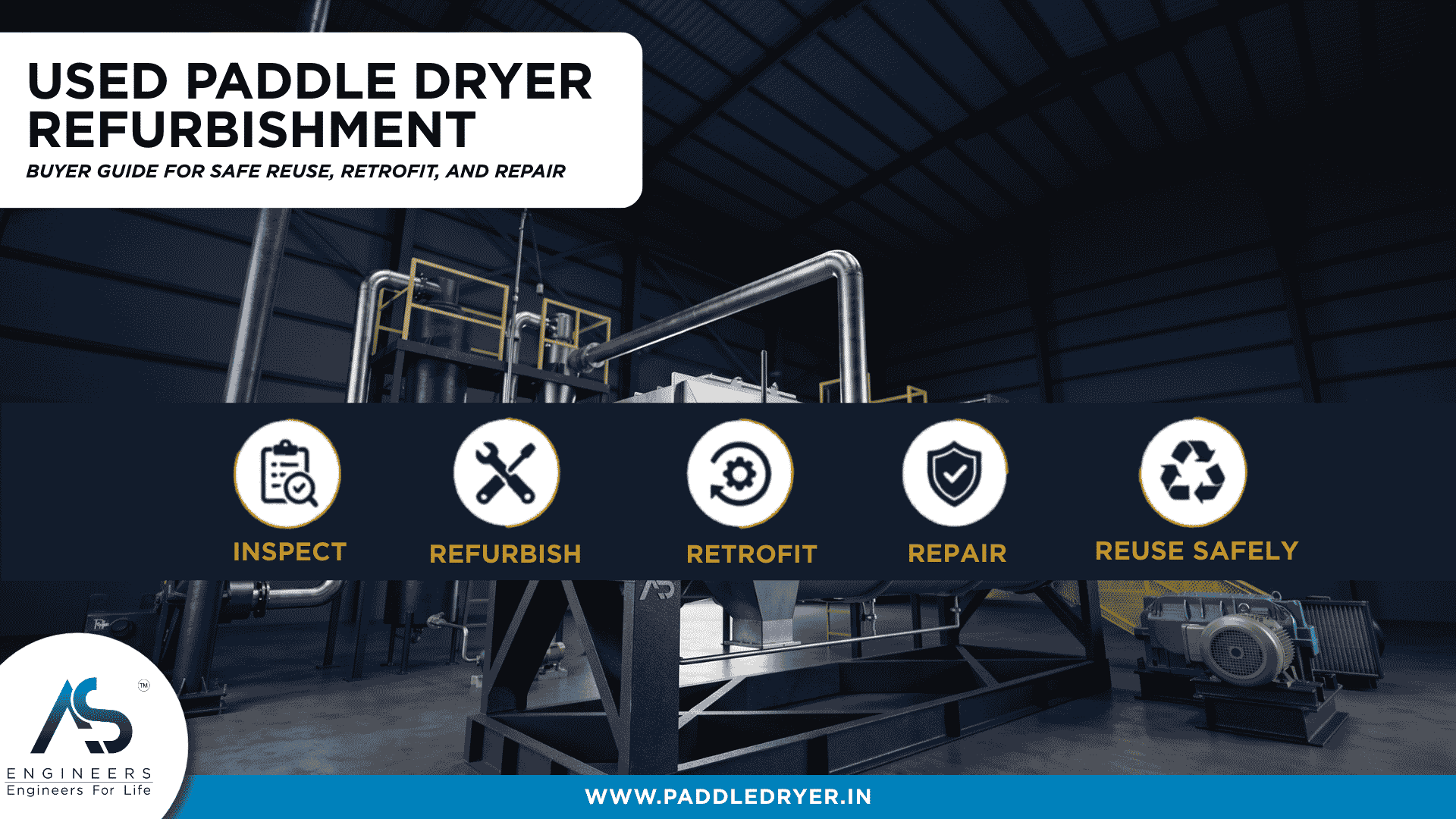
What Is Used Paddle Dryer Refurbishment?
Used paddle dryer refurbishment is the technical restoration of a previously operated paddle dryer so it can run safely, efficiently, and predictably in a new or existing process. It is not just repainting, polishing, or replacing a few visible parts. A correct refurbishment checks the shaft, paddles, jacket, gearbox, bearings, seals, heating system, feeding, discharge, controls, and downstream pollution control requirements.
For buyers, the real question is not “Is the used dryer cheap?” The better question is “Can this dryer reliably process my feed, moisture load, temperature condition, and safety requirement after refurbishment?”
A paddle dryer is a heat-transfer machine, not a simple rotating drum. If the hollow shaft, wedge paddles, jacket, and agitation geometry are not healthy, the dryer may consume more energy, leave wet pockets, overload the drive, leak heat-transfer media, or create maintenance failures after installation.
When Does Refurbishment Make Sense?
Refurbishment makes sense when the base dryer body, shaft alignment, heat-transfer surfaces, drive arrangement, and material compatibility are technically recoverable. It is a poor decision when the dryer is the wrong size, wrong metallurgy, badly distorted, or unsuitable for the buyer’s feed. The lowest purchase price can become the highest lifetime cost if these checks are skipped.
A used paddle dryer may be worth refurbishing when the buyer already knows the previous application, operating temperature, heating medium, material of construction, and approximate condition of major components. It is also useful when the plant has space constraints and wants faster restoration of an existing drying line.
However, for sticky sludge, filter cake, slurry, chemicals, pigments, polymers, food materials, or heat-sensitive feed, the dryer must be matched to process behavior. Buyers comparing paddle dryer technology should treat refurbishment as an engineering decision, not a resale equipment decision.
What Should Be Inspected Before Buying a Used Paddle Dryer?
Before buying, inspect the dryer mechanically, thermally, and process-wise. A good inspection should identify what can be repaired, what must be replaced, and what cannot be trusted. The inspection must happen before commercial negotiation, because hidden repairs change the real cost.
Check the shafts for bending, scoring, vibration history, and coupling alignment. Inspect paddles for wear, cracks, hard-facing loss, buildup zones, and uneven clearance. Examine the jacket and hollow shaft heating path for leakage, choking, pressure limitations, or corrosion.
The gearbox, bearings, seals, rotary joints, drive motor, foundation points, discharge arrangement, and feeding connection should also be checked. If the dryer will handle sludge, compare the existing configuration with your dewatering output, because sludge dewatering and drying must work as one system.
Used Paddle Dryer Refurbishment Decision Table
This table helps buyers separate a recoverable machine from a risky purchase. It avoids fake numbers because every used dryer depends on condition, previous duty, metallurgy, and feed behavior.
| Refurbishment Check | Low Risk | Medium Risk | High Risk |
|---|---|---|---|
| Shaft condition | Straight, no major wear | Repairable wear | Bent, cracked, unknown history |
| Paddle condition | Uniform wear | Some replacement needed | Heavy erosion or broken paddles |
| Heating jacket | Clean and pressure-sound | Needs cleaning or repair | Leakage, corrosion, blockage |
| Gearbox and bearings | Serviceable | Rebuild possible | Repeated failure history |
| MOC compatibility | Matches new feed | Needs review | Wrong for corrosive feed |
| Process fit | Same or similar application | Requires pilot validation | Unknown feed behavior |
| Controls and safety | Upgrade-friendly | Partial rewiring needed | Unsafe or undocumented |
| Total value | Strong candidate | Engineering review needed | Avoid or rebuild deeply |
Which Parts Usually Need Repair or Replacement?
Most refurbishment work concentrates on rotating parts, heat-transfer areas, drive components, seals, and material-handling interfaces. These are the zones where production stress is highest. Cosmetic repair is secondary; process reliability comes first.
Common work includes shaft, gearbox, bearing replacement, system repair, upgrades, retrofitment, OEM spare parts, on-site alignment, on-site balancing, operator training, and process optimization. AS Engineers provides paddle dryer services for these service needs and also supports OEM spare parts for correct component replacement.
For sludge drying, the discharge system also matters. Dried sludge may behave as powder, granules, or lumps depending on inlet moisture and final dryness. A paddle sludge dryer must be checked with the full handling system, not only the dryer shell.
Can a Refurbished Paddle Dryer Handle a New Material?
A refurbished dryer can handle a new material only if the thermal duty, metallurgy, agitation pattern, residence time, pressure condition, and safety requirements are suitable. Do not assume a dryer used for one sludge, chemical, or powder will work for another. Feed behavior changes everything.
AS Engineers’ paddle dryer design knowledge covers drying, solvent stripping, heating, calcining, roasting, and cooling applications. The company’s available dryer variants include standard dryer, dual zone dryer, and vacuum dryer, while heating options include steam up to 14.06 kg/cm² and thermal oil up to 400°C, according to AS Engineers.
For chemical, pharma, pigment, polymer, and sludge applications, the buyer should review corrosion risk, vapor handling, fines carryover, and off-gas treatment. A used dryer for chemical industry sludge drying may need different seals, metallurgy, or pollution control support before reuse.
What Mistakes Make Used Paddle Dryer Refurbishment Fail?
Most refurbishment failures happen because buyers focus on machine price instead of process risk. A used dryer can look acceptable from outside but still fail under load. The dangerous defects are usually hidden in alignment, heat-transfer paths, shaft condition, and feed compatibility.
The biggest mistake is buying without a trial or technical inspection. The second mistake is replacing non-OEM parts that do not match the dryer’s mechanical load. The third mistake is ignoring the downstream system, especially cyclone, scrubber, bag filter, condenser, screw conveyor, silo, or bagging equipment.
Buyers should also avoid assuming that a hollow paddle dryer design is automatically self-cleaning under every feed condition. Self-cleaning geometry helps reduce buildup, but sticky, fibrous, or variable-moisture feed still needs correct speed, temperature, residence time, and discharge control.
How Should Buyers Validate a Refurbished Paddle Dryer?
Validation should include inspection, repair scope, trial planning, safety review, and operating cost review. A refurbished dryer should prove that it can achieve the required outlet moisture, throughput stability, and maintenance access before the buyer depends on it for production. Testing is especially important when feed quality changes daily.
AS Engineers offers a 50 kg/hr pilot trial machine at its facility or client site, with the trial cost waived upon order placement. This is useful for performance evaluation, issue identification, process optimization, and feasibility assessment before a buyer commits to a new, repaired, or retrofitted dryer system.
For uncertain materials, a paddle dryer pilot trial can reduce risk better than assumptions. Buyers should test inlet moisture, stickiness, drying curve, outlet quality, vapor behavior, fines generation, and material handling after discharge.
Why Work With AS Engineers for Refurbishment Decisions?
A refurbishment partner should understand both old-machine repair and new-process responsibility. The work requires mechanical inspection, heat-transfer judgement, spare part selection, alignment discipline, and operating experience. A vendor who only sells used equipment may not be enough.
AS Engineers, based at GIDC Vatva, Ahmedabad, Gujarat, India, is ISO 9001:2015 TUV India certified and CE Certified. The company has 25+ years of experience, 500+ clients, and 1500+ projects, with Acmefil Engineering Systems’ engineering backing since 1992 through the group ecosystem.
For buyers comparing replacement, repair, retrofit, or new equipment, the AS Engineers Paddle Dryer page is the right starting point. The Acmefil background also helps global buyers understand the wider engineering base behind AS Engineers.
FAQs
1. Is a used paddle dryer always cheaper than a new paddle dryer?
Not always. A used paddle dryer may cost less at purchase, but shaft repair, gearbox work, jacket leakage, wrong MOC, controls upgrade, and installation changes can increase the final cost. Always compare total refurbished cost against a new or custom-built dryer.
2. Can AS Engineers refurbish any used paddle dryer?
AS Engineers provides repair, upgrades, retrofitment, OEM spare parts, on-site alignment, balancing, AMC, training, and process optimization. Final feasibility depends on the dryer’s condition, design, application, and required duty.
3. What is the most important part to inspect in a used paddle dryer?
The shaft and heat-transfer system are critical. If the shaft is bent, cracked, badly worn, or the jacket and hollow heating path are compromised, refurbishment may become expensive or unsafe.
4. Should I run a pilot trial before refurbishing a paddle dryer?
Yes, when the feed material is new, sticky, corrosive, solvent-bearing, or moisture-variable. Pilot testing helps confirm outlet moisture, handling behavior, drying stability, and process feasibility before investment.
5. Can refurbishment improve dryer performance?
Yes, if the work includes correct mechanical repair, OEM spare parts, alignment, process tuning, and suitable upgrades. It cannot fix a fundamentally wrong dryer size, metallurgy, or application match.
Closing
Used paddle dryer refurbishment can save capital only when the dryer is technically suitable, correctly inspected, and repaired with process responsibility. Before buying or restarting a used dryer, discuss the machine condition, feed material, moisture target, heating medium, and repair scope with AS Engineers through the AS Engineers contact team.

Karan Dargode leads operations and environmental health & safety at AS Engineers, an Ahmedabad-based manufacturer with over 25 years of experience in centrifugal blowers, industrial fans, paddle dryers, sludge dryers, and air pollution control equipment. He joined AS Engineers in July 2019 and has spent over six years building operational systems that support the company’s engineering and manufacturing work. His role spans business strategy execution, operational process design, EHS compliance, and policy development. Day to day, that means keeping manufacturing output consistent, ensuring workplace and environmental standards are met, and supporting the company’s growth across domestic and export markets. Education and Qualifications Karan holds a Bachelor of Engineering in Mechanical Engineering from Silver Oak College of Engineering and Technology, Ahmedabad, affiliated with Gujarat Technological University (GTU), completed in 2018. He later pursued a Post Graduate Diploma in Business Administration (PGDBA) with a focus on Operations Management from Symbiosis Centre for Distance Learning, Pune, strengthening his understanding of manufacturing strategy and industrial operations. What He Writes About The articles and posts on this site reflect what Karan works with directly. He covers: Paddle dryer selection, working principles, and industrial applications Sludge drying technology for ETP and CETP operators Centrifugal blower engineering and maintenance Industrial drying process optimization EHS compliance for industrial manufacturing units His writing is technical without being academic. The goal is straightforward: give plant engineers, ETP operators, and procurement managers the specific information they need to make good equipment decisions. At AS Engineers AS Engineers has manufactured industrial equipment since 1997, serving clients across chemicals, pharmaceuticals, food processing, wastewater treatment, and heavy industry. The Ahmedabad facility at GIDC Vatva handles design, fabrication, and testing in-house. Karan’s work at the operations level puts him directly involved with product delivery quality, production planning, and customer-facing timelines. If you have questions about any article on this site or want to discuss a specific application for blowers, dryers, or air pollution control equipment, you can reach the AS Engineers team through the contact page. Contact AS Engineers