
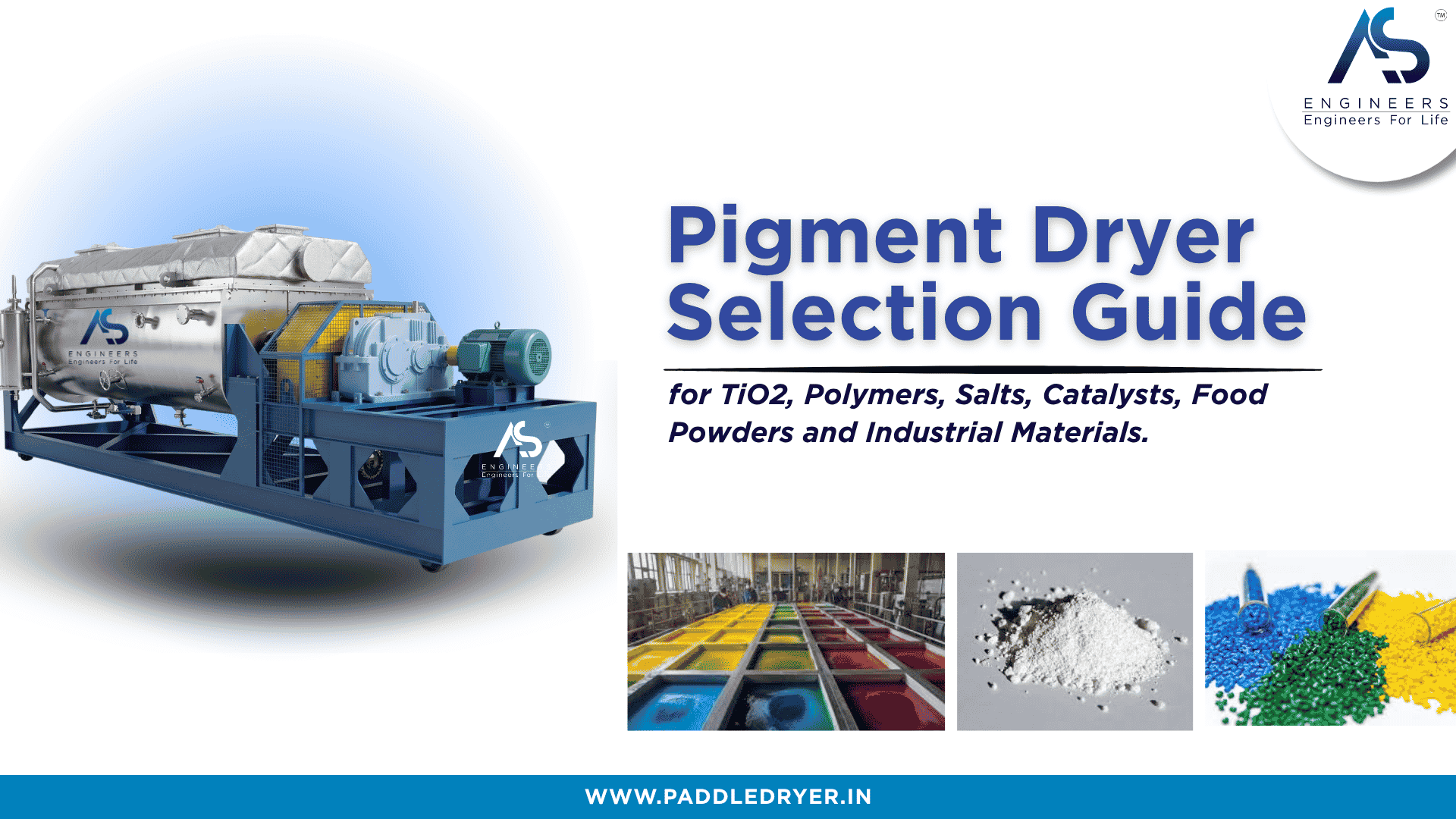
What Is a Pigment Dryer and Why Do Buyers Compare It With Other Material Dryers?
A pigment dryer is industrial drying equipment used to remove moisture or solvent from pigment cakes, TiO₂, oxide powders, dye intermediates, and similar fine materials. Buyers often compare it with a polymer dryer, API intermediate dryer, salt dryer, catalyst dryer, and food powder dryer because many of these materials share the same real problem: controlled drying without contamination, lumps, overheating, dust loss, or poor discharge.
For specialty materials, the dryer is not only a heating machine. It decides product consistency, downstream milling load, packing behavior, dust control, and safe handling. A poor dryer choice can create hard lumps in pigment, degraded polymer chips, sticky salt discharge, dusty catalyst fines, or uneven moisture in food powders.
For plants evaluating a Paddle Dryer, the main reason to consider indirect paddle drying is controlled heat transfer through hollow shafts and jacketed surfaces. Per AS Engineers, paddle dryers are used for drying, heating, cooling, solvent stripping, calcining, and roasting, making them suitable for many industrial solids where direct hot-air drying may create excess dust or uncontrolled exposure.
Which Materials Can Be Evaluated for Paddle Dryer Applications?
A paddle dryer can be evaluated for pigments, polymers, inorganic salts, minerals, catalysts, metal powders, drilling mud, food powders, and selected heat-sensitive industrial materials. The correct decision depends on feed moisture, stickiness, bulk density, particle behavior, heat sensitivity, solvent type, corrosion risk, and final moisture requirement.
Common application searches include pigment dryer, titanium dioxide dryer, TiO2 dryer, polymer dryer, PET chips dryer, polyester chips dryer, superabsorbent polymer dryer, aluminium hydroxide dryer, aluminum hydroxide dryer, ammonium sulphate dryer, ammonium sulfate dryer, sodium sulphate dryer, sodium sulfate dryer, sodium chloride dryer, calcium carbonate dryer, sodium carbonate dryer, API intermediate dryer, catalyst dryer, metal powder dryer, manganese dioxide dryer, coal lignite dryer, drilling mud dryer, drilling mud reclamation dryer, starch dryer, instant coffee dryer, cake flour dryer, meat dryer industrial, and spent grain dryer.
Some materials, such as ammonium nitrate dryer and sodium cyanide dryer applications, require stricter safety review. These should never be selected only from a keyword list. They need formal hazard assessment, compatible metallurgy, emission control, containment planning, operator protection, and trial validation before commercial design.
For pigment and chemical buyers, the chemical industry paddle dryer guide is a useful internal reference for understanding why indirect drying is often preferred where product behavior and emissions matter.
Why Indirect Paddle Drying Fits Pigments, TiO2, Polymers, Salts and Catalysts
Indirect paddle drying is suitable when the product should be heated through metal contact surfaces instead of being carried aggressively by a high-volume hot gas stream. This can help reduce off-gas volume, dust carryover, and product exposure compared with many direct drying systems.
In an AS Engineers paddle dryer, heat transfer happens through hollow shafts and a jacket. Counter-rotating shafts with wedge-shaped paddles mix, shear, expose, and move the wet material through the dryer. This is useful for pigment filter cakes, titanium dioxide, calcium carbonate, polymer chips, superabsorbent polymers, salts, catalysts, API intermediates, and metal powders where mixing quality affects final uniformity.
For polymers, PET chips, polyester chips, and superabsorbent polymer drying, buyers should focus on thermal sensitivity, residence time, final moisture, and particle integrity. The AS Engineers external article on paddle dryer for polymers, PET, SAP and PA drying is relevant for this application group.
For pigments and TiO₂, the main concern is consistent drying without hard deposits, uneven moisture, or excessive dust loss. The external AS Engineers article on pigments manufacturing with paddle dryers is a stronger fit for buyers comparing a pigment dryer or titanium dioxide dryer.
How Should Buyers Compare Dryers for Different Material Groups?
Buyers should compare dryers by feed behavior, safety risk, product value, emission load, cleaning requirement, and discharge quality, not only by evaporation rate. The same dryer size can perform very differently when the feed changes from a sticky pigment cake to free-flowing sodium chloride, PET chips, drilling mud, or instant coffee powder.
| Material group | Keywords covered | Main drying risk | Buyer selection check |
|---|---|---|---|
| Pigments and oxides | pigment dryer, titanium dioxide dryer, TiO2 dryer, manganese dioxide dryer, calcium carbonate dryer | Lumps, dusting, uneven moisture, contamination | Check product color sensitivity, abrasion, cleaning access, off-gas fines control |
| Polymers and chips | polymer dryer, PET chips dryer, polyester chips dryer, superabsorbent polymer dryer | Thermal damage, sticking, particle breakage | Confirm residence time, heat medium, discharge temperature, trial result |
| Inorganic salts and chemicals | aluminium hydroxide dryer, aluminum hydroxide dryer, ammonium sulphate dryer, ammonium sulfate dryer, sodium sulphate dryer, sodium sulfate dryer, sodium chloride dryer, sodium carbonate dryer | Corrosion, scaling, hygroscopic discharge | Verify MOC, surface finish, moisture target, bagging behavior |
| Hazard-sensitive materials | ammonium nitrate dryer, sodium cyanide dryer | Safety, toxicity, decomposition, containment | Requires EHS review, compatible design, controlled handling, no assumption-based selection |
| Pharma and catalyst materials | API intermediate dryer, catalyst dryer, metal powder dryer | Cross-contamination, solvent vapors, fines loss | Check enclosed drying, solvent handling, cleaning protocol, material compatibility |
| Mining, oil and heavy solids | coal lignite dryer, drilling mud dryer, drilling mud reclamation dryer | Abrasion, variable feed, heavy discharge | Check torque, wear areas, feed uniformity, product handling |
| Food and feed powders | starch dryer, instant coffee dryer, cake flour dryer, meat dryer industrial, spent grain dryer | Hygiene, odor, heat sensitivity, organic load | Confirm sanitary needs, temperature limits, odor control, cleaning frequency |
This comparison also explains why a single “best dryer” answer is unsafe. A hollow paddle dryer may be a strong option when the feed benefits from indirect heating, close mixing, and compact off-gas handling, but the final design should still be application-specific.
What Should Be Checked Before Ordering a TiO2 Dryer, Polymer Dryer or Chemical Salt Dryer?
Before ordering, buyers should verify feed moisture, final moisture, heat sensitivity, corrosion risk, MOC, dust control, discharge form, cleaning need, utilities, and test data. A quotation without feed analysis and process expectations is not enough for specialty materials.
For TiO₂, pigments, manganese dioxide, calcium carbonate, and metal powders, abrasion and fines handling matter. For ammonium sulphate, ammonium sulfate, sodium sulphate, sodium sulfate, sodium chloride, sodium carbonate, aluminium hydroxide, and aluminum hydroxide, corrosion and scaling behavior should be checked carefully. For API intermediates and catalysts, enclosed processing, solvent recovery, contamination control, and cleanability are usually more important than only capital cost.
AS Engineers offers material options such as CS, SS304, SS316, Duplex Steel, and other alloy steels, along with steam heating up to 14.06 kg/cm² or thermal oil heating up to 400°C depending on application suitability. The dryer can also be evaluated for atmospheric, vacuum, or pressurized operation, but these choices should be made only after material and process review.
For pharma-related material drying, the AS Engineers article on pharma intermediates manufacturing and drying solutions is useful for buyers studying API intermediate dryer decisions.
Where Do Food, Starch, Spent Grain and Drilling Mud Dryer Applications Fit?
Food, feed, starch, spent grain, and drilling mud applications fit into paddle dryer evaluation when the feed is wet, semi-solid, sticky, pasty, granular, or difficult to handle in ordinary dryers. These materials need different design thinking because hygiene, odor, abrasion, disposal, or reclamation goals may dominate the selection.
A starch dryer, instant coffee dryer, cake flour dryer, meat dryer industrial system, and spent grain dryer must be reviewed for product safety, cleaning, odor, heat sensitivity, and final use. Food applications should not be treated like chemical drying. For readers comparing drying systems in food processing, the internal guide on paddle dryers for sludge drying in the food industry gives useful context on industrial drying value.
Drilling mud drying and drilling mud reclamation dryer applications are different. The goal is often volume reduction, recoverable solids handling, or controlled disposal support. Abrasion, variable feed, oil contamination, and heavy-duty discharge design become more important. For this group, the AS Engineers article on paddle dryer for drilling mud is the most relevant cross-domain reference.
Why Pilot Testing Matters for Specialty Material Drying
Pilot testing matters because many specialty materials behave differently after heat, shear, evaporation, and residence time. Lab moisture data alone cannot show sticking, ball formation, dust carryover, discharge quality, odor release, or cleaning difficulty under real operating conditions.
Per AS Engineers, a 50 kg/hr pilot trial machine is available at its facility or at the client’s site, with the trial fee waived upon order placement. This is important for pigment dryer, TiO2 dryer, polymer dryer, catalyst dryer, API intermediate dryer, and drilling mud dryer decisions because the buyer can validate performance before full-scale commitment.
A proper paddle dryer pilot trial should answer practical questions: Does the material discharge freely? Does it stick to shafts or paddles? Does it form lumps? Is the outlet moisture stable? Is the off-gas manageable? Does the dried product meet downstream handling needs?
For buyers comparing plastic and polymer drying routes, the internal article on paddle dryers for the plastic industry can support broader selection thinking.
How AS Engineers Supports Multi-Material Dryer Selection
AS Engineers supports multi-material dryer selection by combining paddle dryer design, process review, pilot testing, MOC selection, heating-system choice, product handling, and pollution-control integration. This is useful for plants handling more than one product family, such as pigments, salts, polymers, catalysts, API intermediates, and waste reclamation materials.
AS Engineers is based in GIDC Vatva, Ahmedabad, Gujarat, India, and manufactures industrial drying and fluid-mechanics equipment for global B2B buyers. The company’s paddle dryer portfolio includes standard dryer, dual zone dryer, and vacuum dryer variants. Its wider system view can include feeding, drying, scavenging, cyclone, scrubber, condenser, solvent tank, screw conveyor, bagging, silo, bucket elevator, or truck disposal options depending on project scope.
This matters because dryer performance is rarely isolated from the full line. A sodium chloride dryer may fail because of discharge handling. A pigment dryer may lose value because fines are not managed. A spent grain dryer may face odor complaints. A catalyst dryer may need better containment. A polymer dryer may require better temperature control.
FAQs
1. Can one paddle dryer handle pigment, TiO2, polymer chips, salts and catalyst materials?
One paddle dryer platform can be evaluated for many material groups, but the same machine design should not be assumed for every product. Feed behavior, moisture, corrosion, heat sensitivity, cleaning need, and safety risk decide the final configuration.
2. Is a paddle dryer suitable for PET chips dryer or polyester chips dryer applications?
A paddle dryer can be evaluated for PET chips and polyester chips where controlled heating, mixing, and final moisture consistency are required. Buyers should confirm heat sensitivity, residence time, discharge temperature, and particle integrity through testing.
3. Can AS Engineers evaluate hazardous materials like ammonium nitrate or sodium cyanide?
Such applications require strict EHS review, compatible materials of construction, containment planning, and formal process validation. They should never be selected using generic dryer assumptions or copied operating conditions.
4. What is the best dryer for API intermediate dryer applications?
The best dryer depends on solvent type, temperature sensitivity, contamination limits, cleaning protocol, containment, and final moisture target. Vacuum or enclosed indirect drying may be considered when solvent handling or product protection is critical.
5. Why is pilot testing recommended before buying a specialty material dryer?
Pilot testing shows real behavior such as sticking, lumping, dust carryover, outlet moisture, discharge quality, and cleaning difficulty. It reduces purchase risk before scaling to a commercial dryer.
Closing
If your plant is comparing a pigment dryer, titanium dioxide dryer, TiO2 dryer, polymer dryer, PET chips dryer, salt dryer, API intermediate dryer, catalyst dryer, drilling mud dryer, starch dryer, or spent grain dryer, start with feed behavior and process risk, not only dryer price. Share your material details, moisture range, heat source, safety constraints, and final product goal with AS Engineers for application-specific evaluation through the AS Engineers contact team.

Karan Dargode leads operations and environmental health & safety at AS Engineers, an Ahmedabad-based manufacturer with over 25 years of experience in centrifugal blowers, industrial fans, paddle dryers, sludge dryers, and air pollution control equipment. He joined AS Engineers in July 2019 and has spent over six years building operational systems that support the company’s engineering and manufacturing work. His role spans business strategy execution, operational process design, EHS compliance, and policy development. Day to day, that means keeping manufacturing output consistent, ensuring workplace and environmental standards are met, and supporting the company’s growth across domestic and export markets. Education and Qualifications Karan holds a Bachelor of Engineering in Mechanical Engineering from Silver Oak College of Engineering and Technology, Ahmedabad, affiliated with Gujarat Technological University (GTU), completed in 2018. He later pursued a Post Graduate Diploma in Business Administration (PGDBA) with a focus on Operations Management from Symbiosis Centre for Distance Learning, Pune, strengthening his understanding of manufacturing strategy and industrial operations. What He Writes About The articles and posts on this site reflect what Karan works with directly. He covers: Paddle dryer selection, working principles, and industrial applications Sludge drying technology for ETP and CETP operators Centrifugal blower engineering and maintenance Industrial drying process optimization EHS compliance for industrial manufacturing units His writing is technical without being academic. The goal is straightforward: give plant engineers, ETP operators, and procurement managers the specific information they need to make good equipment decisions. At AS Engineers AS Engineers has manufactured industrial equipment since 1997, serving clients across chemicals, pharmaceuticals, food processing, wastewater treatment, and heavy industry. The Ahmedabad facility at GIDC Vatva handles design, fabrication, and testing in-house. Karan’s work at the operations level puts him directly involved with product delivery quality, production planning, and customer-facing timelines. If you have questions about any article on this site or want to discuss a specific application for blowers, dryers, or air pollution control equipment, you can reach the AS Engineers team through the contact page. Contact AS Engineers