
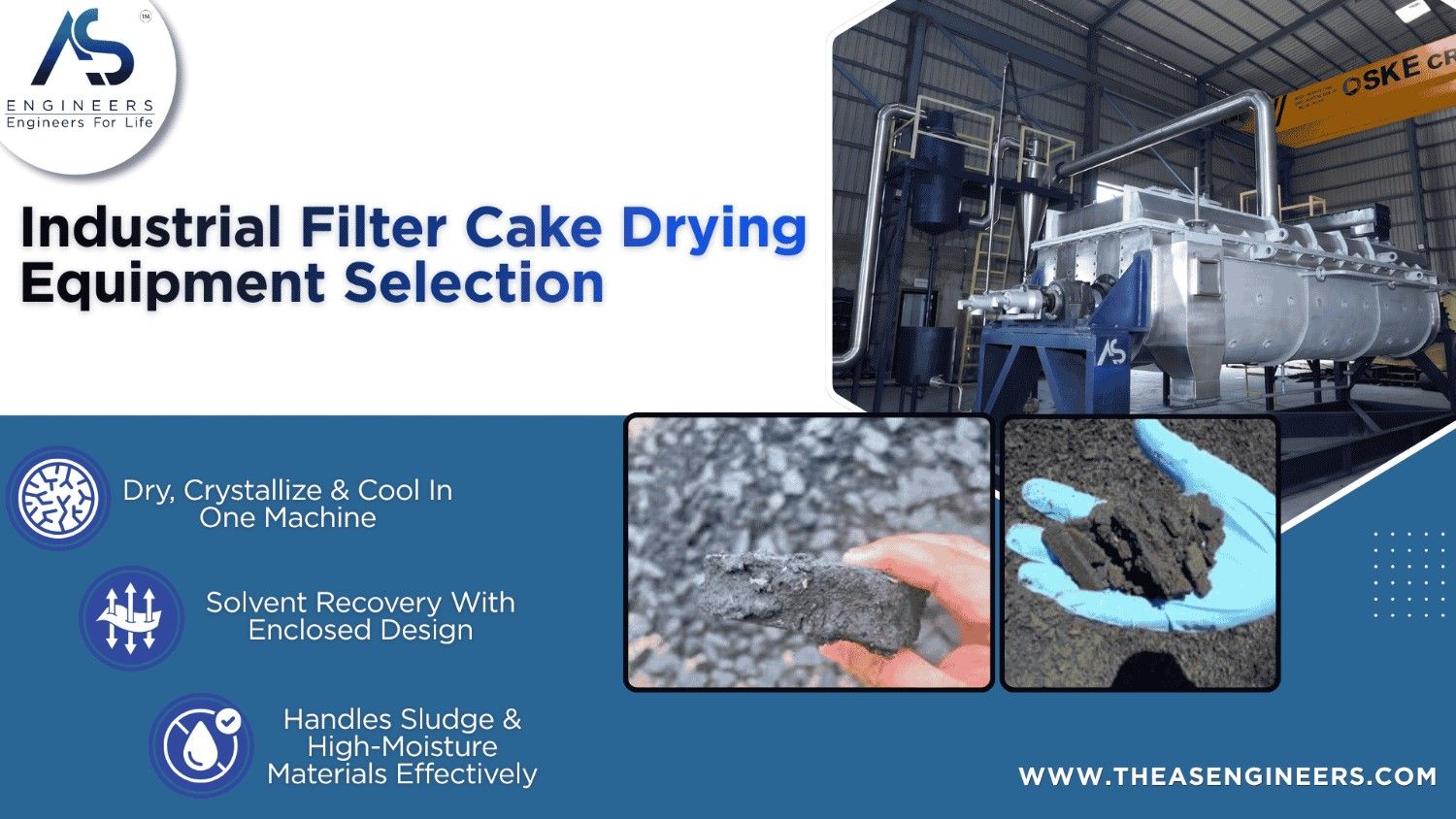
What is a filter cake dryer?
A filter cake dryer is industrial drying equipment used to remove residual moisture from dewatered cake discharged from a filter press, centrifuge, belt press, vacuum filter, or similar solid-liquid separation system. Dewatering removes free water, but many cakes still remain sticky, heavy, odorous, and expensive to store or dispose. A well-selected filter cake dryer converts this difficult wet mass into a drier, easier-to-handle solid.
For many buyers, the real decision is whether the cake is suitable for disposal, reuse, incineration, co-processing, bagging, or further thermal processing. That decision depends on moisture, stickiness, heat sensitivity, corrosion risk, solvent content, and final moisture target.
An indirect industrial paddle dryer is often considered for filter cake drying because heat is transferred through a jacket and hollow shafts instead of pushing a large volume of hot gas through the cake. This is useful when the cake is sticky, dusty after drying, sensitive to contamination, or needs contained vapour handling. AS Engineers manufactures an AS Engineers paddle dryer for slurries, pastes, cakes, granules, and powders across industrial drying applications.
Why does filter cake remain a disposal problem after dewatering?
Filter cake remains a disposal problem because dewatering is not the same as drying. A filter press or centrifuge can reduce liquid load, but the cake may still carry bound moisture inside pores, fibres, biological solids, salts, pigments, or chemical crystals. That remaining moisture keeps transport weight high and makes the material harder to convey, bag, store, or reuse.
The common mistake is treating dewatered cake as a finished product. Wet cake can still create odour, leachate, hygiene concerns, handling delays, and higher disposal cost. Drying is often the step that changes cake from a liability into a controlled solid stream.
The upstream separator still matters. A filter press normally produces a cake with better solids concentration than many gravity-based systems, but cake quality changes with feed chemistry, polymer dosing, filtration cycle, cloth condition, and washing steps. That is why sludge dewatering and drying should be evaluated as one process chain, not two separate purchases.
How does filter cake drying equipment work in a paddle dryer?
In a paddle dryer, wet filter cake is continuously mixed while heat is transferred indirectly through the heated jacket, hollow shafts, and paddles. Dual counter-rotating shafts improve contact between cake and heated surfaces, while wedge-shaped paddles break lumps, renew the heat-transfer surface, and move material toward discharge. The enclosed body helps control vapour, dust, odour, and solvent handling.
AS Engineers’ paddle dryer design uses hollow shafts and a jacket for indirect heat transfer. The system can use steam up to 14.06 kg/cm² or thermal oil up to 400°C, depending on the application, and can operate under atmospheric, vacuum, or pressurized conditions. According to AS Engineers, the dryer can be configured for specific final moisture targets and up to 99% dryness where the material and process allow.
The drying path usually passes through three visible stages: plastic, shearing, and granular or powder-like discharge. This transition is explained further in paddle dryer technology and is one reason paddle dryers are used for difficult cake feeds.
Which filter cakes are suitable for indirect drying?
Indirect drying is suitable when the cake needs controlled heat transfer, contained vapour handling, compact layout, and consistent mixing. It is commonly evaluated for industrial sludge cake, biosludge, paper sludge, pigment cake, dye intermediates, chemical salts, catalyst cake, mineral concentrate, gypsum, starch, food residues, polymer cake, pharma intermediates, and other wet solids. Suitability still requires testing because cakes that look similar can dry very differently.
Three cake properties decide most projects: stickiness during the plastic phase, process sensitivity, and mechanical behaviour at discharge. Some cakes become powder, some granules, and some hard lumps if overdried.
Material of construction also matters. AS Engineers lists options such as carbon steel, SS304, SS316, Duplex Steel, and other alloys, with surface finish options including buffing, hard facing, and electropolishing. For chemical, dye, pharma, and high-chloride wastewater cakes, corrosion risk should be checked before selecting the dryer body, shafts, paddles, seals, and discharge equipment. Buyers comparing sludge cake applications can also review ETP sludge management.
What should buyers check before choosing filter cake drying equipment?
A filter cake dryer should be selected from test data, not only from catalogue capacity. Feed variability, moisture target, heat source, vapour load, dust load, and discharge handling can change the correct dryer size and accessories. A good purchase specification should define the full system around the dryer, not only the dryer shell.
| Buyer decision point | What to verify before purchase | Risk if ignored |
|---|---|---|
| Cake source | Filter press, centrifuge, belt press, vacuum filter, or mixed feed | Dryer may be sized for the wrong feed behaviour |
| Feed consistency | Sticky paste, crumbly cake, fibrous cake, crystalline cake, or abrasive cake | Build-up, torque overload, poor discharge |
| Moisture target | Disposal, reuse, fuel, bagging, landfill, or process recovery | Overdrying wastes energy; underdrying fails handling goals |
| Heating medium | Steam, thermal oil, hot water, or site-specific heating system | Utility mismatch and unstable drying cost |
| Vapour handling | Water vapour, solvent vapour, odour, fines, or corrosive fumes | Unsafe venting and compliance issues |
| MOC and wear | Corrosion, abrasion, hard lumps, salts, or sticky organics | Shaft, paddle, seal, and body life may reduce |
| Downstream handling | Screw conveyor, silo, bagging, bucket elevator, or truck loading | Dry cake may bridge, dust, or reabsorb moisture |
| Trial requirement | Lab data, pilot run, or site trial | Scale-up uncertainty remains high |
The safest buyer approach is to connect upstream dewatering, dryer selection, off-gas treatment, and dry product handling in one layout. The plate frame filter press and paddle dryer combination is one example of how dewatering and drying can be evaluated together. For uncertain materials, AS Engineers offers a 50 kg/hr paddle dryer pilot trial at its works or client site on a minimal paid basis, with the fee waived upon order placement.
Filter cake dryer vs belt dryer vs solar drying: which is better?
No drying method is best for every filter cake. Paddle dryers, belt dryers, and solar drying systems solve different problems, and the right choice depends on land availability, moisture target, odour control, energy source, environmental limits, and automation level. The wrong comparison can lead to an attractive quote that fails during daily operation.
A belt dryer can suit materials that spread evenly and tolerate direct or semi-direct airflow. Solar drying can reduce utility demand in favourable climates, but it depends heavily on weather, area, odour control, and residence time. For buyers comparing technologies, paddle dryers vs belt dryers and broader sludge drying methods are useful starting points.
A paddle dryer is often preferred where space is limited, off-gas volume must stay lower, the cake is sticky, or enclosed operation is important. It can also suit plants that need controlled drying before bagging, reuse, or disposal. Still, the best decision comes from feed testing and a clear operating cost model, not from equipment name alone.
What operating mistakes reduce filter cake dryer performance?
Most filter cake dryer problems begin before the dryer starts. Poor feed control, oversized lumps, inconsistent moisture, poor dewatering chemistry, or irregular feeding can reduce heat transfer and create unstable discharge. Even a good dryer design cannot correct a feed system that surges, starves, or sends foreign objects into the machine.
Common operating mistakes include overfeeding, ignoring sticky transition zones, using the wrong heating medium, neglecting vapour condensation risk, and undersizing fines separation. Dry cake may dust, bridge, compact, or absorb moisture again if storage and conveying are poorly planned.
The system around the dryer must be engineered with the same seriousness as the dryer itself. AS Engineers’ process flow includes feeding, heating, scavenging, pollution control, solvent management, and product handling systems. For cake streams that produce fines, odour, or vapour, cyclone, scrubber, bag filter, condenser, chimney, and ID/FD fan decisions should be made early, not after installation.
When should you demand a pilot trial before finalizing the dryer?
A pilot trial is important when the cake is sticky, valuable, hazardous, solvent-bearing, heat-sensitive, corrosive, abrasive, or highly variable. It is also important when the buyer needs proof of final moisture, discharge form, dusting tendency, odour control, or reuse potential. Trial data reduces uncertainty in sizing, residence time, heating medium, and downstream handling.
For complex chemical or pharma cakes, pilot drying can reveal crusting, lump hardening, solvent condensation, polymer softening, or poor powder flow. It also helps procurement compare real dried output, not only quotation language.
A strong specification includes feed analysis, target moisture, test observations, heating utility details, off-gas expectations, MOC selection, safety needs, maintenance access, and dry discharge plan.
FAQs
1. What is a filter cake dryer used for?
A filter cake dryer is used to dry wet cake after mechanical dewatering. It reduces residual moisture so the cake becomes easier to store, convey, bag, dispose, incinerate, co-process, or reuse depending on material composition and local regulations.
2. Is a paddle dryer suitable for filter cake drying?
Yes, a paddle dryer can be suitable for many filter cake drying applications because it provides indirect heat transfer, continuous mixing, compact layout, and enclosed vapour handling. Suitability should still be confirmed with feed properties and, where needed, drying trials.
3. Can filter cake drying equipment reduce disposal cost?
It can reduce disposal cost when disposal is charged by weight, volume, handling class, or transport load. In AS Engineers’ sludge drying benchmark, 10 tons per day of wet sludge becomes 2 tons per day of dry sludge, with dry sludge taking up 90% less space. Actual savings for any filter cake depend on moisture, solids, disposal route, and reuse possibility.
10.4 Which heat source is used in a filter cake dryer?
Common heat sources include steam, thermal oil, hot water, and site-specific heating systems. AS Engineers’ paddle dryer can be configured with indirect steam or thermal oil, selected according to process temperature, utility availability, safety, and operating economics.
5. What data is required before asking for a filter cake dryer quotation?
A buyer should provide cake source, feed rate, inlet moisture, target outlet moisture, bulk density, stickiness, particle behaviour, temperature sensitivity, solvent or odour details, corrosive components, available utilities, and discharge plan. Without these details, the quotation can miss key accessories or understate operating risk.
If your plant is handling wet filter cake from a filter press, centrifuge, ETP, STP, CETP, chemical process, pigment line, paper mill, food process, or pharma operation, do not finalize the dryer from capacity alone. Share the cake sample, moisture target, heat source, vapour condition, and discharge requirement with the AS Engineers team for application-specific review through Paddle Dryer Services.
