
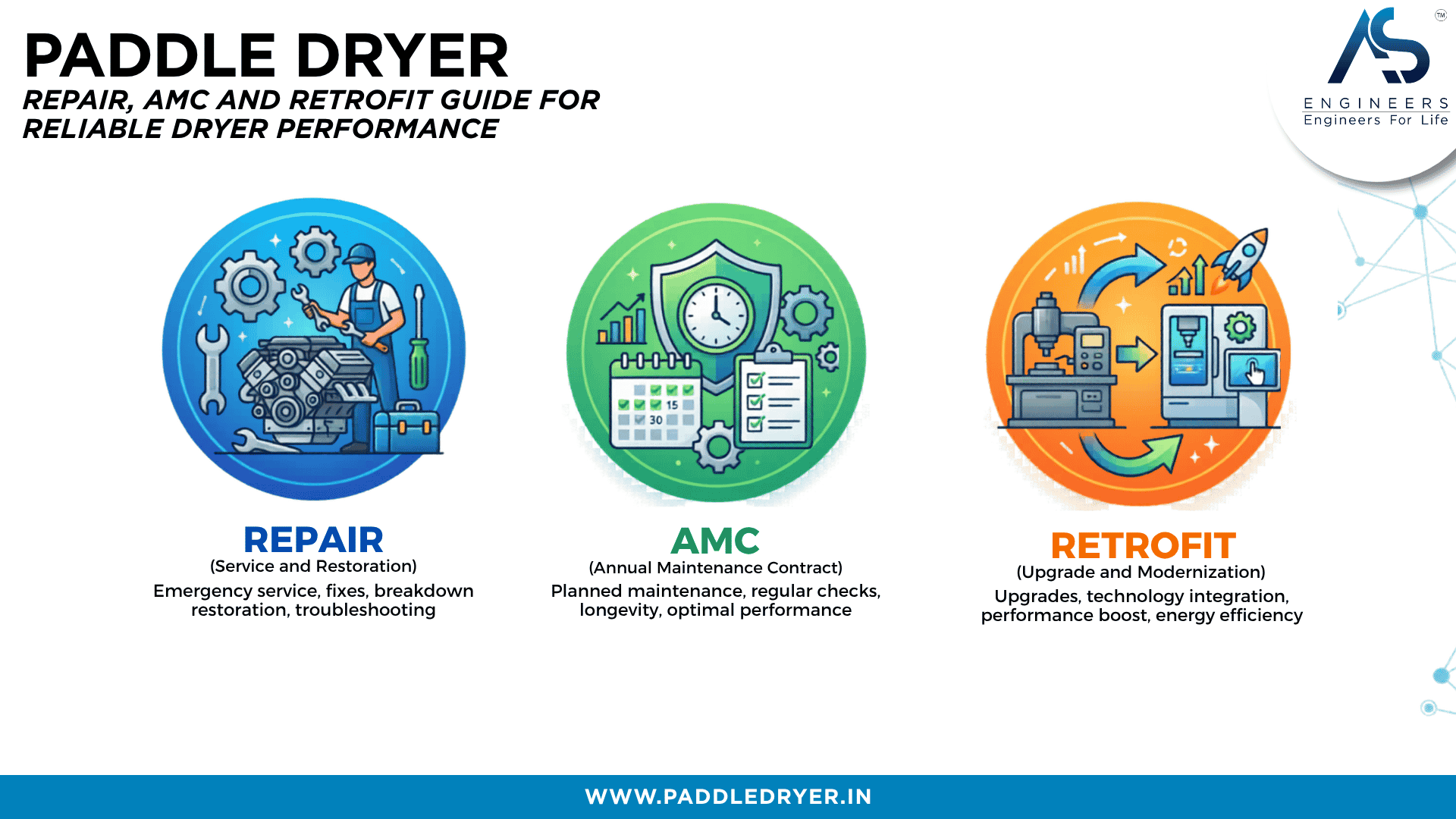
What Does Paddle Dryer Repair Actually Include?
Paddle dryer repair is the corrective service required when an industrial dryer loses performance, develops mechanical issues, or becomes unsafe for steady operation. The goal is not only to restart the machine, but to restore drying consistency, heat transfer, shaft movement, sealing reliability, and process stability.
A paddle dryer works under continuous thermal, mechanical, and material-handling stress. Wet sludge, sticky cake, crystalline chemicals, abrasive solids, and heat-sensitive materials can all create different wear patterns. That is why repair should begin with diagnosis, not immediate part replacement.
Typical paddle dryer repair may involve shaft, gearbox, bearing, seal, paddle, jacket, drive, alignment, balancing, feeding, discharge, or process-related correction. AS Engineers’ verified service scope includes shaft, gearbox and bearing replacement, system repair and upgrades, retrofitment, OEM spare parts, on-site alignment, on-site balancing, AMC, training, and process optimization.
For buyers comparing service partners, repair capability should be judged by dryer-specific experience, not only fabrication ability. A general fabricator may weld a damaged part, but a paddle dryer specialist checks how that repair will affect heat transfer, shaft rotation, paddle clearance, residence time, and long-term reliability. For a deeper understanding of the equipment itself, start with this guide to paddle dryer technology.
When Should a Plant Choose Paddle Dryer AMC?
A paddle dryer AMC is best when the dryer is critical to daily production, sludge handling, disposal cost control, or compliance. Instead of waiting for breakdowns, an annual maintenance contract creates a planned inspection and service discipline around the machine.
In ETP, STP, CETP, chemical, pharma, food, textile, paper, and waste-management plants, dryer stoppage can create a chain reaction. Wet sludge storage increases, transport costs rise, downstream handling becomes messy, and operators start running the machine outside ideal conditions. A structured paddle dryer AMC helps prevent that situation.
A practical AMC should cover periodic inspection of bearings, gearbox, shaft alignment, paddle condition, seals, heating system, feeding consistency, discharge behavior, insulation, vibration, noise, and operator practices. It should also include recommendations for spare parts planning, because waiting for a critical component after failure can increase downtime.
Plants already using dryers for sludge should also connect AMC with process monitoring. If the dryer is struggling because feed moisture has changed, the answer may not be only mechanical service. It may require feed control, heating adjustment, discharge correction, or operator retraining. This is especially important in sludge applications where upstream dewatering quality changes often. Related reading: sludge dewatering and drying.
Paddle Dryer Retrofit: When Repair Is Not Enough
A paddle dryer retrofit is suitable when the machine still has usable base structure but needs upgrades to match new process demands, material behavior, safety expectations, or output targets. Retrofitment can help avoid full equipment replacement when the existing system can be technically improved.
Repair restores what is damaged. Retrofit improves what is limiting performance. That difference matters for buyers because a machine may be running, yet still underperforming due to outdated design, changed feed characteristics, poor feeding, weak discharge, heating limitations, or recurring shaft and bearing stress.
Paddle dryer retrofit may include process upgrades, mechanical modernization, better feeding arrangement, discharge improvement, heating system adjustment, shaft-related correction, spare part standardization, or integration with pollution control and product handling systems. According to AS Engineers, retrofitment solutions are designed to adapt existing equipment to new requirements without full replacement where technically feasible.
Retrofit decisions need evidence. Check current moisture reduction, throughput, fuel or heating performance, downtime pattern, vibration, material buildup, cleaning frequency, product handling problems, and operator complaints. For plants handling sticky or wet sludge, the paddle sludge dryer concept is useful because it explains why mechanical agitation, indirect heating, and enclosed drying matter together.
Repair vs AMC vs Retrofit: Buyer Decision Table
The right service choice depends on failure pattern, dryer age, process importance, and future production requirements. A low-cost repair may be enough for an isolated problem, but repeated breakdowns usually need AMC discipline or retrofit analysis.
| Buyer Situation | Best Service Direction | Why It Matters | Risk if Ignored |
|---|---|---|---|
| Sudden bearing, gearbox, seal, shaft, or drive problem | Paddle dryer repair | Restores mechanical operation | Longer shutdown and secondary damage |
| Dryer is running but downtime is becoming frequent | Paddle dryer AMC | Creates planned inspection and prevention | Unplanned stoppage during production |
| Output moisture is unstable despite operation | Process diagnosis plus AMC | Finds feed, heat, residence time, or discharge causes | Higher fuel use and inconsistent dry product |
| Old dryer cannot match current feed or throughput | Paddle dryer retrofit | Upgrades usable system instead of replacing immediately | Continual underperformance |
| Spare parts are non-standard or locally modified | OEM spare parts planning | Maintains fit, reliability, and service traceability | Repeat failure and poor alignment |
| Sludge disposal cost depends on dryer uptime | AMC plus critical spares | Protects volume reduction and handling plan | Wet sludge backlog and higher disposal burden |
| Machine has shaft retrofitment or alignment history | Specialist inspection | Avoids repeating root-cause failure | Shaft, bearing, and drive stress |
This table should be used before issuing a purchase order. The cheapest option is not always the lowest-cost option over the next year. A repair without root-cause correction can become a recurring monthly expense.
Common Failure Signals Plants Should Not Ignore
Most paddle dryer failures give warning signs before a major shutdown. Operators and maintenance teams should treat these signals seriously because the dryer combines heat, rotation, torque, material movement, and sealing.
Common warning signs include abnormal noise, vibration, uneven discharge, wet lumps in output, sudden increase in drying time, overheating near bearings, gearbox issues, leakage, frequent jamming, excessive buildup, irregular feed movement, and higher operator intervention. In sludge drying, odor, sticky discharge, or poor granulation can also indicate process imbalance.
A buyer mistake is assuming every symptom is a heating problem. Poor drying may come from feed inconsistency, paddle buildup, reduced mixing, residence-time change, shaft speed issue, discharge restriction, or air and vapor handling problems. Mechanical and process checks should happen together.
For sludge users, this is closely tied to waste handling economics. If dried sludge becomes wetter than expected, storage, transport, hygiene, and compliance risks increase. The broader sludge drying guide explains why consistent moisture reduction is central to sludge management.
How AS Engineers Supports Existing Paddle Dryers
AS Engineers supports paddle dryer users through repair, upgrades, retrofitment, OEM spare parts, on-site alignment, on-site balancing, AMC, operator training, and process optimization. This matters because a paddle dryer is not a standalone shell; it is part of a full drying system.
The dryer interacts with feeding, heating, scavenging, vapor handling, pollution control, solvent or moisture management, and dry product handling. A service partner must understand that system. A bearing change may fail again if feed surging, misalignment, overloading, or discharge restriction remains unresolved.
AS Engineers manufactures from GIDC Vatva, Ahmedabad, Gujarat, India, and positions itself as “The Leading Name in Paddle Dryer Industry.” The company’s verified credibility stack includes ISO 9001:2015 TUV India certification, CE certification, 25+ years of experience, 500+ clients, 1500+ projects, and 500+ dryers operational.
For service-specific evaluation, buyers can review AS Engineers’ paddle dryer services, OEM spare parts, and paddle dryer training and spare parts. For equipment context, the industrial paddle dryer page is also useful.
What Should You Share Before Asking for a Service Quote?
A good service quote depends on accurate operating information. Share the machine condition, material details, symptoms, operating pattern, and maintenance history before asking for paddle dryer repair, AMC, or retrofit support.
Useful information includes material name, feed moisture, desired outlet moisture, operating hours, heating medium, dryer model or size, gearbox details, bearing condition, shaft history, paddle condition, vibration or noise observations, photographs, videos, and current problems. For sludge applications, include ETP, STP, CETP, paper, textile, chemical, pharma, food, or municipal context.
Also share whether the goal is emergency repair, annual maintenance, performance improvement, safety correction, spare parts replacement, or capacity improvement. This helps the service team separate urgent repair from retrofit opportunity.
If your team wants to validate process behavior before major changes, AS Engineers offers a 50 kg/hr pilot trial machine at its facility or client site, with the cost waived upon order placement. This is especially useful when material behavior is uncertain. See the paddle dryer pilot trial page for related context.
Keeping Dryer Performance Stable After Service
The value of service is proven after the dryer returns to steady operation. A successful repair, AMC visit, or retrofit should reduce repeat issues and improve operating confidence.
After service, plants should monitor outlet moisture, discharge quality, vibration, bearing temperature, gearbox sound, heating stability, feed consistency, and operator intervention. Keep a simple log. A dryer that needs constant manual adjustment is still telling you something.
Maintenance teams should also standardize spare parts. Non-OEM or poorly matched parts can create fitment, alignment, and reliability issues. This is one reason OEM spare parts planning should be part of AMC discussions, not only emergency repair.
For plants drying ETP or industrial sludge, stable dryer performance supports lower sludge volume, easier handling, and better disposal planning. The ETP sludge management article gives useful context on why drying is not only a machine decision, but a waste-management decision. For dryer construction understanding, the hollow paddle dryer guide is also relevant.
FAQs
1. What is included in paddle dryer repair?
Paddle dryer repair may include shaft, gearbox, bearing, seal, paddle, alignment, balancing, drive, feeding, discharge, heating, and process-related correction. The exact scope depends on inspection findings and machine condition.
2. When should I choose paddle dryer AMC instead of one-time repair?
Choose paddle dryer AMC when the dryer is critical to continuous production, sludge disposal, compliance, or daily plant operation. AMC is better when you want planned inspection, preventive maintenance, spare parts planning, and reduced breakdown risk.
3. What is paddle dryer retrofit?
Paddle dryer retrofit means upgrading or modifying an existing dryer so it can meet changed process needs, material behavior, capacity targets, or reliability expectations. It is considered when repair alone will not solve repeated limitations.
4. Can AS Engineers provide OEM spare parts for paddle dryers?
Yes. AS Engineers offers OEM spare parts along with repair, shaft-related support, upgrades, AMC, training, and process optimization for paddle dryers.
5. Is a pilot trial useful before retrofit or process improvement?
Yes. A pilot trial is useful when material behavior, drying performance, or outlet moisture expectations need validation before a major decision. AS Engineers offers a 50 kg/hr pilot trial machine at its facility or client site, with the fee waived upon order placement.
Closing
If your paddle dryer is facing repeated downtime, unstable outlet moisture, shaft or bearing issues, poor discharge, or rising maintenance cost, do not treat it as only a spare-part problem. A structured inspection can show whether you need repair, AMC, retrofit, OEM spare parts, or process optimization.
To discuss paddle dryer repair, AMC, retrofitment, or spare parts support, connect with AS Engineers and share your machine details, operating problem, material, and photographs for a practical service direction.

Karan Dargode leads operations and environmental health & safety at AS Engineers, an Ahmedabad-based manufacturer with over 25 years of experience in centrifugal blowers, industrial fans, paddle dryers, sludge dryers, and air pollution control equipment. He joined AS Engineers in July 2019 and has spent over six years building operational systems that support the company’s engineering and manufacturing work. His role spans business strategy execution, operational process design, EHS compliance, and policy development. Day to day, that means keeping manufacturing output consistent, ensuring workplace and environmental standards are met, and supporting the company’s growth across domestic and export markets. Education and Qualifications Karan holds a Bachelor of Engineering in Mechanical Engineering from Silver Oak College of Engineering and Technology, Ahmedabad, affiliated with Gujarat Technological University (GTU), completed in 2018. He later pursued a Post Graduate Diploma in Business Administration (PGDBA) with a focus on Operations Management from Symbiosis Centre for Distance Learning, Pune, strengthening his understanding of manufacturing strategy and industrial operations. What He Writes About The articles and posts on this site reflect what Karan works with directly. He covers: Paddle dryer selection, working principles, and industrial applications Sludge drying technology for ETP and CETP operators Centrifugal blower engineering and maintenance Industrial drying process optimization EHS compliance for industrial manufacturing units His writing is technical without being academic. The goal is straightforward: give plant engineers, ETP operators, and procurement managers the specific information they need to make good equipment decisions. At AS Engineers AS Engineers has manufactured industrial equipment since 1997, serving clients across chemicals, pharmaceuticals, food processing, wastewater treatment, and heavy industry. The Ahmedabad facility at GIDC Vatva handles design, fabrication, and testing in-house. Karan’s work at the operations level puts him directly involved with product delivery quality, production planning, and customer-facing timelines. If you have questions about any article on this site or want to discuss a specific application for blowers, dryers, or air pollution control equipment, you can reach the AS Engineers team through the contact page. Contact AS Engineers