
Paddle Dryer vs Rotary Dryer: What Is the Direct Difference?
Paddle dryer vs rotary dryer selection depends mainly on feed behavior, heat-transfer method, off-gas load, and final product handling. A paddle dryer is usually better for sludge, sticky paste, filter cake, heat-sensitive material, solvent-bearing feed, and plants that need compact enclosed drying. A rotary dryer is usually considered for free-flowing granular solids, minerals, aggregates, biomass, and high-throughput bulk drying where direct hot gas contact is acceptable.
The mistake many buyers make is comparing only dryer capacity. Capacity matters, but the real decision is whether the wet material will move, mix, dry, discharge, and remain safe inside the selected dryer. A dryer that looks economical on paper can become expensive if the feed sticks, forms lumps, creates excess dust, or overloads the pollution-control system.
For buyers comparing industrial paddle dryer technology with rotary drum drying, the correct question is not “which dryer is best?” The correct question is “which dryer matches my material, moisture, heating medium, compliance limits, layout, and disposal objective?”
How Does a Paddle Dryer Work Compared With a Rotary Dryer?
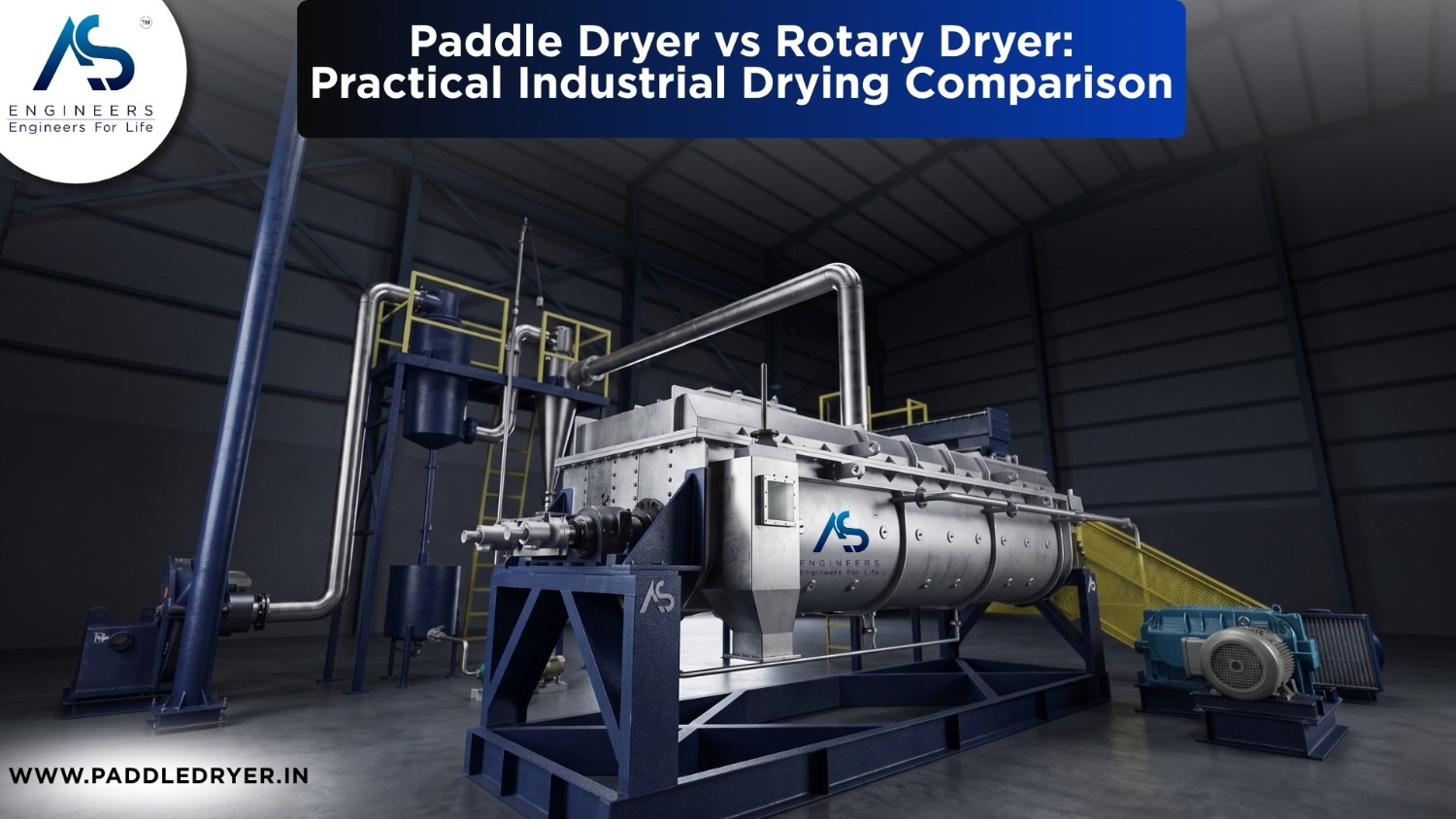
A paddle dryer uses indirect heat transfer through hollow shafts, paddles, and a heated jacket. A rotary dryer generally uses a rotating drum where the material is lifted, cascaded, and contacted with hot gas or heated surfaces depending on design. This creates a major difference in off-gas volume, material agitation, and heat exposure.
According to AS Engineers, its paddle dryer design uses hollow shafts and jacket heating, dual counter-rotating shafts, wedge-shaped paddles, plug-flow movement, and self-cleaning paddle action. This makes it suitable for wet, sticky, and difficult feed materials that need continuous agitation while moisture is removed.
In a rotary dryer, material movement depends heavily on drum rotation, slope, internal flights, feed distribution, and air velocity. This can work well for sand, minerals, biomass, and granular solids. But with sticky sludge or paste, internal buildup, balling, uneven residence time, and carryover can become serious operating risks.
For sludge and semi-solid waste streams, buyers should study a practical sludge drying guide before assuming that any thermal dryer can handle the same feed.
Which Dryer Handles Sticky Sludge, Paste, and Filter Cake Better?
A paddle dryer is generally the stronger choice for sticky sludge, pastes, wet cakes, and high-moisture semi-solids. Its paddles continuously knead, shear, mix, and expose fresh surface area to indirect heat. A rotary dryer can struggle when feed material does not flow freely.
This matters in ETP sludge, STP sludge, CETP sludge, biosolids, chemical paste, pigment cake, paper sludge, and filter cake applications. These materials may pass through plastic, shearing, and granular phases during drying. A paddle dryer is designed to support this transition through controlled agitation and enclosed drying.
A rotary dryer usually needs the feed to tumble and cascade. If the feed is too sticky, the material may coat the drum, form balls, block discharge zones, or create irregular drying. Pre-conditioning, back-mixing with dry product, or special internals may help, but these add complexity.
For sludge buyers, a paddle sludge dryer is often more relevant than a general bulk-solids dryer because sludge handling is not only a drying issue. It is also a hygiene, disposal, odor, transport, and compliance issue.
What Should Buyers Compare Before Choosing Between Paddle Dryer and Rotary Dryer?
The best comparison is based on feed type, heating method, emissions, footprint, product quality, and maintenance risk. A dryer should be selected after matching the process duty, not after looking only at equipment price. Pilot testing is especially important when moisture behavior, stickiness, or outlet dryness is uncertain.
| Buyer Decision Point | Paddle Dryer Fit | Rotary Dryer Fit | Practical Selection Signal |
|---|---|---|---|
| Sticky sludge or paste | High | Low to application-specific | Choose paddle dryer when material smears, cakes, or passes through a plastic phase |
| Free-flowing minerals or granules | Application-specific | High | Rotary dryer may suit tumbling bulk solids |
| Off-gas volume control | High | Medium to high off-gas load | Paddle dryer is useful when smaller off-gas handling is preferred |
| Heat-sensitive product | High | Depends on gas temperature and residence time | Indirect heating can reduce direct flame or hot gas exposure |
| Solvent-bearing feed | High, with enclosed design | Application-specific | Enclosed indirect systems help solvent management |
| Large bulk throughput | Application-specific | High | Rotary dryers often suit large free-flowing bulk tonnage |
| Compact plant layout | High | Medium to low | Paddle dryer usually offers a compact footprint |
| Dust and fines control | High | Depends on air velocity | Rotary systems may need larger dust collection |
| Final dryness target | Up to application requirement | Application-specific | Trial testing should confirm outlet moisture |
| Maintenance risk | Depends on feed and design | Depends on buildup and wear | Select based on actual material behavior |
This table is not a universal verdict. It is a buyer-screening tool. The final selection should consider feed testing, moisture curve, thermal sensitivity, corrosion, abrasiveness, hazardous components, installation space, and downstream handling.
Why Is Off-Gas Volume a Major Difference?
Off-gas volume can decide the real cost of a drying system. Paddle dryers use indirect heating, so they generally need less process gas than direct-contact rotary dryers. Lower off-gas volume can reduce the load on cyclone separators, scrubbers, condensers, bag filters, ID fans, and chimneys.
In a direct rotary dryer, hot gas often becomes both the heating medium and the moisture carrier. This can increase exhaust volume, dust entrainment, odor load, and pollution-control sizing. For simple mineral drying, that may be acceptable. For sludge, chemicals, solvents, or odorous waste, it can increase system cost and compliance risk.
AS Engineers’ paddle dryer system approach includes feeding, heating, drying, scavenging, pollution control, solvent management, and product handling. This is important because the dryer alone does not solve the plant problem. The complete drying line must manage vapors, fines, odor, condensate, discharge, and bagging.
For buyers comparing multiple drying routes, the thermal drying and solar drying comparison helps frame why footprint, weather dependence, emission handling, and drying control should be reviewed together.
Is a Paddle Dryer More Energy Efficient Than a Rotary Dryer?
A paddle dryer can be more energy-efficient for many sludge, paste, and wet cake duties because heat is transferred indirectly through heated surfaces and the off-gas volume is lower. Rotary dryer efficiency depends on hot gas design, insulation, air leakage, exhaust temperature, feed properties, and heat recovery. There is no honest single answer without material testing and heat balance.
Per AS Engineers’ approved data, paddle dryers can use steam up to 14.06 kg/cm² or thermal oil up to 400°C, depending on the process requirement. Their paddle dryers can also operate under atmospheric, vacuum, or pressurized conditions and support materials such as slurries, pastes, cakes, granules, and powders.
For sludge drying, AS Engineers’ official fuel reference gives practical drying equivalents from 80% initial moisture to 20% final moisture: 1 kg wood for 5 kg sludge, 1 kg coal for 8.25 kg sludge, 1 Nm³ gas for 22.5 kg sludge, and 1 kg LDO for 21 kg sludge. These figures should be used as reference benchmarks, not as universal guarantees, because fuel quality, sludge composition, inlet moisture, outlet moisture, and plant losses change the result.
Buyers should also compare dewatering before drying. Good sludge dewatering and drying reduces thermal load and can improve total operating economics.
Where Does a Rotary Dryer Still Make Better Sense?
A rotary dryer can be the better practical choice for free-flowing bulk solids where direct hot gas contact is acceptable and large-scale throughput is the main objective. Examples may include minerals, sand, aggregates, biomass, some fertilizers, and granular industrial materials. It is not a weak technology, but it is not automatically the right technology for sludge and sticky feed.
Rotary dryers are widely used because they are mechanically simple in concept, familiar to many bulk-solid plants, and capable of continuous operation. For materials that tumble cleanly and tolerate hot gas, the design can be effective. The problem begins when buyers force sticky, odorous, toxic, or solvent-bearing materials into a dryer better suited for free-flowing solids.
A rotary dryer may also require larger dust collection and gas-cleaning equipment when fines are carried with exhaust air. Plants handling regulated waste should compare the full system, not only the drum. That includes ducting, fan power, scrubber load, bag filter load, fire risk, odor control, and local emission limits.
If the comparison also includes belt drying, the paddle dryers vs belt dryers guide can help buyers evaluate footprint, contact time, airflow, and sludge handling differences.
Which Industries Should Shortlist a Paddle Dryer First?
Plants should shortlist a paddle dryer first when the feed is wet, sticky, pasty, odorous, solvent-bearing, heat-sensitive, or difficult to discharge. This includes many sludge, chemical, pharma, pigment, food, paper, polymer, and waste-management applications. Rotary dryers should stay in the comparison only if the material can tumble and dry uniformly without major buildup or emission problems.
AS Engineers lists paddle dryer applications across environmental sludge, chemicals, petrochemicals, mining, metals, agriculture, animal feed, plastics, polymers, paper, pulp, pigments, dyes, food, beverage, pharmaceuticals, healthcare, petroleum, and oil and gas. The same equipment family can support drying, heating, solvent stripping, calcining, roasting, and cooling depending on process design.
This flexibility is important for procurement teams that do not want a one-purpose machine without future adaptability. A plant drying ETP sludge today may later need process optimization, different outlet moisture, improved feeding, or modified product handling. Equipment selection should leave room for process reality.
For a wider view of model choices, buyers can review AS Engineers’ guide on different types of paddle dryers and compare standard, dual-zone, and vacuum dryer options.
How Should a Serious Buyer Make the Final Selection?
A serious buyer should select the dryer after testing the material, defining the outlet moisture target, checking utilities, reviewing emission control, and confirming downstream handling. The decision should include total installed system cost, not only dryer body cost. Feed preparation, conveyors, pumps, heating system, condenser, scrubber, cyclone, bag filter, chimney, and bagging system can change the final economics.
AS Engineers offers a 50 kg/hr pilot trial machine at its facility or client site, with the trial fee waived upon order placement. This is valuable because sludge, paste, and filter cake behavior cannot always be predicted from lab moisture data alone. A paddle dryer pilot trial can reveal stickiness, discharge quality, vapor behavior, drying time, and final product form.
Buyers comparing paddle dryer vs rotary dryer should send representative material samples, not ideal samples. Include seasonal moisture variation, worst-case sludge, chemical analysis, corrosive components, particle size, volatile content, odor concerns, and current disposal cost. Bad input data leads to wrong dryer selection.
For equipment-level review, AS Engineers provides an AS Engineers paddle dryer product line, sludge dryer manufacturer support, and paddle dryer services for repair, upgrades, OEM spare parts, retrofitment, alignment, balancing, AMC, and training.
FAQs
1. Is a paddle dryer better than a rotary dryer for sludge?
Yes, a paddle dryer is usually better for sludge because sludge is wet, sticky, difficult to tumble, and often odorous. Paddle dryers use indirect heating, mixing, and shearing to move sludge through different drying phases. Rotary dryers are more suitable when the feed is free-flowing and can cascade properly inside a drum.
2. Can a rotary dryer dry filter cake?
A rotary dryer can dry some filter cakes if the material is conditioned, free-flowing, or blended with dry product. However, sticky filter cake can coat the drum, form lumps, or dry unevenly. A paddle dryer is usually safer for sticky cake and paste-like feed.
3. Which dryer has lower off-gas handling requirements?
A paddle dryer often has lower off-gas handling requirements because heat is transferred indirectly through heated surfaces. Rotary dryers using direct hot gas generally move more air through the system. That can increase dust collection, scrubbing, fan power, and exhaust-treatment load.
4. Can paddle dryers handle powders and granules too?
Yes, paddle dryers can handle slurries, pastes, cakes, powders, granules, and similar industrial materials when designed correctly. The final design depends on bulk density, moisture, stickiness, abrasiveness, corrosion, heat sensitivity, and discharge requirement.
5. Should I choose based on dryer price or total system cost?
Choose based on total system cost. Dryer price alone ignores feeding, heating, fuel, power, pollution control, solvent management, maintenance, downtime, disposal savings, and operator safety. For difficult materials, trial testing is the safest way to avoid a wrong purchase.
If your plant is comparing paddle dryer vs rotary dryer for sludge, paste, filter cake, or difficult industrial waste, do not finalize the technology only from brochures or capacity charts. Share your feed details, moisture range, fuel availability, outlet moisture target, and disposal problem with AS Engineers Contact for a practical dryer-selection discussion.

Karan Dargode leads operations and environmental health & safety at AS Engineers, an Ahmedabad-based manufacturer with over 25 years of experience in centrifugal blowers, industrial fans, paddle dryers, sludge dryers, and air pollution control equipment. He joined AS Engineers in July 2019 and has spent over six years building operational systems that support the company’s engineering and manufacturing work. His role spans business strategy execution, operational process design, EHS compliance, and policy development. Day to day, that means keeping manufacturing output consistent, ensuring workplace and environmental standards are met, and supporting the company’s growth across domestic and export markets. Education and Qualifications Karan holds a Bachelor of Engineering in Mechanical Engineering from Silver Oak College of Engineering and Technology, Ahmedabad, affiliated with Gujarat Technological University (GTU), completed in 2018. He later pursued a Post Graduate Diploma in Business Administration (PGDBA) with a focus on Operations Management from Symbiosis Centre for Distance Learning, Pune, strengthening his understanding of manufacturing strategy and industrial operations. What He Writes About The articles and posts on this site reflect what Karan works with directly. He covers: Paddle dryer selection, working principles, and industrial applications Sludge drying technology for ETP and CETP operators Centrifugal blower engineering and maintenance Industrial drying process optimization EHS compliance for industrial manufacturing units His writing is technical without being academic. The goal is straightforward: give plant engineers, ETP operators, and procurement managers the specific information they need to make good equipment decisions. At AS Engineers AS Engineers has manufactured industrial equipment since 1997, serving clients across chemicals, pharmaceuticals, food processing, wastewater treatment, and heavy industry. The Ahmedabad facility at GIDC Vatva handles design, fabrication, and testing in-house. Karan’s work at the operations level puts him directly involved with product delivery quality, production planning, and customer-facing timelines. If you have questions about any article on this site or want to discuss a specific application for blowers, dryers, or air pollution control equipment, you can reach the AS Engineers team through the contact page. Contact AS Engineers