
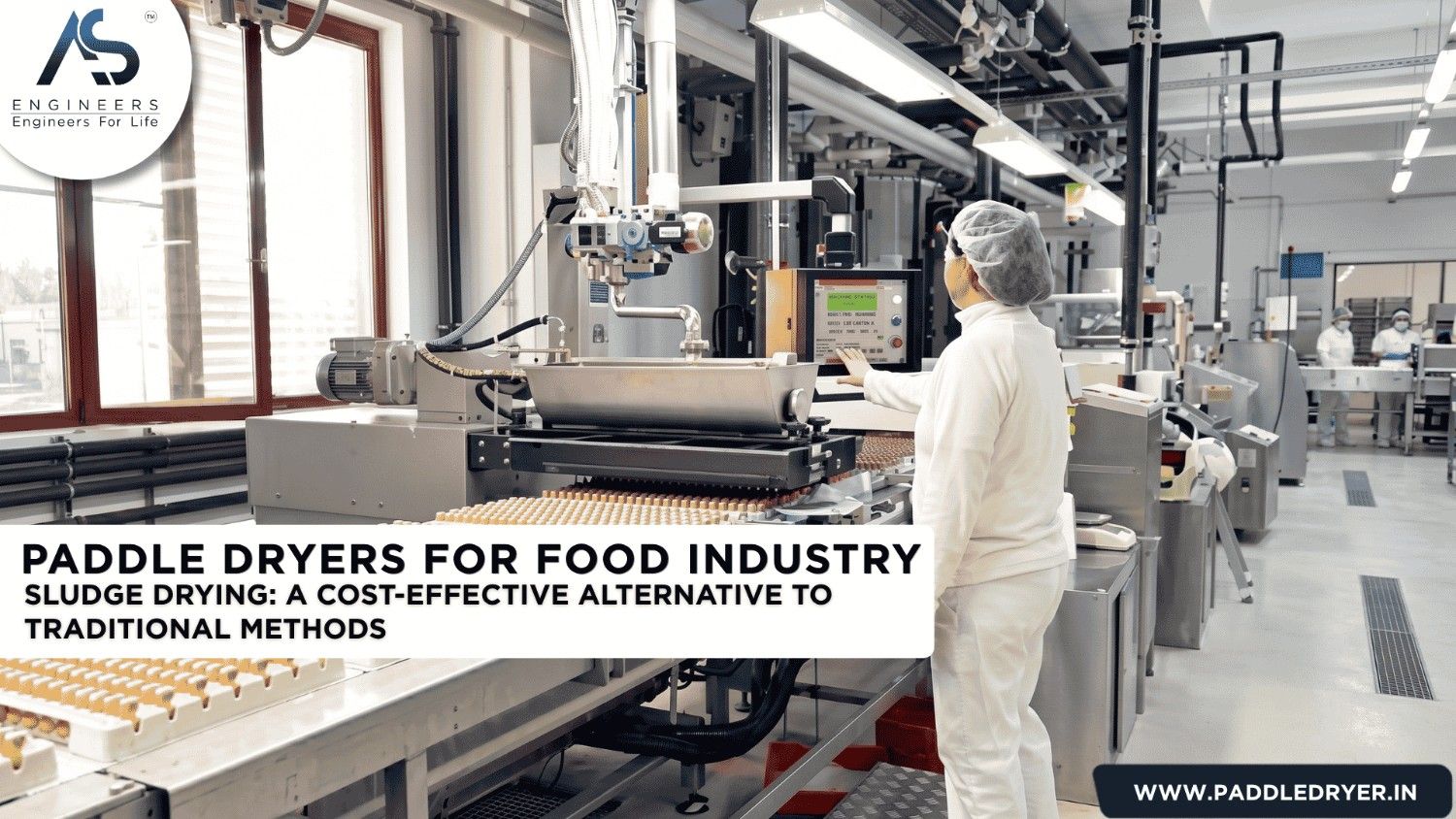
Why Food Sludge Drying Needs Better Alternatives to Traditional Methods
Food sludge drying needs a method that reduces moisture, handling difficulty, odor risk, storage pressure, and disposal weight without depending on open drying space or unstable weather. A paddle dryer gives food processing plants a controlled indirect-heat drying route for wet sludge cake. It is especially useful where traditional drying methods become slow, labour-heavy, or difficult to manage.
Food processing plants generate wastewater sludge from washing, peeling, starch recovery, dairy, beverage, meat processing, sugar, oil, and other organic material streams. This sludge often contains high moisture and can become odorous when stored wet. The result is higher transport weight, more floor space, more operator handling, and more pressure on ETP teams.
Traditional options such as open drying beds, basic hot-air drying, or repeated wet sludge disposal may look simple at first. In daily operation, they can create hidden costs. A paddle dryer for sludge drying in the food industry helps plants move from reactive waste handling to controlled moisture reduction.
How Are Paddle Dryers Different from Traditional Sludge Drying Methods?
Paddle dryers use indirect heat transfer through hollow shafts and a heated jacket while paddles continuously mix and move the sludge. Traditional methods often depend on open exposure, large drying area, direct hot air, or repeated transportation of wet sludge. The difference is control.
In a paddle dryer, the wet sludge is fed into an enclosed drying chamber. Dual counter-rotating shafts and wedge-shaped paddles agitate, shear, and move the material forward. Heat evaporates moisture while the paddles help prevent buildup and support more uniform drying.
Open drying depends heavily on climate, space, time, and manual sludge turning. Direct hot-air drying can create higher off-gas volume and may need larger air-handling systems. Wet disposal avoids drying capex but keeps the plant paying to move water. Paddle drying gives the plant a mechanical and thermal control point before disposal or approved downstream use.
For buyers comparing the basic categories, this comparison of thermal drying and solar drying gives useful context.
What Makes Paddle Dryers Cost-Effective for Food Processing Plants?
Paddle dryers become cost-effective when moisture reduction lowers total sludge handling cost. The saving is not only in disposal. It can also come from reduced transport load, lower storage pressure, easier discharge, less manual handling, and cleaner sludge movement.
AS Engineers’ sludge drying data gives a practical example: 10 tons per day of wet sludge can reduce to 2 tons per day after drying when moisture is reduced from 80% to 20%. The same example shows disposal cost reducing from ₹1,00,000 per day to ₹20,000 per day when disposal is charged at ₹10,000 per ton. This is an example, not a guaranteed result for every food plant.
Food processors should calculate cost before and after drying using their own sludge quantity, moisture, fuel cost, disposal rate, operating hours, and target outlet moisture. A low-cost traditional method may become expensive if it requires large land, long drying time, extra labour, odor control, and frequent wet sludge transport.
For broader cost planning, review ETP sludge management as a waste-to-resource strategy.
Buyer Decision Table: Paddle Dryer vs Traditional Food Sludge Drying Options
The best drying method depends on sludge behavior, site layout, cost structure, and compliance expectations. This table helps food processors compare options without relying only on equipment price.
| Decision Factor | Open/Solar Drying | Direct Hot-Air Drying | Wet Sludge Disposal | Paddle Dryer |
|---|---|---|---|---|
| Weather dependence | High | Low | Low | Low |
| Space requirement | High | Medium | Medium | Low to Medium |
| Process control | Low | Medium | Low | High |
| Odor exposure risk | High | Medium | Medium | Lower with enclosed design |
| Labour requirement | High | Medium | Medium | Lower after automation |
| Off-gas volume | Low to Medium | High | Low | Lower than many direct systems |
| Handling of sticky sludge | Difficult | Application-specific | Avoided, but costly | Strong fit after testing |
| Disposal weight reduction | Slow | High | None | High |
| Suitability for continuous operation | Low | Medium to High | Not a drying method | High |
| Buyer risk without testing | High | Medium | Cost continues | Requires pilot validation |
Why Is Indirect Heat Useful for Food Sludge Drying?
Indirect heat is useful because the heating medium does not directly contact the sludge. Heat passes through metal surfaces, while the paddles mix and expose the material to the heated area. This supports controlled drying with lower off-gas volume than many direct hot-air arrangements.
Food sludge can contain organics, fiber, starch, fats, proteins, biological solids, or suspended solids. Some materials pass through a sticky phase before becoming dry enough to discharge. In this stage, mixing and surface contact matter more than simply blowing hot air across the material.
AS Engineers’ paddle dryers can use steam heating up to 14.06 kg/cm² or thermal oil heating up to 400°C, depending on the application. They can also be designed for atmospheric, vacuum, or pressurized conditions. This flexibility helps match the system to the food plant’s utility and sludge behavior.
For deeper technical understanding, see the guide to paddle dryer technology for sludge drying.
What Food Sludge Problems Should Be Checked Before Dryer Selection?
Food sludge should be checked for moisture, stickiness, organic content, oil or fat content, fiber, salt, odor behavior, and discharge requirement. A dryer should not be selected only by tons per day. Sludge behavior during drying decides whether the system will run smoothly.
The first issue is inlet moisture. If upstream dewatering is poor, the dryer must remove more water and consume more energy. The second issue is stickiness. Food sludge may become more adhesive during the middle stage of drying, which can affect discharge and cleaning.
The third issue is the outlet target. Some plants need reduced transport weight. Others need baggable sludge, conveyable sludge, or material ready for approved co-processing. The fourth issue is vapor handling. Organic sludge can create odor, vapor, and fines that need proper downstream control.
Food processors comparing equipment options should also read the paddle dryers vs belt dryers comparison for sludge drying.
Can Dried Food Sludge Support Waste-to-Value Goals?
Dried food sludge may support waste-to-value goals only when composition, safety, calorific value, and local approvals allow it. Drying can make sludge easier to evaluate, store, transport, and handle, but reuse should never be assumed without laboratory testing and regulatory clearance.
AS Engineers’ materials identify possible dried sludge end-use routes such as alternative fuel, cement production, agriculture, and bricks. For food sludge, the actual route depends on contaminants, salts, oil, biological stability, odor, and final dry solids.
Even when reuse is not possible, drying can still create value by reducing sludge volume and improving handling. A plant may benefit through lower disposal quantity, cleaner storage, fewer emergency movements, and better control over waste logistics.
For related sludge treatment strategy, see the paddle sludge dryer guide for effective sludge treatment.
How Can Pilot Trials Reduce Buyer Risk?
Pilot trials reduce buyer risk by showing actual drying behavior before full-scale investment. Food sludge can change across raw materials, production schedules, cleaning cycles, wastewater load, and ETP chemistry. Testing helps confirm moisture reduction, stickiness, discharge form, vapor behavior, and utility requirement.
AS Engineers offers a 50 kg/hr pilot trial machine at its facility or, where suitable, at the client’s site. The trial is available on a minimal paid basis, with the fee waived upon order placement. This is useful when the buyer needs technical confidence before approving capex.
A pilot test also helps prevent overdesign and underdesign. Oversizing increases capex. Undersizing creates bottlenecks. Testing gives engineering teams better data for capacity, heating medium, MOC, discharge system, and vapor handling decisions.
Buyers can review the paddle dryer pilot trial before final equipment selection.
Why Choose AS Engineers for Food Sludge Drying Applications?
AS Engineers manufactures paddle dryers from GIDC Vatva, Ahmedabad, Gujarat, India, and positions itself as The Leading Name in Paddle Dryer Industry. The company has 25+ years of experience, 500+ clients, 1500+ projects, and 500+ dryers operational as stated in its company materials. It is ISO 9001:2015 TUV India certified and CE Certified.
For food processors, experience matters because sludge drying affects hygiene, ETP reliability, odor management, utility cost, maintenance, and disposal planning. AS Engineers’ paddle dryer applications include food and beverage materials such as starch, chocolate, cake flour, instant coffee, and meat, along with sludge and biosolid applications.
The company supports standard, dual-zone, and vacuum dryer configurations. It can also design connected systems for feeding, heating, scavenging, pollution control, solvent or vapor management, and dried product handling.
Relevant AS Engineers resources include paddle dryer in food industry, paddle dryers for sludge drying, paddle dryer for cocoa and sugar, and high-quality starch production with paddle dryer.
FAQs
1. Are paddle dryers better than open drying beds for food sludge?
For controlled industrial operation, paddle dryers are usually more practical than open drying beds when space, odor, weather, hygiene, and drying time are serious issues. Open drying may look cheaper, but it often needs more land, time, and labour.
2. Can a paddle dryer handle sticky food processing sludge?
Yes, paddle dryers are suitable for many wet and sticky materials, but actual suitability should be confirmed through testing. Food sludge can pass through sticky phases during drying, so pilot trials are important.
3. Does paddle drying reduce food sludge disposal cost?
It can reduce disposal cost when lower moisture reduces the final quantity sent for transport or disposal. Actual savings depend on sludge quantity, moisture, fuel cost, disposal rate, and operating schedule.
4. What utilities are needed for a food sludge paddle dryer?
The heating system may use steam, thermal oil, hot water, or other site-specific arrangements. Selection depends on temperature requirement, available utilities, energy cost, and drying target.
5. Can dried food sludge be reused?
Possibly, but reuse depends on composition, contamination level, local regulation, and approved downstream application. Testing and compliance approval must come before any reuse decision.
If traditional sludge drying is taking too much space, time, labour, or disposal cost in your food processing plant, evaluate a controlled paddle dryer system before expanding storage or paying for more wet sludge movement. Share your sludge quantity, inlet moisture, dewatering method, current disposal cost, utility availability, and outlet target with AS Engineers through the AS Engineers contact page.

Karan Dargode leads operations and environmental health & safety at AS Engineers, an Ahmedabad-based manufacturer with over 25 years of experience in centrifugal blowers, industrial fans, paddle dryers, sludge dryers, and air pollution control equipment. He joined AS Engineers in July 2019 and has spent over six years building operational systems that support the company’s engineering and manufacturing work. His role spans business strategy execution, operational process design, EHS compliance, and policy development. Day to day, that means keeping manufacturing output consistent, ensuring workplace and environmental standards are met, and supporting the company’s growth across domestic and export markets. Education and Qualifications Karan holds a Bachelor of Engineering in Mechanical Engineering from Silver Oak College of Engineering and Technology, Ahmedabad, affiliated with Gujarat Technological University (GTU), completed in 2018. He later pursued a Post Graduate Diploma in Business Administration (PGDBA) with a focus on Operations Management from Symbiosis Centre for Distance Learning, Pune, strengthening his understanding of manufacturing strategy and industrial operations. What He Writes About The articles and posts on this site reflect what Karan works with directly. He covers: Paddle dryer selection, working principles, and industrial applications Sludge drying technology for ETP and CETP operators Centrifugal blower engineering and maintenance Industrial drying process optimization EHS compliance for industrial manufacturing units His writing is technical without being academic. The goal is straightforward: give plant engineers, ETP operators, and procurement managers the specific information they need to make good equipment decisions. At AS Engineers AS Engineers has manufactured industrial equipment since 1997, serving clients across chemicals, pharmaceuticals, food processing, wastewater treatment, and heavy industry. The Ahmedabad facility at GIDC Vatva handles design, fabrication, and testing in-house. Karan’s work at the operations level puts him directly involved with product delivery quality, production planning, and customer-facing timelines. If you have questions about any article on this site or want to discuss a specific application for blowers, dryers, or air pollution control equipment, you can reach the AS Engineers team through the contact page. Contact AS Engineers