
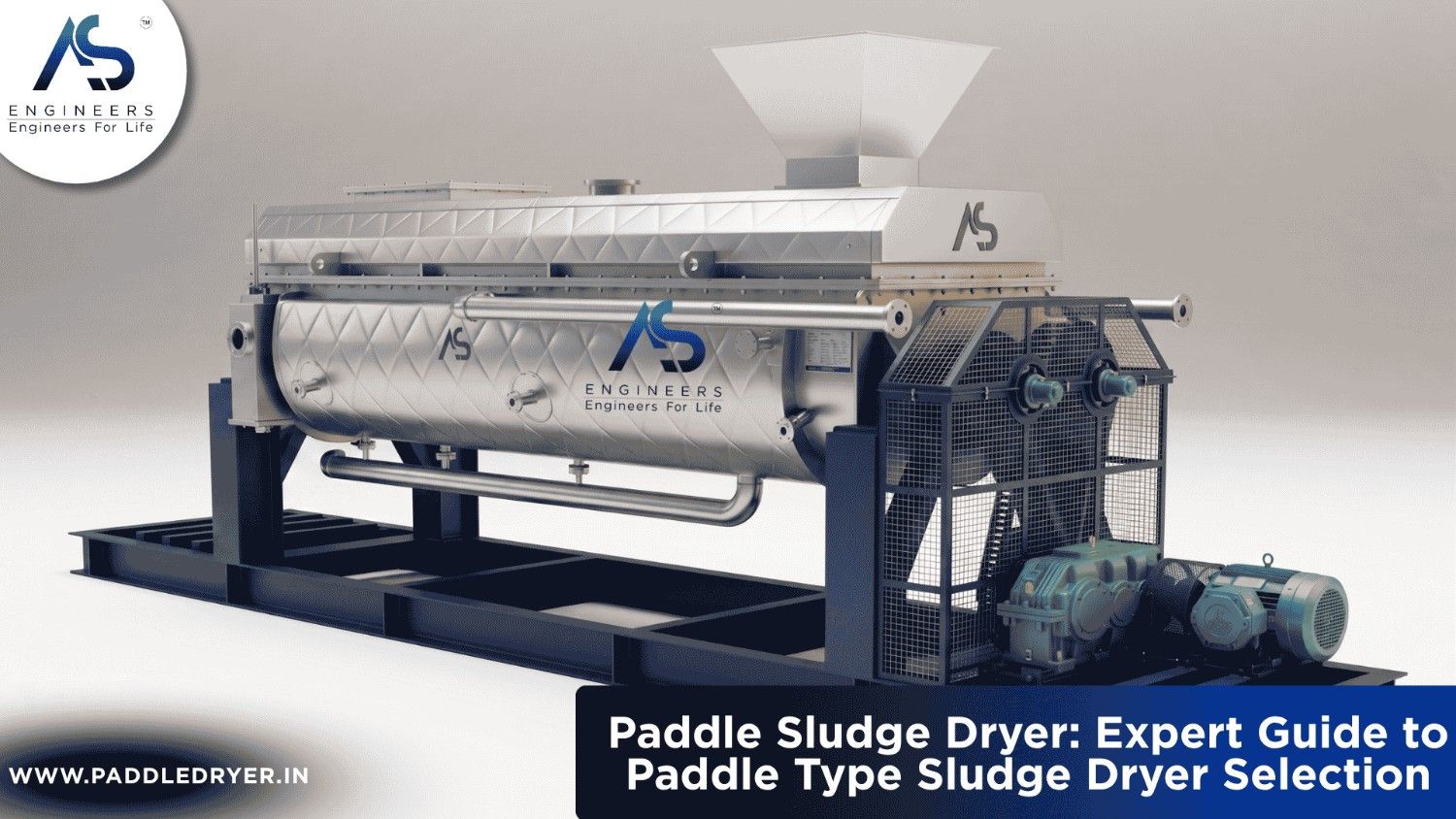
What Is a Paddle Sludge Dryer?
A paddle sludge dryer is an indirect thermal drying system used to reduce moisture in wet sludge from ETP, STP, CETP, municipal wastewater, chemical plants, textile units, paper mills, pharma plants, and other industrial facilities. The main decision for buyers is not only whether the dryer can remove moisture, but whether it can handle sticky, variable, high-moisture sludge reliably.
A paddle type sludge dryer uses hollow shafts, heated paddles, and a jacketed body to transfer heat into the sludge without direct flame contact. This makes it useful where sludge handling, disposal cost, hygiene, and compliance pressure are serious plant-level concerns.
For buyers comparing sludge drying routes, a paddle sludge dryer for effective sludge treatment is usually evaluated after dewatering, when filter press cake, centrifuge cake, or thickened sludge still contains too much moisture for economical disposal or reuse.
How Does a Paddle Type Sludge Dryer Work?
A paddle type sludge dryer works by indirectly heating sludge through hollow shafts, paddles, and the dryer jacket while the paddles continuously mix, shear, and move the material forward. The sludge typically changes from plastic and sticky to sheared, semi-dry, and then granular or manageable dry product.
According to AS Engineers, the paddle dryer design uses dual counter-rotating shafts with wedge-shaped paddles to improve mixing and heat transfer. The self-cleaning action of intermeshing paddles helps reduce material build-up inside the dryer.
The drying process is enclosed, which helps control vapour, odour, fines, and emission handling. Depending on the application, the system may include feeding equipment, fuel and heating system, scavenging arrangement, cyclone, scrubber, bag filter, condenser, chimney, screw conveyor, bagging system, silo, or truck loading arrangement.
This is why buyers should assess the complete sludge drying system, not only the dryer body. A dryer without proper feeding, vapour handling, discharge, and pollution control can become an operating problem.
Why Do Plants Choose Paddle Sludge Dryers Instead of Wet Sludge Disposal?
Plants choose paddle sludge dryers because wet sludge is expensive to store, transport, handle, and dispose of. Drying reduces the sludge load, improves hygiene, reduces storage pressure, and can create options for disposal, co-processing, fuel use, bricks, cement, fertilizer, or other reuse routes depending on sludge composition.
The commercial argument is direct. Wet sludge contains water that plants pay to move and dispose of. Removing that water before transport or disposal can reduce repeated operating cost.
AS Engineers’ sludge drying data shows a practical example: 10 ton/day wet sludge can become around 2 ton/day dry sludge after drying under the stated case basis. That changes disposal logistics, labour requirement, floor space, and daily handling discipline.
For broader context on moisture reduction and drying technology, see this guide on sludge drying with paddle dryer technology.
Which Sludge Types Are Suitable for a Paddle Sludge Dryer?
Paddle sludge dryers are suitable for many sludge categories, but the final design must be based on the actual sludge sample. ETP sludge, STP sludge, CETP sludge, paper sludge, biosludge, textile sludge, chemical sludge, and municipal sludge can behave very differently even when the moisture percentage looks similar.
The most important sludge variables are initial moisture, stickiness, abrasiveness, chloride content, organic content, bulk density, odour, solvent presence, final dryness target, and disposal route. A chemical ETP sludge may need different material of construction than municipal sewage sludge. A sticky biological sludge may need different feeding and discharge planning than mineral-rich sludge.
AS Engineers supports materials of construction such as carbon steel, SS304, SS316, Duplex Steel, and other alloys based on process need. Heating may be through steam up to 14.06 kg/cm² or thermal oil up to 400°C, depending on the application and plant utility.
For ETP-focused buyers, ETP sludge management is especially important because industrial sludge may carry compliance, handling, and end-use restrictions.
How Should Buyers Select a Paddle Sludge Dryer Manufacturer?
A paddle sludge dryer manufacturer should be evaluated on drying trials, process understanding, mechanical design, heating system integration, sludge handling knowledge, and after-sales support. Lowest quotation is a weak selection method because sludge dryers fail most often at the boundaries: feeding, sticking, vapour handling, discharge, and maintenance.
A serious buyer should ask the manufacturer for sludge sample testing, expected outlet moisture range, material of construction logic, heating medium recommendation, vapour treatment approach, layout needs, maintenance access, spare parts support, and operator training.
AS Engineers manufactures paddle dryers from GIDC Vatva, Ahmedabad, Gujarat, India, and positions itself as The Leading Name in Paddle Dryer Industry. The company has 25+ years of experience, ISO 9001:2015 TUV India certification, CE certification, 500+ clients, 1500+ projects, and 500+ dryers operational.
Buyers can review the main AS Engineers paddle dryer product page and the dedicated sludge dryer manufacturer page when shortlisting equipment.
Paddle Sludge Dryer Buyer Decision Table
This table helps buyers compare key purchase factors before requesting a quotation. Exact sizing, utility load, and final performance should always be confirmed through sludge testing and engineering review.
| Buyer Decision Factor | What to Check | Risk if Ignored | Selection Priority |
|---|---|---|---|
| Sludge feed condition | Moisture, stickiness, particle load, variability | Feeding blockage, uneven drying | High |
| Heating medium | Steam, thermic fluid, hot water, fuel availability | Higher operating cost or underperformance | High |
| Final moisture target | Disposal, reuse, co-processing, storage need | Over-drying or incomplete drying | High |
| Material of construction | Corrosion, chloride, solvent, abrasion risk | Premature wear or corrosion | High |
| Vapour and odour handling | Cyclone, scrubber, condenser, chimney, bag filter | Compliance and workplace issues | High |
| Discharge system | Screw conveyor, bagging, silo, truck disposal | Dry product handling problems | Medium |
| Pilot testing | 50 kg/hr trial or sample validation | Wrong dryer sizing or process assumptions | High |
| After-sales support | Spares, alignment, retrofitment, AMC, training | Longer downtime | High |
What Mistakes Should Buyers Avoid Before Ordering?
The biggest mistake is treating sludge drying as a standard catalogue purchase. Sludge is not a fixed commodity. Two plants with the same moisture percentage can need different drying residence time, heating surface, metallurgy, discharge design, and vapour handling.
Another mistake is comparing dryer price without comparing system scope. A lower-cost offer may exclude feeding equipment, pollution control, condenser, screw conveyor, bagging, installation support, or controls. That can shift hidden cost back to the buyer.
Buyers should also avoid selecting a dryer only by ton/day feed capacity. Feed rate matters, but evaporative load, initial moisture, final moisture, heat source, operating hours, and sludge behaviour decide actual dryer duty.
For comparison against other sludge drying approaches, review paddle dryers vs belt dryers and sludge drying methods.
Why Pilot Testing Matters for Paddle Type Sludge Dryer Projects?
Pilot testing reduces purchase risk because it shows how the sludge behaves under real thermal and mechanical action. It can reveal stickiness, odour, drying curve, discharge form, required residence time, and whether the target outlet moisture is practical.
AS Engineers offers a 50 kg/hr pilot trial machine at its facility or at the client’s site. The trial is available on a minimal paid basis, and the fee is waived upon order placement. This is valuable for plants handling variable sludge, new waste streams, or strict disposal targets.
A pilot test also helps plant teams make better internal decisions. Procurement can compare technical offers more fairly. EHS can assess vapour and handling concerns. Operations can understand feeding, discharge, and maintenance implications before purchase.
Buyers planning a new system can start with a paddle dryer pilot trial before freezing specifications.
Where Does a Paddle Sludge Dryer Fit in the Complete Plant?
A paddle sludge dryer usually sits after dewatering and before disposal, bagging, reuse, storage, or co-processing. It is not a replacement for every upstream treatment step. It is the thermal reduction stage that converts difficult wet sludge into a lower-volume dry or semi-dry product.
A complete system may include wet sludge silo, screw feeder, belt conveyor, sludge pump, paddle dryer, FD blower, heat exchanger, ID fan, cyclone, scrubber, condenser, solvent tank, chimney, screw conveyor, silo, or bagging system. The exact arrangement depends on whether the evaporated solvent is water or another recoverable vapour.
For plants evaluating industrial thermal drying equipment, hollow paddle dryers are relevant because hollow shafts and paddles are central to indirect heat transfer. AS Engineers also offers paddle dryer services and spare parts for long-term equipment support.
FAQs
1. What is the difference between a paddle sludge dryer and a paddle type sludge dryer?
A paddle sludge dryer and paddle type sludge dryer usually refer to the same drying principle. Both use heated hollow paddles and shafts to indirectly transfer heat into sludge while mixing and moving it through the dryer.
2. Can a paddle sludge dryer achieve very high dryness?
Yes, AS Engineers states that its paddle dryer can achieve up to 99% dryness or a specific required moisture level, depending on feed condition and process design. Final dryness should be confirmed through sludge characteristics and trial data.
3. Is a paddle sludge dryer suitable for sticky sludge?
Yes, paddle dryers are commonly considered for sticky sludge because the paddles agitate, shear, and continuously renew the heated contact surface. However, very sticky sludge should be pilot tested before final sizing.
4. What heating options are used in paddle sludge dryers?
Common heating options include steam and thermic fluid. AS Engineers also supports system-level fuel flexibility such as natural gas, wood, coal, LDO, electricity, briquette, and other site-specific options through the heating system.
5. Does AS Engineers provide repair, retrofitment, and spare parts?
Yes, AS Engineers provides repair services, OEM spare parts, shaft, gearbox and bearing replacement, system upgrades, retrofitment, on-site alignment, on-site balancing, AMC, and operator training.
A paddle sludge dryer is a long-term plant decision, not a simple equipment purchase. The right system can reduce sludge volume, improve handling, support compliance, and lower recurring disposal pressure when it is designed around actual sludge behaviour. To discuss sludge sample testing, dryer configuration, heating options, and project suitability, contact AS Engineers for paddle sludge dryer consultation.

Karan Dargode leads operations and environmental health & safety at AS Engineers, an Ahmedabad-based manufacturer with over 25 years of experience in centrifugal blowers, industrial fans, paddle dryers, sludge dryers, and air pollution control equipment. He joined AS Engineers in July 2019 and has spent over six years building operational systems that support the company’s engineering and manufacturing work. His role spans business strategy execution, operational process design, EHS compliance, and policy development. Day to day, that means keeping manufacturing output consistent, ensuring workplace and environmental standards are met, and supporting the company’s growth across domestic and export markets. Education and Qualifications Karan holds a Bachelor of Engineering in Mechanical Engineering from Silver Oak College of Engineering and Technology, Ahmedabad, affiliated with Gujarat Technological University (GTU), completed in 2018. He later pursued a Post Graduate Diploma in Business Administration (PGDBA) with a focus on Operations Management from Symbiosis Centre for Distance Learning, Pune, strengthening his understanding of manufacturing strategy and industrial operations. What He Writes About The articles and posts on this site reflect what Karan works with directly. He covers: Paddle dryer selection, working principles, and industrial applications Sludge drying technology for ETP and CETP operators Centrifugal blower engineering and maintenance Industrial drying process optimization EHS compliance for industrial manufacturing units His writing is technical without being academic. The goal is straightforward: give plant engineers, ETP operators, and procurement managers the specific information they need to make good equipment decisions. At AS Engineers AS Engineers has manufactured industrial equipment since 1997, serving clients across chemicals, pharmaceuticals, food processing, wastewater treatment, and heavy industry. The Ahmedabad facility at GIDC Vatva handles design, fabrication, and testing in-house. Karan’s work at the operations level puts him directly involved with product delivery quality, production planning, and customer-facing timelines. If you have questions about any article on this site or want to discuss a specific application for blowers, dryers, or air pollution control equipment, you can reach the AS Engineers team through the contact page. Contact AS Engineers