
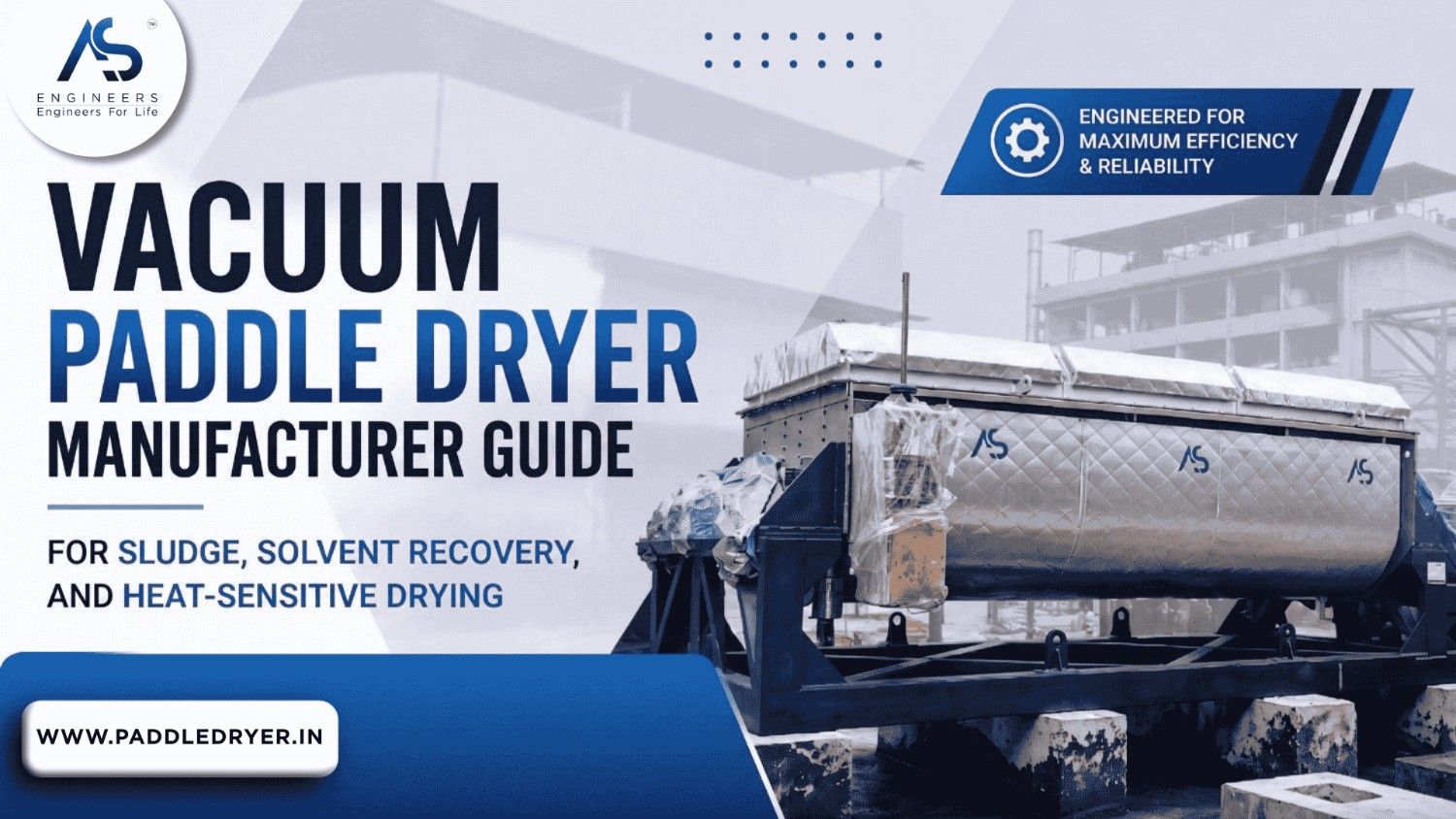
What Is a Vacuum Paddle Dryer?
A vacuum paddle dryer is an indirect thermal drying machine used when the material needs controlled drying under reduced pressure. It is commonly considered for sludge, chemicals, pharma intermediates, pigments, pastes, cakes, powders, and solvent-bearing materials where open drying creates quality, emission, or handling problems.
Unlike direct dryers, the heat does not mainly come from hot air passing through the product. In a paddle dryer technology system, heat is transferred through hollow shafts, heated paddles, and the dryer jacket. Under vacuum, moisture or solvent can evaporate at lower operating conditions, which helps when the feed is heat-sensitive, sticky, odorous, or solvent-rich.
For buyers, the main decision is not only “Which dryer removes moisture?” The better question is: will the dryer control vapours, protect product quality, reduce disposal load, fit the plant layout, and support safe operation?
How Does a Vacuum Paddle Dryer Work?
A vacuum paddle dryer works by combining indirect heat transfer, mechanical agitation, enclosed vapour handling, and controlled pressure. The feed enters the dryer chamber, the jacket and hollow shafts transfer heat, and rotating paddles continuously mix, expose, and move the material toward discharge.
According to AS Engineers, paddle dryers can operate under atmospheric, vacuum, or pressurized conditions. Their paddle dryer mechanism uses dual counter-rotating shafts, wedge-shaped paddles, self-cleaning intermeshing action, and plug-flow movement to support uniform drying. For related equipment structure, see hollow paddle dryers.
In vacuum duty, the vapour outlet becomes critical. The system may need condenser, solvent tank, ID blower, scrubber, cyclone, bag filter, or chimney based on whether the evaporated liquid is water, solvent, or mixed vapour. A good vacuum paddle dryer manufacturer will not quote only the dryer shell. They will study the complete drying train.
Where Does a Vacuum Paddle Dryer Create Buyer Value?
A vacuum paddle dryer creates the most value where drying must be enclosed, controlled, and consistent. It is not the right answer for every wet material, but it becomes a strong option when emission control, solvent recovery, odour reduction, product quality, or compact layout matters.
In sludge and ETP applications, wet sludge increases transport, storage, labour, hygiene, and disposal cost. AS Engineers’ source data shows a sludge example where 10 tons/day wet sludge becomes 2 tons/day dry sludge, reducing disposal load sharply when drying is suitable. For broader sludge strategy, review sludge dewatering and drying and ETP sludge management.
In chemical and pharma applications, the enclosed design helps when solvent vapours need recovery or controlled discharge. In pigments, dyes, catalysts, and intermediates, agitation and indirect heating help reduce uneven drying. In waste-to-value cases, dried sludge may be easier to handle for fuel, cement, brick, or fertilizer routes, depending on composition and regulatory acceptance.
Vacuum Paddle Dryer Manufacturer Selection Table
The right vacuum paddle dryer manufacturer should evaluate feed behaviour, vapour handling, heat source, metallurgy, discharge condition, and service support before finalizing design. A low-quality quotation may look attractive at first, but it can fail during sticky feed handling, condenser load, shaft wear, or moisture control.
| Buyer Decision Point | Why It Matters in Vacuum Drying | Risk if Ignored | What to Ask the Manufacturer |
|---|---|---|---|
| Feed form | Slurry, paste, cake, powder, or granule behaves differently | Poor movement, build-up, uneven drying | Has this feed type been tested? |
| Vapour type | Water vapour and solvent vapour need different handling | Emission, odour, recovery loss, safety risk | Is condenser, scrubber, or solvent tank needed? |
| Heat source | Steam, thermic fluid, hot water, or other utilities affect drying rate | Wrong utility load and high running cost | Which heat source matches my plant? |
| Moisture target | Final dryness may be product-specific | Over-drying, under-drying, disposal rejection | What outlet moisture is realistic after testing? |
| Material of construction | Corrosive or abrasive feed needs correct metallurgy | Short life, leakage, contamination | CS, SS304, SS316, Duplex, or alloy? |
| Maintenance access | Vacuum systems need reliable sealing and inspection | Downtime and difficult cleaning | What are access, spare, and AMC options? |
| Pilot validation | Lab assumptions may fail with sticky industrial feed | Wrong dryer size or poor discharge | Can we run a pilot trial before order? |
What Should You Check Before Sending an RFQ?
Before sending an RFQ, collect feed, utility, vapour, discharge, and site data. A serious manufacturer can size and configure a vacuum paddle dryer only when the process conditions are clear enough.
Prepare feed moisture, desired final moisture, bulk density, temperature sensitivity, solvent details, corrosiveness, abrasiveness, hourly feed rate, and operating hours. Also share available utilities such as steam pressure, thermic fluid temperature, power limits, cooling water, nitrogen requirement if applicable, and pollution control expectations.
AS Engineers’ data mentions steam heating up to 14.06 kg/cm² and thermal oil operation up to 400°C, with material options such as CS, SS304, SS316, Duplex Steel, and other alloys. Buyers comparing paddle dryers vs belt dryers should also compare floor area, off-gas volume, vapour control, cleaning access, and wet feed behaviour, not only installed price.
Common Purchase Mistakes to Avoid
The biggest mistake is buying a vacuum paddle dryer as a standalone machine instead of a process system. Vacuum drying performance depends on feed preparation, heat transfer, vapour evacuation, condensation, discharge handling, and operator discipline.
Do not assume that one design fits every sludge or chemical paste. Some feeds pass through plastic, shearing, and granular phases during drying, and sticky intermediate phases can decide whether the dryer runs smoothly or struggles. For sludge-specific handling, paddle sludge dryer selection should include disposal route and dried material handling.
Another mistake is ignoring service support. Shafts, bearings, gearbox, paddles, seals, and internals must be maintainable. AS Engineers offers OEM spare parts, shaft and gearbox replacement, system upgrades, retrofitment, on-site alignment, on-site balancing, operator training, AMC, and paddle dryer services.
Why AS Engineers Is a Vacuum Paddle Dryer Manufacturer for Practical Industrial Drying
AS Engineers manufactures paddle dryers from GIDC Vatva, Ahmedabad, Gujarat, India, and positions itself as “The Leading Name in Paddle Dryer Industry.” For vacuum applications, the important point is their practical dryer experience across sludge, chemicals, pigments, pharma, food, polymers, mining, paper, and waste management materials.
The company’s paddle dryer range includes standard dryer, dual zone dryer, and vacuum dryer variants. AS Engineers has 25+ years of experience, 500+ clients, 1500+ projects, 500+ dryers operational, ISO 9001:2015 TUV India certification, and CE certification. Buyers can review the dedicated vacuum paddle dryer by AS Engineers, the main paddle dryer, and their paddle dryer manufacturer in India resource for equipment context.
For uncertain materials, pilot validation is strongly recommended. AS Engineers offers a 50 kg/hr pilot trial machine at its facility or the client’s site, with trial cost waived upon order placement. The internal paddle dryer pilot trial page is useful before final RFQ submission.
FAQs
1. Is a vacuum paddle dryer suitable for all sludge types?
No. Suitability depends on sludge moisture, organic content, stickiness, abrasiveness, corrosiveness, disposal route, and required final dryness. ETP, STP, CETP, paper, bio-sludge, and industrial sludge should be tested or evaluated before final design.
2. Why choose a vacuum paddle dryer instead of a normal paddle dryer?
Choose vacuum when reduced-pressure drying helps with heat-sensitive feed, solvent recovery, odour control, enclosed vapour handling, or emission reduction. If the material only needs simple water removal and no special vapour control, atmospheric drying may be enough.
3. Can a vacuum paddle dryer recover solvent?
Yes, a fully enclosed paddle dryer system can be configured for solvent recovery with condenser and solvent tank when the process requires it. The final design depends on solvent type, vapour load, condensation temperature, safety requirements, and site utilities.
4. What details does a vacuum paddle dryer manufacturer need?
The manufacturer needs feed rate, initial moisture, final moisture target, feed form, solvent or water content, heat sensitivity, bulk density, operating hours, utility availability, metallurgy requirements, and pollution control expectations.
5. Should I run a pilot trial before buying?
Yes, especially for sticky sludge, solvent-bearing chemicals, pharma intermediates, pigments, and unknown waste streams. Pilot testing helps validate drying behaviour, outlet moisture, discharge quality, vapour handling, and equipment sizing before capital purchase.
A vacuum paddle dryer should be selected as a process decision, not only a machine purchase. Share your feed sample, moisture target, utility conditions, vapour details, and disposal or recovery goal with AS Engineers for technical review. To discuss a pilot trial or project-specific quotation, contact AS Engineers.

Karan Dargode leads operations and environmental health & safety at AS Engineers, an Ahmedabad-based manufacturer with over 25 years of experience in centrifugal blowers, industrial fans, paddle dryers, sludge dryers, and air pollution control equipment. He joined AS Engineers in July 2019 and has spent over six years building operational systems that support the company’s engineering and manufacturing work. His role spans business strategy execution, operational process design, EHS compliance, and policy development. Day to day, that means keeping manufacturing output consistent, ensuring workplace and environmental standards are met, and supporting the company’s growth across domestic and export markets. Education and Qualifications Karan holds a Bachelor of Engineering in Mechanical Engineering from Silver Oak College of Engineering and Technology, Ahmedabad, affiliated with Gujarat Technological University (GTU), completed in 2018. He later pursued a Post Graduate Diploma in Business Administration (PGDBA) with a focus on Operations Management from Symbiosis Centre for Distance Learning, Pune, strengthening his understanding of manufacturing strategy and industrial operations. What He Writes About The articles and posts on this site reflect what Karan works with directly. He covers: Paddle dryer selection, working principles, and industrial applications Sludge drying technology for ETP and CETP operators Centrifugal blower engineering and maintenance Industrial drying process optimization EHS compliance for industrial manufacturing units His writing is technical without being academic. The goal is straightforward: give plant engineers, ETP operators, and procurement managers the specific information they need to make good equipment decisions. At AS Engineers AS Engineers has manufactured industrial equipment since 1997, serving clients across chemicals, pharmaceuticals, food processing, wastewater treatment, and heavy industry. The Ahmedabad facility at GIDC Vatva handles design, fabrication, and testing in-house. Karan’s work at the operations level puts him directly involved with product delivery quality, production planning, and customer-facing timelines. If you have questions about any article on this site or want to discuss a specific application for blowers, dryers, or air pollution control equipment, you can reach the AS Engineers team through the contact page. Contact AS Engineers