
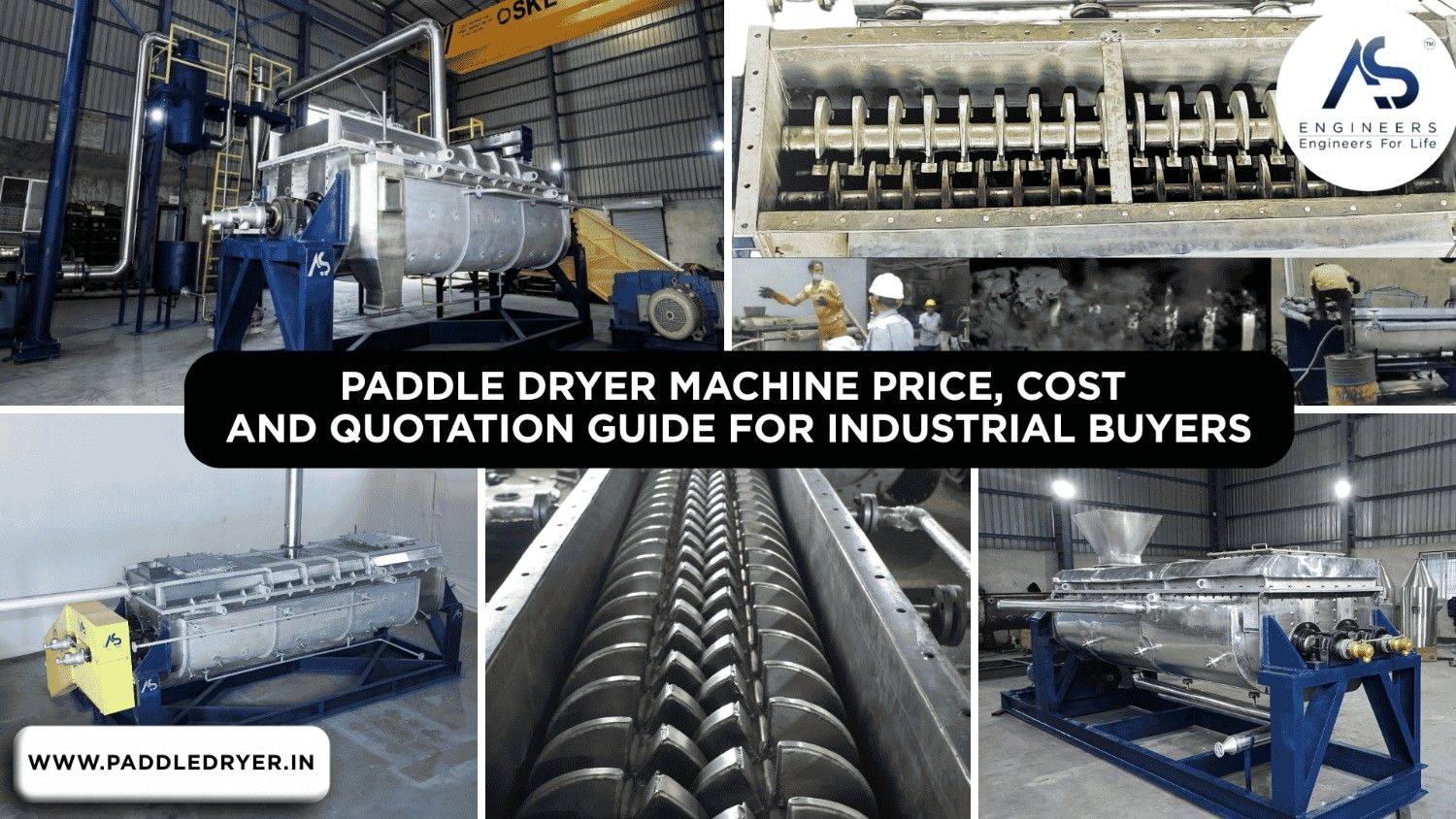
Paddle Dryer Machine: Direct Price Answer for Buyers
A paddle dryer machine is not priced like a standard catalogue item because it is usually engineered around feed moisture, material behavior, heating medium, metallurgy, automation, and outlet moisture target. If you are searching for paddle dryer price, paddle dryer cost, paddle dryer quotation, or paddle dryer for sale, the first rule is simple: ask for a process-based quote, not only a machine price.
A low initial price can become expensive if the dryer struggles with sticky sludge, solvent vapors, corrosion, poor discharge, or undersized pollution control. A correct quotation should include the dryer body, heating system interface, feeding arrangement, vapor handling, safety logic, discharge handling, and service scope.
For technical background on how this machine works, review sludge drying with paddle dryer technology before comparing commercial offers.
Why Does Paddle Dryer Price Vary So Much?
Paddle dryer price varies because the equipment is selected around process duty, not only size. Two dryers with similar length and diameter can have very different cost if one handles non-corrosive biomass and the other handles hazardous ETP sludge, solvent-bearing cake, or heat-sensitive chemical residue.
The biggest price drivers are feed condition, evaporation load, material of construction, heating medium, operating pressure, vapor treatment, discharge method, automation level, and site integration. A plant handling sticky sludge may need stronger agitation logic, better feeding control, and a more careful discharge design than a plant drying free-flowing granules.
AS Engineers’ paddle dryer design uses indirect heat through hollow shafts and jacketed surfaces, with dual counter-rotating shafts and wedge-shaped paddles for mixing and moisture removal. Buyers evaluating hollow paddle dryer thermal drying technology should pay attention to heat-transfer area, residence time, shaft design, and self-cleaning action.
Main Factors That Decide Paddle Dryer Cost
Paddle dryer cost should be evaluated as total system cost, not only equipment purchase cost. A complete drying installation may include feeding, heating, scavenging air, vapor management, cyclone, scrubber, bag filter, condenser, product handling, electrical panel, and site support.
Material of construction is a major cost factor. AS Engineers lists options such as Carbon Steel, SS304, SS316, Duplex Steel, and other alloys, depending on the feed chemistry and corrosion risk. For aggressive sludge, chemical cake, or solvent-bearing material, choosing a lower-grade metallurgy can reduce purchase price but increase maintenance and shutdown risk.
Heating medium also changes the cost. AS Engineers supports indirect steam heating up to 14.06 kg/cm² and thermal oil heating up to 400°C, depending on process requirements. Atmospheric, vacuum, and pressurized operation are also possible, but vacuum and pressure designs need more engineering control.
Buyer Decision Table: What Changes the Quotation?
A good quotation should show why the price is what it is. If a vendor gives a price without asking process questions, the risk is usually hidden in performance, utility use, discharge quality, or compliance scope.
| Quotation Factor | Why It Changes Cost | Buyer Risk If Ignored | What to Share Before Quote |
|---|---|---|---|
| Feed moisture and final moisture | Decides evaporation load and residence time | Undersized dryer or wet discharge | Initial moisture, target moisture, daily feed rate |
| Feed behavior | Sticky, pasty, granular, abrasive, or corrosive materials need different handling | Choking, buildup, shaft overload | Sample, photos, lab data, past handling issues |
| Material of construction | Corrosion and abrasion drive metallurgy choice | Premature wear or leakage | pH, chlorides, solvents, temperature sensitivity |
| Heating medium | Steam, thermic fluid, hot water, or other utilities affect design | Poor heat transfer or high utility cost | Available utilities, pressure, temperature, fuel economics |
| Vapor and odor control | Water vapor, solvent vapor, fines, and odor need different treatment | Non-compliance or unsafe operation | Solvent details, emission limits, site norms |
| Automation level | Controls feeding, temperature, torque, alarms, and safety | Operator dependency and unstable drying | Required panel logic, PLC, sensors, interlocks |
| Product discharge | Dry powder, granules, cake, or sludge residue need different discharge systems | Spillage, dust, manual handling | Desired packing, conveyor, silo, truck loading |
| Trial requirement | Testing reduces sizing and performance risk | Wrong selection on unknown material | Sample availability and pilot trial objective |
What Details Are Needed for a Correct Paddle Dryer Quotation?
A paddle dryer quotation should start with process data, not negotiation. The minimum data should include feed type, feed quantity, initial moisture, required final moisture, operating hours, bulk density, particle size, stickiness, temperature limits, corrosion data, available fuel, and emission handling needs.
For sludge applications, the quotation should also ask whether the sludge comes from ETP, STP, CETP, paper, textile, chemical, pharma, food, petroleum, or municipal treatment. A paddle sludge dryer for effective sludge treatment needs different design attention than a dryer used for crystals, powders, or granules.
AS Engineers also offers a 50 kg/hr pilot trial machine on a minimal paid basis, with the trial cost waived upon order placement. For unknown or high-risk materials, a paddle dryer pilot trial can help confirm feasibility, outlet moisture, handling behavior, and process optimization before full-scale purchase.
Is Paddle Dryer for Sale the Same as Ready-to-Use Equipment?
When buyers search for “paddle dryer for sale,” they often expect a ready machine. In industrial drying, this can be risky because the dryer must match the feed, utility, moisture target, safety requirements, and downstream handling system.
A used or generic dryer may look attractive on purchase price, but it may not match the required heat-transfer area, metallurgy, shaft torque, vapor load, or residence time. For sticky sludge or chemical waste, mismatch can lead to buildup, high maintenance, unstable outlet moisture, and higher disposal cost.
If the buyer needs short-term use, trial support, or temporary drying capacity, AS Engineers also has a paddle dryer rental service. For long-term plant operation, a custom-engineered industrial paddle dryer is usually the safer purchase path.
How Paddle Dryer Cost Connects to Disposal Savings
The lowest equipment price is not always the lowest operating cost. In sludge drying, the real financial question is whether the dryer reduces wet waste weight, transport cost, disposal cost, storage area, odor problems, and compliance pressure.
According to AS Engineers’ sludge drying data, a wet sludge stream of 10 tons per day can reduce to around 2 tons per day after drying in a specific disposal-cost example. The same source presents dry sludge as taking up 90% less space, depending on application and final dryness.
Fuel economics also matter. AS Engineers’ fuel benchmark states that, from 80% initial moisture to 20% final moisture, 1 kg wood dries 5 kg sludge, 1 kg coal dries 8.25 kg sludge, 1 Nm³ gas dries 22.5 kg sludge, and 1 kg LDO dries 21 kg sludge. These figures should be used for early evaluation, while final operating cost should be validated against local fuel price, plant hours, moisture load, and heat recovery scope.
For disposal-focused buyers, compare equipment price with the long-term impact explained in ETP sludge management and waste-to-resource planning.
What Should Buyers Compare Before Final Purchase?
A serious buyer should compare performance responsibility, not only offer value. The quotation should state feed basis, evaporation load, outlet moisture target, MOC, utility assumptions, vapor handling scope, automation, inspection, installation support, trial basis, and after-sales support.
Compare the paddle dryer against other drying options only after considering sludge behavior, space, operator requirement, odor, energy use, and discharge quality. A paddle dryer vs belt dryer comparison can help buyers understand when indirect thermal drying is more suitable than belt-based systems.
Also evaluate service continuity. AS Engineers provides paddle dryer services, OEM spare parts, shaft, gearbox, bearing replacement, retro-fitment support, on-site alignment, on-site balancing, training, AMC, and process optimization. This matters because industrial dryers are long-life assets, not one-time purchases.
AS Engineers as a Paddle Dryer Machine Manufacturer
AS Engineers manufactures paddle dryer systems from GIDC Vatva, Ahmedabad, Gujarat, India, and positions itself as “The Leading Name in Paddle Dryer Industry.” The company’s verified proof points include 25+ years of experience, ISO 9001:2015 TUV India certification, CE certification, 500+ clients, 1500+ projects, and 500+ operational dryers.
The paddle dryer can be used for drying, solvent stripping, heating, calcining, roasting, cooling, and other thermal processing duties. It is applied across sludge, chemicals, petrochemicals, mining, metals, agriculture, animal feed, plastics, polymers, paper, pulp, pigments, dyes, food, beverage, pharmaceuticals, healthcare, petroleum, and waste management applications.
For plants managing dewatering and drying together, review sludge dewatering and drying system planning before requesting a commercial offer. The better the process data, the more accurate the quotation.
FAQs
1. What is the average paddle dryer machine price?
There is no reliable average paddle dryer machine price without process data. Price depends on capacity, feed moisture, final moisture, metallurgy, heating medium, pressure condition, automation, vapor handling, and auxiliary systems. A valid quotation should be built from the buyer’s material and site requirements.
2. Why is paddle dryer cost different from vendor to vendor?
Paddle dryer cost differs because each vendor may include a different scope. One offer may include only the dryer body, while another may include feeding, heating interface, vapor handling, pollution control, automation, discharge, testing, service, and spares. Always compare scope line by line.
3. Can I buy a paddle dryer for sale without a material trial?
You can, but it is not ideal for unknown, sticky, corrosive, solvent-bearing, or high-moisture materials. A pilot trial helps verify material behavior, outlet moisture, handling, and process feasibility. For critical applications, trial data is safer than assumption-based sizing.
4. What should I send to get a paddle dryer quotation?
Send feed type, feed rate, initial moisture, target final moisture, operating hours, bulk density, temperature limit, pH or corrosion data, available utilities, fuel type, required MOC, emission handling needs, site layout, and discharge requirement. Material samples and photos make the quotation more reliable.
5. Does lower paddle dryer price mean better value?
Not necessarily. A lower price may exclude essential systems or use unsuitable metallurgy, undersized heat-transfer area, weak automation, or incomplete vapor handling. Better value comes from reliable drying performance, lower downtime, lower disposal cost, safer operation, and long-term support.
A paddle dryer machine should be purchased after process review, not only price comparison. For sludge, chemical cake, food residue, pharma waste, mineral slurry, or industrial wet material, share your feed data, moisture target, utility details, and handling challenge with AS Engineers for a practical quote. To discuss the right scope, service support, or commercial next step, contact AS Engineers for a paddle dryer quotation.

Karan Dargode leads operations and environmental health & safety at AS Engineers, an Ahmedabad-based manufacturer with over 25 years of experience in centrifugal blowers, industrial fans, paddle dryers, sludge dryers, and air pollution control equipment. He joined AS Engineers in July 2019 and has spent over six years building operational systems that support the company’s engineering and manufacturing work. His role spans business strategy execution, operational process design, EHS compliance, and policy development. Day to day, that means keeping manufacturing output consistent, ensuring workplace and environmental standards are met, and supporting the company’s growth across domestic and export markets. Education and Qualifications Karan holds a Bachelor of Engineering in Mechanical Engineering from Silver Oak College of Engineering and Technology, Ahmedabad, affiliated with Gujarat Technological University (GTU), completed in 2018. He later pursued a Post Graduate Diploma in Business Administration (PGDBA) with a focus on Operations Management from Symbiosis Centre for Distance Learning, Pune, strengthening his understanding of manufacturing strategy and industrial operations. What He Writes About The articles and posts on this site reflect what Karan works with directly. He covers: Paddle dryer selection, working principles, and industrial applications Sludge drying technology for ETP and CETP operators Centrifugal blower engineering and maintenance Industrial drying process optimization EHS compliance for industrial manufacturing units His writing is technical without being academic. The goal is straightforward: give plant engineers, ETP operators, and procurement managers the specific information they need to make good equipment decisions. At AS Engineers AS Engineers has manufactured industrial equipment since 1997, serving clients across chemicals, pharmaceuticals, food processing, wastewater treatment, and heavy industry. The Ahmedabad facility at GIDC Vatva handles design, fabrication, and testing in-house. Karan’s work at the operations level puts him directly involved with product delivery quality, production planning, and customer-facing timelines. If you have questions about any article on this site or want to discuss a specific application for blowers, dryers, or air pollution control equipment, you can reach the AS Engineers team through the contact page. Contact AS Engineers