
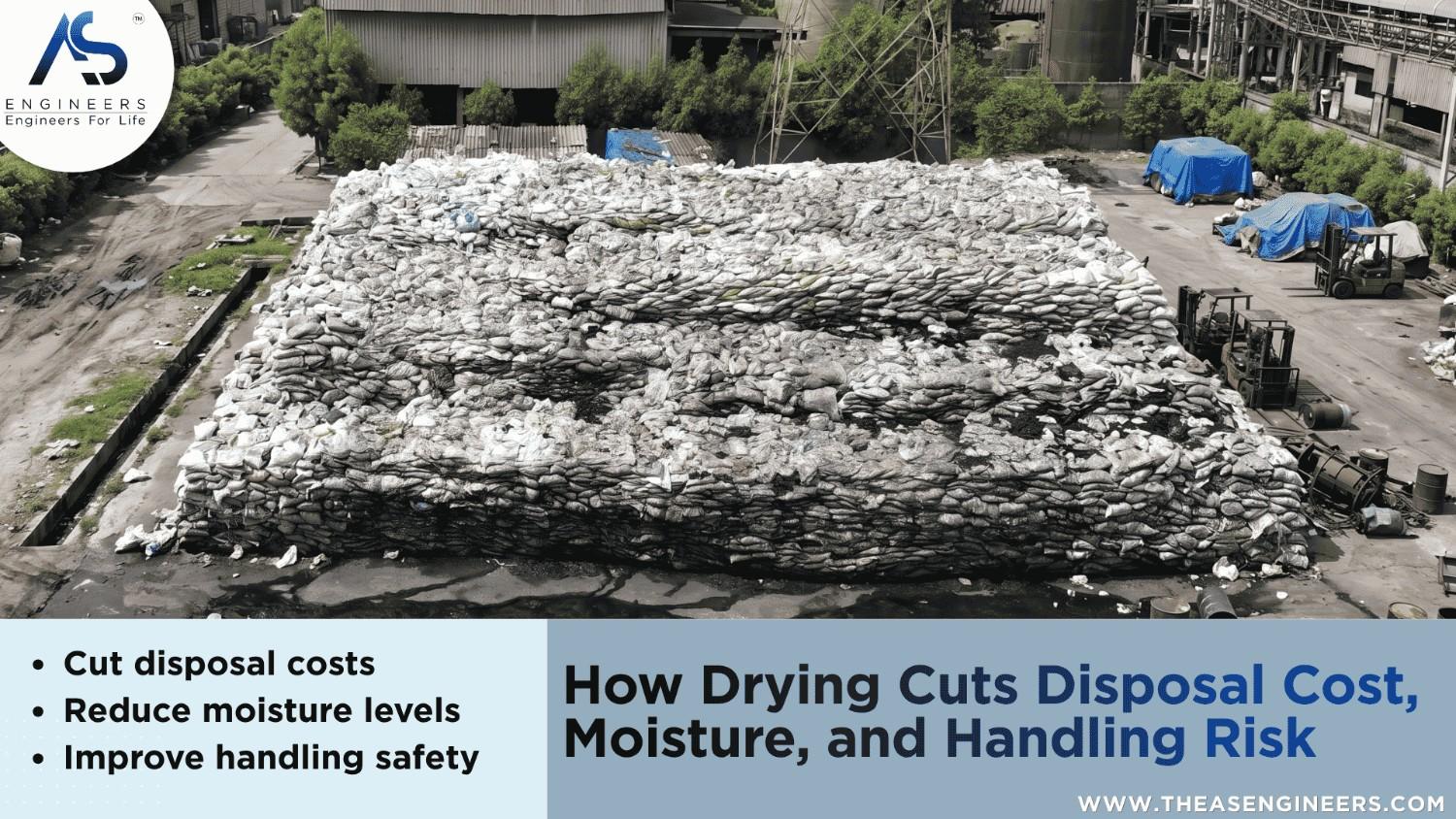
What Does Sludge Volume Reduction Actually Mean for a Plant?
Sludge volume reduction means reducing the mass, moisture, storage load, transport burden, and disposal quantity of sludge before it leaves the plant. For ETP, STP, CETP, paper, chemical, textile, pharma, food, and municipal operations, the main target is simple: remove moisture so the plant handles less waste.
Most disposal cost problems begin with water. Wet sludge may look like waste, but a large part of what the plant pays to store, load, transport, and dispose is moisture. A drying system changes that equation by converting wet, sticky sludge into a drier material that is easier to convey, store, bag, transport, or reuse.
For buyers comparing options, sludge drying technology should not be evaluated only as equipment purchase. It should be evaluated as a cost-control step between dewatering and final disposal.
Why Does Wet Sludge Create High Disposal Cost?
Wet sludge increases disposal cost because it carries extra water, needs more storage space, creates handling problems, and usually requires more transport trips. The buyer is not only paying for sludge, the buyer is often paying for water movement, odour control, labour, and poor hygiene around wet sludge handling.
The biggest hidden cost is logistics. A plant generating wet sludge every day needs collection space, loaders, labour, safety controls, vehicle movement, and disposal coordination. When sludge remains wet and sticky, manual intervention also increases because conveying, bagging, and truck loading become difficult.
AS Engineers’ approved disposal example shows the commercial impact clearly: before drying, 10 Ton/Day wet sludge can create ₹1,00,000/day disposal cost at ₹10,000/ton. After drying, the disposal quantity can reduce to 2 Ton/Day, bringing the disposal cost to ₹20,000/day on the same rate basis. That is a disposal-side saving potential of ₹80,000/day before considering reuse value.
How Does a Paddle Dryer Support Sludge Moisture Reduction?
A paddle dryer supports sludge moisture reduction through indirect heat transfer, continuous agitation, and controlled residence time. In AS Engineers’ paddle dryer design, hollow shafts and jacket surfaces transfer heat to the material while counter-rotating paddles mix, shear, and expose wet sludge to heated surfaces.
This matters because sludge is rarely a free-flowing material. It may be sticky, pasty, biological, chemical, oily, or fibrous. A dryer that cannot keep the material moving will suffer buildup, uneven drying, high operator attention, and poor discharge consistency.
A paddle sludge dryer is suited for sludge because it is enclosed, compact, and designed for wet and difficult materials. According to AS Engineers, the system can work with steam up to 14.06 kg/cm² or thermal oil up to 400°C, and it can achieve up to 99% dryness depending on application requirements and testing.
Which Cost Factors Control Sludge Drying Cost?
Sludge drying cost depends on feed moisture, target outlet moisture, daily sludge load, fuel type, heat-transfer efficiency, operating hours, utilities, handling system, and pollution-control requirements. A correct cost estimate cannot be made from sludge tonnage alone.
For sludge dryer operating cost, the buyer must define the moisture balance first. A sludge stream at 80% moisture behaves very differently from a filter cake at lower moisture. If the dryer is selected without real feed data, the plant may under-size the system, over-spend on utilities, or fail to reach the required dry sludge condition.
Per AS Engineers’ fuel benchmark for sludge drying from 80% initial moisture to 20% final moisture, 1 kg wood dries 5 kg sludge, 1 kg coal dries 8.25 kg sludge, 1 Nm³ gas dries 22.5 kg sludge, and 1 kg LDO dries 21 kg sludge. Buyers should use these as technical benchmarks, not as universal cost quotes, because local fuel price and sludge behaviour decide final operating cost.
What Should Buyers Check Before Selecting a Sludge Drying System?
Buyers should check feed consistency, moisture percentage, disposal route, final dryness target, material corrosiveness, fuel availability, automation needs, and dry sludge handling method. The best sludge drying system is not the one with the lowest quoted price, it is the one that reduces total cost without creating new operating problems.
A plant should also check what happens after drying. Will dried sludge go to bags, silo, truck disposal, cement use, fertilizer route, bricks, alternative fuel, or incineration? Each route needs a different discharge, cooling, dust-control, and material-handling plan.
This is why sludge dewatering and drying should be planned together. Dewatering reduces free water. Drying reduces bound and remaining moisture. Dry sludge handling completes the cost-saving chain.
| Buyer Decision Area | What Changes After Drying | Cost Impact | What to Verify Before Order |
|---|---|---|---|
| Disposal quantity | Wet sludge can reduce from 10 Ton/Day to 2 Ton/Day in AS Engineers’ approved example | High | Feed moisture, final moisture, daily load |
| Storage space | Dry sludge can need up to 90% less space | High | Site layout and storage days |
| Transport trips | Lower quantity means fewer truck movements | High | Disposal distance and truck capacity |
| Labour requirement | Dry material is easier to convey, bag, or load | Medium to High | Automation level and discharge method |
| Fuel use | Depends on moisture removal duty and fuel selection | Application-specific | Steam, thermal oil, gas, coal, wood, LDO, electricity |
| Reuse potential | Dried sludge may become fuel, cement input, fertilizer, or brick material depending on composition | Requires testing | Sludge analysis and local acceptance rules |
Where Does Dry Sludge Handling Fail in Real Plants?
Dry sludge handling fails when the dryer outlet is treated as an afterthought. Even if moisture reduction is successful, poor discharge design can create dust, bridging, bagging delays, operator exposure, spillage, and truck-loading problems.
Buyers should define the outlet system early. A screw conveyor, bagging system, silo, bucket elevator, or truck disposal system may be required depending on the dried material condition and disposal route. Pollution-control equipment such as cyclone, scrubber, or bag filter may also be needed when fines and vapours are part of the process.
If the plant compares technologies, paddle dryers vs belt dryers can be useful for understanding footprint, enclosure, handling, and off-gas differences. For buyers comparing solar, thermal, and mechanical drying routes, sludge drying methods also helps clarify selection trade-offs.
How Can Sludge Disposal Cost Reduction Become Waste-to-Value?
Sludge disposal cost reduction becomes stronger when dried sludge is accepted for reuse instead of only disposal. Depending on composition and local rules, dried sludge may be used as alternative fuel, cement input, fertilizer material, brick input, or waste-to-energy feed.
This does not mean every sludge can be reused. Chemical composition, heavy metals, calorific value, biological safety, odour, ash, and regulatory acceptance must be checked. Industrial sludge from ETP plants needs more careful testing than many organic or biosolid streams.
For ETP buyers, ETP sludge management should start with lab analysis and disposal-route mapping. The dryer should then be selected around the realistic outlet use, not around a generic dryness number.
Why Should Pilot Testing Be Part of Operating Cost Validation?
Pilot testing reduces purchase risk because sludge behaviour is application-specific. It helps verify drying rate, outlet moisture, material flow, discharge quality, fuel estimate, odour tendency, buildup risk, and handling requirement before final engineering.
AS Engineers offers a 50 kg/hr pilot trial machine at its facility or at the client site, with the trial cost waived upon order placement. This is valuable for serious buyers because it changes the discussion from assumptions to tested performance.
For difficult materials, a paddle dryer pilot trial is often the safest way to validate sludge drying cost and dry sludge handling. It also helps the project team decide whether a standard dryer, dual zone dryer, or vacuum dryer is more suitable.
Why Work With AS Engineers for Sludge Volume Reduction Projects?
AS Engineers is based at GIDC Vatva, Ahmedabad, Gujarat, India, and manufactures industrial drying systems for sludge and process materials. The company has 25+ years of experience, ISO 9001:2015 TUV India certification, CE certification, 500+ clients, 1500+ projects, and 500+ dryers operational.
For sludge projects, the practical advantage is not only the dryer body. A reliable solution needs feeding, heating, scavenging, pollution control, solvent or vapour management, product handling, spare parts, service, and operator understanding. AS Engineers supports paddle dryer systems with OEM spare parts, shaft retrofitment, repair, AMC, on-site alignment, and process optimization.
Buyers can review AS Engineers’ industrial paddle dryer, sludge dryer manufacturer, and paddle dryers for sludge drying resources before shortlisting a system. For cost-focused buyers, the AS Engineers guide on efficient sludge disposal by drying is also directly relevant.
FAQs
1. How much can sludge volume reduce after drying?
Sludge volume reduction depends on initial moisture, final moisture, solids content, and sludge type. AS Engineers’ approved example shows 10 Ton/Day wet sludge reduced to 2 Ton/Day dry sludge, with disposal cost falling from ₹1,00,000/day to ₹20,000/day at the same disposal rate.
2. What controls sludge dryer operating cost the most?
Moisture removal duty controls sludge dryer operating cost more than any single factor. Fuel type, steam or thermal oil availability, drying temperature, feed consistency, operating hours, and final dryness target all affect cost.
3. Is dry sludge easier to handle than wet sludge?
Yes, dry sludge is usually easier to convey, store, bag, and transport than wet sludge. It also reduces hygiene problems, floor spillage, odour issues, and manual handling compared with sticky wet sludge.
4. Can dried sludge be reused instead of disposed?
Dried sludge may be reused as alternative fuel, cement input, fertilizer material, brick input, or waste-to-energy feed, but only after testing. Composition, contamination, local regulations, and end-user acceptance decide whether reuse is practical.
5. Should a plant do pilot testing before buying a sludge dryer?
Pilot testing is strongly recommended when sludge is sticky, variable, toxic, oily, biological, or difficult to convey. It helps confirm moisture reduction, drying cost, discharge behaviour, and handling design before final investment.
If your plant is paying high disposal cost for wet sludge, start with moisture data, daily sludge load, current disposal rate, fuel availability, and desired dry sludge route. AS Engineers can review these inputs and guide the correct paddle dryer configuration, pilot trial path, and handling system. To discuss a sludge volume reduction project, contact AS Engineers.

Karan Dargode leads operations and environmental health & safety at AS Engineers, an Ahmedabad-based manufacturer with over 25 years of experience in centrifugal blowers, industrial fans, paddle dryers, sludge dryers, and air pollution control equipment. He joined AS Engineers in July 2019 and has spent over six years building operational systems that support the company’s engineering and manufacturing work. His role spans business strategy execution, operational process design, EHS compliance, and policy development. Day to day, that means keeping manufacturing output consistent, ensuring workplace and environmental standards are met, and supporting the company’s growth across domestic and export markets. Education and Qualifications Karan holds a Bachelor of Engineering in Mechanical Engineering from Silver Oak College of Engineering and Technology, Ahmedabad, affiliated with Gujarat Technological University (GTU), completed in 2018. He later pursued a Post Graduate Diploma in Business Administration (PGDBA) with a focus on Operations Management from Symbiosis Centre for Distance Learning, Pune, strengthening his understanding of manufacturing strategy and industrial operations. What He Writes About The articles and posts on this site reflect what Karan works with directly. He covers: Paddle dryer selection, working principles, and industrial applications Sludge drying technology for ETP and CETP operators Centrifugal blower engineering and maintenance Industrial drying process optimization EHS compliance for industrial manufacturing units His writing is technical without being academic. The goal is straightforward: give plant engineers, ETP operators, and procurement managers the specific information they need to make good equipment decisions. At AS Engineers AS Engineers has manufactured industrial equipment since 1997, serving clients across chemicals, pharmaceuticals, food processing, wastewater treatment, and heavy industry. The Ahmedabad facility at GIDC Vatva handles design, fabrication, and testing in-house. Karan’s work at the operations level puts him directly involved with product delivery quality, production planning, and customer-facing timelines. If you have questions about any article on this site or want to discuss a specific application for blowers, dryers, or air pollution control equipment, you can reach the AS Engineers team through the contact page. Contact AS Engineers