
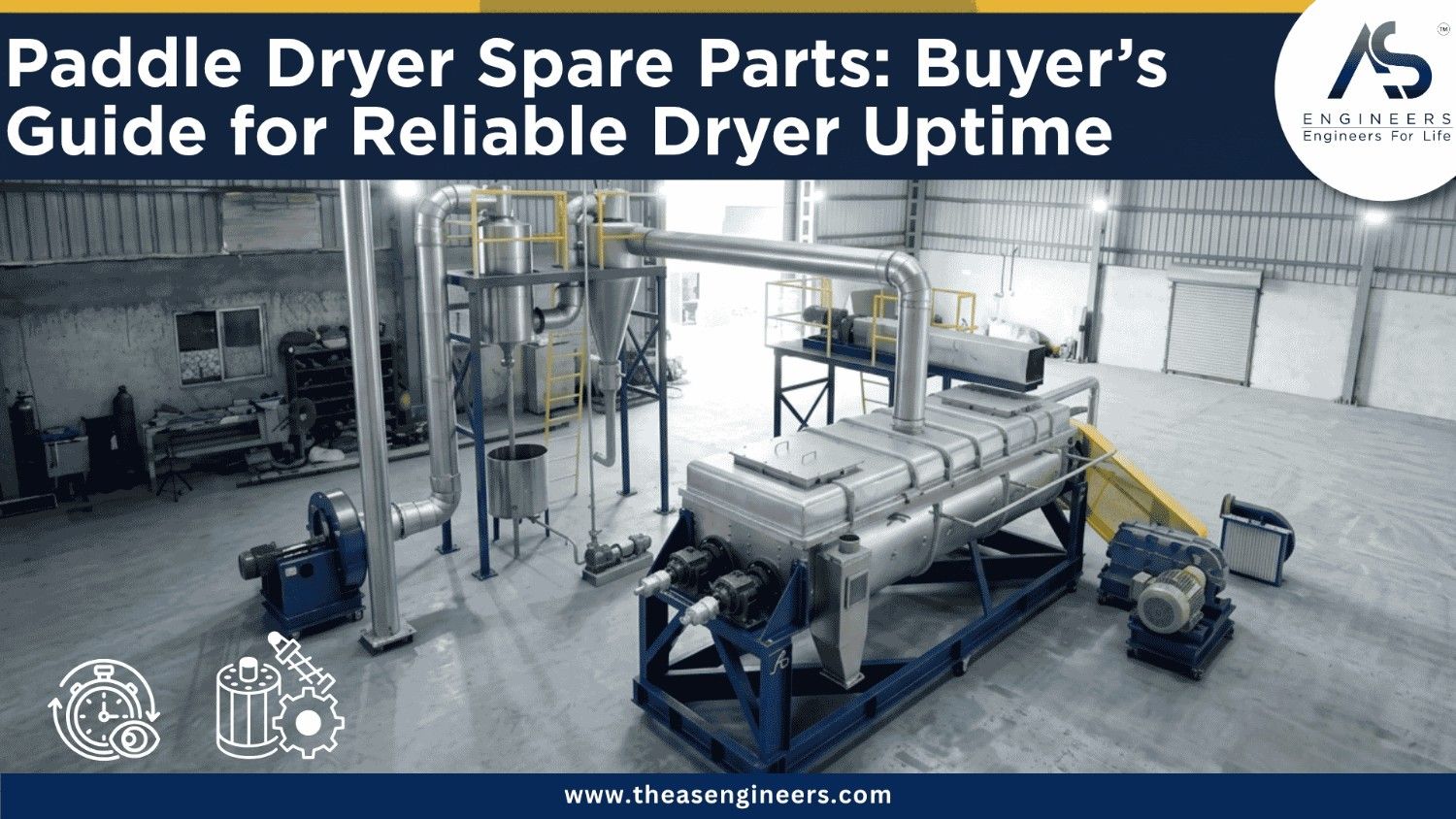
Why Paddle Dryer Spare Parts Decide Your Dryer Uptime
Paddle dryer spare parts are not just replacement items. They protect drying consistency, shaft reliability, heat transfer, material movement, and planned production schedules. For ETP, STP, CETP, chemical, food, pharma, pigment, and sludge processing plants, the right spare part strategy can be the difference between a planned shutdown and a costly emergency stoppage.
A Paddle Dryer works through indirect heat transfer from hollow shafts and jacket surfaces while paddles mix, shear, and move wet material through the dryer. Because the system handles sticky sludge, cakes, pastes, granules, and powders, its spare parts must match the original design, material of construction, process temperature, and feed behavior.
AS Engineers provides OEM spare parts, repair services, shaft, gearbox, and bearing replacement, shaft retrofitment support, on-site alignment, on-site balancing, AMC, operator training, and process optimization support. That matters because spare parts should not be selected only by dimension. They should be selected by duty, load, temperature, moisture, abrasiveness, corrosion risk, and operating history.
Which Paddle Dryer Spare Parts Need the Most Attention?
The highest-priority parts are the components that affect rotation, heat transfer, sealing, alignment, and material movement. In a paddle dryer, these areas typically decide whether the machine dries uniformly or starts showing vibration, uneven discharge, poor moisture control, or mechanical stress.
Start with the shaft system. Hollow shafts and wedge-shaped paddles are central to the drying process because they transfer heat and continuously disturb wet material. If the shafts, paddles, or alignment are compromised, the dryer may still run, but drying quality can drop and power load can increase.
The next critical area is the drive and support system. Bearings, gearbox, couplings, and related drive-side parts need regular condition checks. A small bearing issue ignored during operation can become shaft misalignment, gearbox stress, or unplanned shutdown.
Plants should also inspect the feed and discharge interface. Uneven feeding, wet sludge surges, and dried product build-up can create stress on connected equipment such as screw feeders, sludge pumps, conveyors, rotary discharge points, and bagging systems. For sludge applications, review related guides such as sludge dewatering and drying before finalizing spare parts inventory.
OEM vs Local Parts: What Should a Buyer Choose?
OEM paddle dryer spare parts are safer when the component affects alignment, shaft life, heat transfer, gearbox loading, or dryer safety. Local fabrication may look economical at purchase, but wrong fitment, poor metallurgy, and incorrect tolerances can damage larger assemblies.
This is especially important in hollow paddle dryers where shafts, paddles, and the jacketed body work as an integrated thermal and mechanical system. A part may fit physically but still fail under heat, torque, corrosion, or sticky-feed loading. For process-critical dryers, spare part sourcing should protect the equipment, not only reduce the purchase bill.
Use OEM support when replacing bearings, gearbox parts, shaft-related components, paddles, sealing interfaces, and customized assemblies. Use site-level fabrication only for non-critical supports or accessories after engineering review.
AS Engineers’ OEM paddle dryer spare parts support is relevant for plants that want replacement parts aligned with original machine design, duty, and repair history. For major work, combine spare parts with paddle dryer services so replacement, alignment, and commissioning are handled together.
Buyer Decision Table for Paddle Dryer Spare Parts Planning
This table helps maintenance and procurement teams decide which parts should be stocked, inspected, or ordered after technical evaluation. The correct answer depends on application, moisture load, operating hours, temperature, and feed behavior.
| Dryer Area | Failure Signal | Downtime Risk | Spare Strategy | Buyer Action |
|---|---|---|---|---|
| Hollow shaft and paddle zone | Poor mixing, uneven dryness, abnormal load | High | Engineering review required | Inspect during shutdown before ordering |
| Bearings and supports | Noise, heat, vibration, shaft movement | High | Keep planned replacement path | Check alignment and lubrication history |
| Gearbox and drive | Jerky motion, overload, leakage, noise | High | OEM-compatible replacement | Review torque and operating load |
| Feed system interface | Surging, choking, inconsistent feed | Medium to High | Application-specific | Match spare parts to sludge behavior |
| Discharge and handling area | Build-up, poor flow, dust/fines issue | Medium | Depends on dried product | Review outlet moisture and product form |
| Pollution-control connection | Carryover, fines, vapor handling issue | Medium | System-level review | Check cyclone, scrubber, bag filter needs |
| Covers, access, sealing points | Leakage, odor, heat loss | Medium | Replace during shutdown | Inspect before moisture target changes |
How Do Spare Parts Affect Sludge Dryer Performance?
Spare parts affect dryer performance because mechanical condition directly changes heat transfer, residence time, mixing quality, and moisture removal. A dryer with worn, misaligned, or poorly fitted components may consume more energy and still miss the desired outlet moisture.
For sludge plants, this becomes a disposal-cost issue. Wet sludge is heavy, difficult to handle, and expensive to transport. When a dryer is maintained properly, it supports better sludge volume reduction and cleaner dry sludge handling. AS Engineers’ process data shows the business logic clearly: drying can reduce wet sludge burden significantly, and dried sludge may become easier to store, transport, or reuse depending on composition and compliance requirements.
For process context, review paddle sludge dryer applications and the broader sludge drying guide. These pages help connect spare parts planning with moisture reduction, handling, and disposal strategy.
When Should You Replace Instead of Repair?
Replace a paddle dryer part when repair cannot restore geometry, alignment, strength, or process reliability. Repair is useful for controlled restoration, but it should not hide recurring problems caused by wrong feed, overload, corrosion, poor alignment, or missing preventive maintenance.
If a shaft-related problem repeats, do not treat it as a simple part purchase. Investigate feed consistency, torque load, bearing condition, gearbox health, and operating discipline. AS Engineers has documented shaft retrofitment support, which is important when the issue is not only wear but also duty mismatch or mechanical adaptation.
For older dryers, a combined repair and retrofitment route may be better than buying isolated parts. This is where engineering review becomes valuable. A spare part order should answer one question: will this restore stable operation, or only restart the same failure cycle?
What Should Be Included in a Paddle Dryer Maintenance Spares List?
A practical spare list should cover critical rotating parts, drive-side parts, support parts, sealing areas, and connected handling systems. The list must be customized to application because a textile sludge dryer, chemical sludge dryer, food-grade dryer, and pigment dryer do not face the same wear and corrosion conditions.
For hollow paddle dryer applications, maintenance teams should keep special attention on shaft condition, paddle integrity, bearing health, gearbox performance, and heat-transfer surfaces. The hollow paddle dryer technology page is useful for understanding why these components are central to dryer operation.
Plants comparing dryer types should also study paddle dryers vs belt dryers because spare parts planning changes with the equipment design. Paddle dryers usually need careful attention to the rotating heated shaft system, while belt-based systems have different mechanical and belt-tracking concerns.
How AS Engineers Supports Paddle Dryer Spare Parts Buyers
AS Engineers manufactures and supports industrial paddle dryers from GIDC Vatva, Ahmedabad, Gujarat, India. The company’s verified credibility includes ISO 9001:2015 TUV India certification, CE certification, 25+ years of experience, 500+ clients, 1500+ projects, and 500+ dryers operational.
For buyers, the main advantage is not only access to parts. It is access to people who understand the dryer as a complete process system: feeding, drying, scavenging, pollution control, solvent management, and product handling. Spare parts selected in isolation may restart the machine. Spare parts selected with process review can improve reliability.
AS Engineers is also backed by Acmefil Engineering Systems, established in 1992, which strengthens engineering depth for industrial drying and related systems. Buyers evaluating long-term support can review the AS Engineers paddle dryer and Acmefil engineering background before planning spare parts, AMC, or retrofitment.
For plants unsure whether a new operating condition will affect parts life, AS Engineers also offers a Paddle Dryer Pilot Trial program. Pilot testing can help evaluate process behavior before committing to operating changes, feed changes, or larger drying decisions.
FAQs
1. What are paddle dryer spare parts?
Paddle dryer spare parts are replacement components used to maintain the dryer’s rotating, heating, sealing, feeding, and support systems. They may include shaft-related components, bearings, gearbox parts, drive-side parts, and application-specific assemblies.
2. Are OEM paddle dryer spare parts better than local parts?
OEM parts are usually safer for critical areas such as shafts, paddles, bearings, gearbox, alignment-sensitive parts, and customized assemblies. Local parts may reduce initial cost, but wrong fitment or material mismatch can create higher downtime risk.
3. How often should paddle dryer parts be inspected?
Inspection frequency depends on operating hours, material abrasiveness, moisture load, temperature, and maintenance discipline. High-load sludge and chemical applications should follow a planned inspection schedule instead of waiting for vibration, noise, or drying failure.
4. Can old paddle dryers be repaired instead of replaced?
Yes, many old paddle dryers can be repaired, upgraded, or retrofitted if the core structure is suitable. The right decision requires checking shaft condition, gearbox health, bearing alignment, heat-transfer surfaces, and actual process duty.
5. Does AS Engineers provide paddle dryer spare parts and service?
Yes. AS Engineers provides OEM spare parts, repair services, shaft, gearbox, and bearing replacement, shaft retrofitment support, on-site alignment, on-site balancing, AMC, training, and process optimization support.
Closing
If your dryer is showing vibration, uneven discharge, bearing heat, gearbox noise, poor outlet moisture, or repeated shutdowns, do not order spare parts blindly. Share the dryer duty, material behavior, operating symptoms, and available maintenance history with the AS Engineers team so the right part, repair, or retrofitment path can be selected. For spare parts, service, AMC, or technical inspection, contact AS Engineers.

Karan Dargode leads operations and environmental health & safety at AS Engineers, an Ahmedabad-based manufacturer with over 25 years of experience in centrifugal blowers, industrial fans, paddle dryers, sludge dryers, and air pollution control equipment. He joined AS Engineers in July 2019 and has spent over six years building operational systems that support the company’s engineering and manufacturing work. His role spans business strategy execution, operational process design, EHS compliance, and policy development. Day to day, that means keeping manufacturing output consistent, ensuring workplace and environmental standards are met, and supporting the company’s growth across domestic and export markets. Education and Qualifications Karan holds a Bachelor of Engineering in Mechanical Engineering from Silver Oak College of Engineering and Technology, Ahmedabad, affiliated with Gujarat Technological University (GTU), completed in 2018. He later pursued a Post Graduate Diploma in Business Administration (PGDBA) with a focus on Operations Management from Symbiosis Centre for Distance Learning, Pune, strengthening his understanding of manufacturing strategy and industrial operations. What He Writes About The articles and posts on this site reflect what Karan works with directly. He covers: Paddle dryer selection, working principles, and industrial applications Sludge drying technology for ETP and CETP operators Centrifugal blower engineering and maintenance Industrial drying process optimization EHS compliance for industrial manufacturing units His writing is technical without being academic. The goal is straightforward: give plant engineers, ETP operators, and procurement managers the specific information they need to make good equipment decisions. At AS Engineers AS Engineers has manufactured industrial equipment since 1997, serving clients across chemicals, pharmaceuticals, food processing, wastewater treatment, and heavy industry. The Ahmedabad facility at GIDC Vatva handles design, fabrication, and testing in-house. Karan’s work at the operations level puts him directly involved with product delivery quality, production planning, and customer-facing timelines. If you have questions about any article on this site or want to discuss a specific application for blowers, dryers, or air pollution control equipment, you can reach the AS Engineers team through the contact page. Contact AS Engineers