
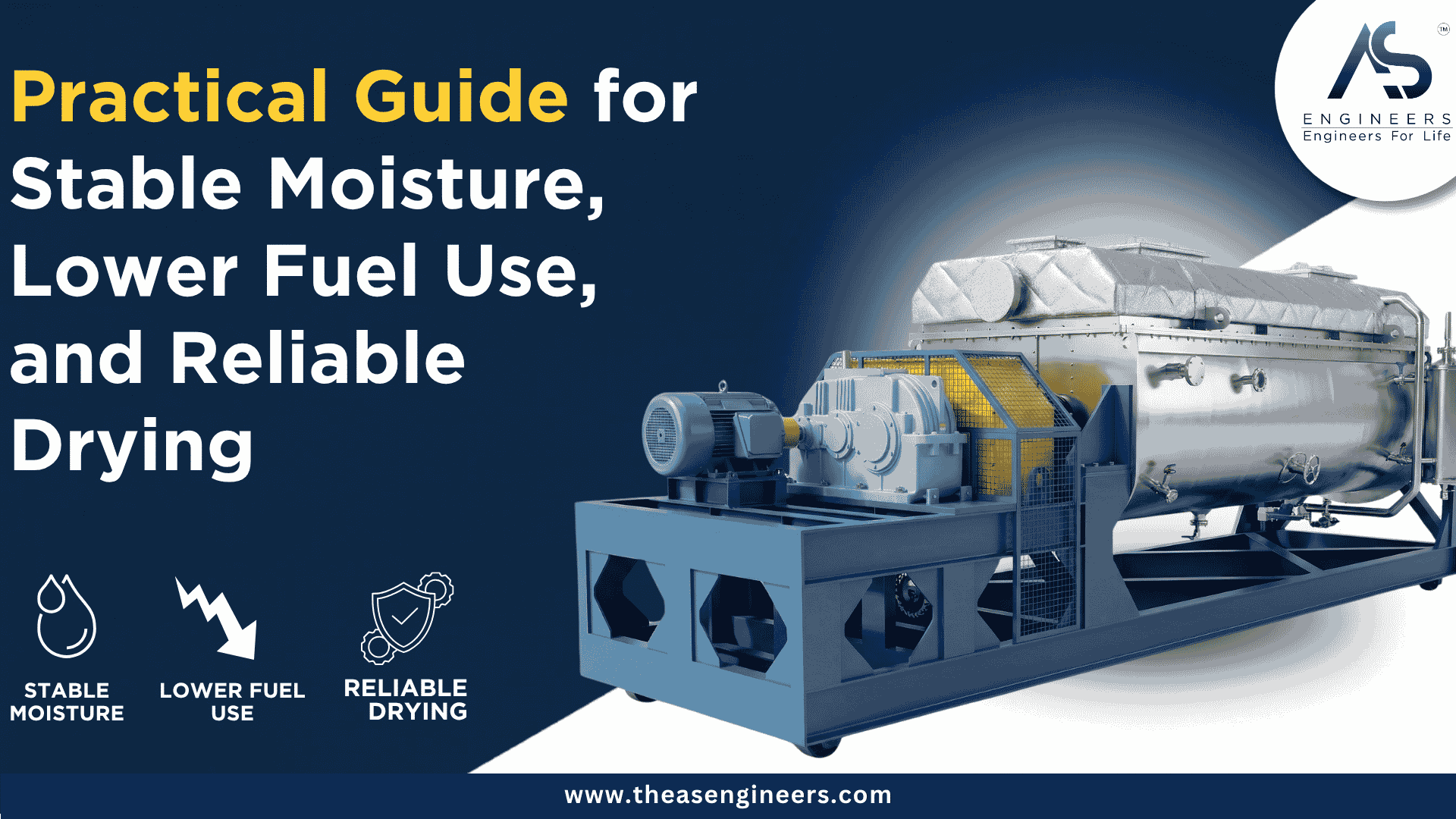
What Does Paddle Dryer Process Optimization Really Mean?
Paddle dryer process optimization means controlling feed consistency, heat transfer, residence time, vapor removal, discharge behavior, and maintenance so the dryer reaches the required outlet moisture without wasting fuel or causing unstable operation. In practical terms, optimization is not one adjustment. It is a disciplined operating method that connects the wet feed system, heating system, dryer internals, pollution control, and product handling.
For buyers comparing a paddle dryer, the real question is not only “Can this dryer remove moisture?” The better question is “Can this system remove moisture every day, with changing feed quality, safe vapor handling, predictable fuel use, and manageable maintenance?”
A paddle dryer is an indirect heat dryer. Heat is transferred through hollow shafts, hollow paddles, and the jacket, while the material is mixed and moved through the dryer. According to AS Engineers, its paddle dryer design can handle slurries, pastes, cakes, granules, and powders, with atmospheric, vacuum, or pressurized operation depending on the application. That flexibility is useful only when the process is tuned properly.
Why Does Optimization Start Before the Feed Enters the Dryer?
A paddle dryer cannot perform consistently if the feed entering it changes heavily every hour. Feed moisture, lump size, stickiness, pumpability, and upstream dewatering quality decide how stable the drying process will be. Many drying problems blamed on the dryer actually begin at the wet feed stage.
The first optimization point is upstream dewatering. If sludge or wet cake comes from a filter press, centrifuge, belt press, or screw press with unstable solids content, the dryer will see changing evaporation load. That leads to moisture fluctuation at discharge, torque variation, and sometimes choking near feed or discharge zones.
For sludge applications, the connection between sludge dewatering and drying is critical. Dewatering reduces free water mechanically. Drying removes remaining moisture thermally. When both are aligned, the dryer does not need to compensate for poor upstream consistency.
A practical plant should check wet feed storage, silo discharge, screw feeder speed, sludge pump selection, bridging tendency, and whether feed is arriving in batches or as a steady flow. Stable feeding gives the dryer enough time to build a predictable thermal profile.
How Should Heat Transfer Be Optimized in a Paddle Dryer?
Heat transfer optimization means matching the heating medium, surface temperature, feed rate, and material behavior instead of simply increasing heat. More heat does not always mean better drying. It can cause sticking, product degradation, vapor surges, or uneven discharge moisture.
AS Engineers’ paddle dryer supports indirect steam heating up to 14.06 kg/cm² and thermal oil heating up to 400°C, depending on the selected design and process requirement. The heating medium should be selected based on target moisture, material sensitivity, operating temperature, utility availability, and plant safety practices. For deeper selection context, buyers can review AS Engineers’ guide on paddle dryer heating medium and fuel options.
Heat transfer depends on clean contact between material and heated surfaces. The dual counter-rotating shafts, wedge-type paddles, and jacket work together to mix, shear, and expose wet material to heated surfaces. If feed is too sticky, too wet, or poorly distributed, the effective heat transfer area reduces even if the heating medium is adequate.
A good optimization approach is to track inlet moisture, feed rate, heating medium temperature or pressure, exhaust vapor condition, torque, discharge moisture, and product form. When these are monitored together, the operator can understand whether the issue is heat input, residence time, vapor removal, or feed quality.
Which Operating Variables Matter Most During Paddle Dryer Process Optimization?
The most important variables are feed rate, inlet moisture, heating medium condition, residence time, shaft load, vapor removal, discharge moisture, and product handling behavior. These variables should not be adjusted randomly. Each change should be made with a clear purpose and checked against product moisture, energy use, and mechanical load.
| Optimization Area | What to Check | Risk if Ignored | Practical Control Action |
|---|---|---|---|
| Feed consistency | Moisture, lump size, flow behavior | Moisture swings and torque variation | Stabilize silo, feeder, or pump operation |
| Heat input | Steam pressure or thermal oil temperature | Underdrying or product overheating | Match heat to material and moisture target |
| Residence time | Feed rate and dryer fill behavior | Wet discharge or excess energy use | Adjust feed rate and discharge control |
| Mixing and shearing | Shaft load, paddle condition, buildup | Poor heat contact | Inspect paddles and clean contact surfaces |
| Vapor removal | ID fan, ducting, condensation risk | Back pressure, odor, wet fines carryover | Balance vapor flow and treatment system |
| Scavenging | Fresh air, heated air, heat tracing | Condensation inside cover | Tune airflow and cover heating method |
| Product discharge | Granular, powdery, sticky, or lumpy output | Blockage and bagging difficulty | Select correct conveyor, silo, or bagging route |
| Maintenance | Bearings, gearbox, seals, alignment | Efficiency loss and downtime | Use planned service and OEM spare parts |
This matrix gives buyers a useful way to separate symptoms from causes. For example, wet discharge may not mean “more heat required.” It may mean high feed rate, unstable inlet moisture, poor vapor removal, or reduced contact because of buildup.
How Can Moisture Control Be Improved Without Overdrying?
Moisture control improves when the dryer is operated to a defined outlet target rather than a vague “dry enough” condition. Overdrying wastes energy and can create dust, handling issues, or product quality problems. Underdrying increases disposal weight, odor risk, and storage difficulty.
AS Engineers states that its paddle dryer can achieve up to 99% dryness or specific outlet moisture, depending on the application. In sludge applications, the right final moisture depends on the disposal route, reuse plan, handling method, and local compliance requirement. A buyer planning fuel use, cement co-processing, fertilizer use, brick production, or disposal should define the target before finalizing the system.
The material inside a paddle dryer often moves through changing physical phases, from plastic or sticky behavior toward shearing and then granular discharge. This transition should be watched carefully during commissioning. A good sludge drying guide helps teams understand why outlet form matters as much as outlet moisture.
For sludge-specific projects, a paddle sludge dryer should be evaluated with actual feed samples wherever possible. Lab data is useful, but real sludge can behave differently because of polymers, salts, fibers, oils, biological content, and seasonal plant variation.
Why Are Vapor, Fines, and Scavenging Systems Part of Optimization?
Drying is not complete when moisture leaves the material. The evaporated moisture, solvent vapor, fines, odor, and non-condensable gases must also be handled safely and efficiently. If vapor handling is weak, the dryer may lose performance even when heat transfer is good.
In AS Engineers’ process flow, scavenging may use an FD blower, filtration, a finned tube heat exchanger, or a heat-traced cover to prevent condensation. The pollution control side can include an ID fan, cyclone separator, scrubber, bag filter, chimney, condenser, and solvent tank depending on the process. This matters because poor vapor removal can create back pressure, internal wetting, fines carryover, odor complaints, or unstable outlet moisture.
For chemical, pharmaceutical, and solvent-bearing materials, optimization must include solvent recovery or safe discharge planning. For water-based sludge, vapor handling may be simpler, but it still needs correct ducting, condensation control, and emission treatment.
This is where equipment design and plant layout meet operating discipline. A compact dryer with poor vapor routing can still underperform. A well-designed dryer with balanced vapor handling can run cleaner, more consistently, and with fewer operator interventions.
Why Maintenance Is a Core Part of Process Optimization
Maintenance is not separate from process optimization. A paddle dryer with worn paddles, misalignment, bearing issues, gearbox trouble, damaged seals, or buildup on heat transfer surfaces will consume more energy and produce less predictable discharge moisture. Operators may keep increasing heat or reducing feed rate, but the root cause may be mechanical.
For long-term performance, buyers should plan periodic inspection of shafts, paddles, bearings, gearbox, seals, covers, feeders, discharge screws, vapor ducts, cyclone, and scrubber system. AS Engineers offers paddle dryer services including repair, upgrades, retro-fitment, on-site alignment, on-site balancing, training, AMC, and process optimization support.
Using correct OEM spare parts matters because dryer performance depends on mechanical geometry, clearances, material compatibility, and reliability under heat and load. A small mechanical mismatch can become a process issue later.
For buyers evaluating long service life, the internal design of hollow paddle dryers deserves attention. Heat transfer, mixing, and self-cleaning behavior depend on the condition and suitability of the contact surfaces.
How Should Buyers Validate Paddle Dryer Process Optimization Before Purchase?
The strongest validation method is to test actual material before finalizing the dryer. A pilot trial helps confirm drying behavior, target moisture, discharge form, vapor characteristics, fuel expectation, and handling risk. It also reduces the chance of buying equipment based only on assumptions.
AS Engineers offers a 50 kg/hr pilot trial machine at its facility or at the client’s site, with the trial fee waived upon order placement. The trial objective is to evaluate performance, identify issues, optimize the process, and assess feasibility before scaling up. Buyers planning complex sludge, sticky cake, solvent-bearing material, or heat-sensitive feed should treat pilot testing as a serious engineering step, not a formality.
A paddle dryer pilot trial is especially useful when material behavior is uncertain. It can show whether the feed becomes granular, stays sticky, creates fines, carries odor, or needs vacuum operation.
When comparing a paddle dryer against other technologies, such as belt dryers, rotary dryers, solar dryers, or thin film dryers, process optimization should be part of the comparison. A paddle dryers vs belt dryers review is useful, but the final decision should still be based on material testing, utility cost, footprint, maintenance, and disposal route.
FAQs
1. What is paddle dryer process optimization?
Paddle dryer process optimization is the controlled improvement of feed rate, heat input, residence time, mixing, vapor handling, discharge moisture, and maintenance. The aim is stable outlet moisture, lower fuel use, easier product handling, and fewer shutdowns.
2. Which parameter should be checked first when a paddle dryer is not drying properly?
Start with inlet moisture and feed consistency. If the feed entering the dryer changes sharply, the outlet moisture will also vary. After that, check heating medium condition, feed rate, vapor removal, shaft load, and discharge behavior.
3. Can a pilot trial improve paddle dryer selection?
Yes. A pilot trial helps verify how the real material behaves under heat, mixing, and residence time. It can identify sticking, dusting, vapor load, moisture target, and discharge handling risks before full-scale purchase.
4. Does optimization reduce sludge disposal cost?
It can reduce disposal cost when drying lowers sludge weight and volume. AS Engineers’ sludge drying example shows wet sludge reducing from 10 ton/day to 2 ton/day after drying, which changes transport, storage, and disposal economics. Actual savings depend on local disposal cost, feed moisture, final moisture, fuel cost, and reuse options.
5. When should a plant choose service or retro-fitment instead of a new dryer?
Service or retro-fitment may be suitable when the dryer shell and core structure are usable but performance has dropped because of worn components, poor alignment, buildup, changed feed quality, or outdated handling systems. A technical inspection is required before deciding between repair, upgrade, or replacement.
Closing
Paddle dryer process optimization is a plant-level decision, not only a dryer setting. The right result comes from testing the material, selecting the heating method correctly, stabilizing feed, balancing vapor handling, and maintaining the mechanical system.
For sludge, wet cake, paste, chemical, pharmaceutical, food, mineral, or waste-to-value drying applications, AS Engineers can support equipment selection, process review, pilot testing, service, spares, and project discussion. Start with AS Engineers’ paddle dryer solution or connect through AS Engineers Contact for an application-specific discussion.

Karan Dargode leads operations and environmental health & safety at AS Engineers, an Ahmedabad-based manufacturer with over 25 years of experience in centrifugal blowers, industrial fans, paddle dryers, sludge dryers, and air pollution control equipment. He joined AS Engineers in July 2019 and has spent over six years building operational systems that support the company’s engineering and manufacturing work. His role spans business strategy execution, operational process design, EHS compliance, and policy development. Day to day, that means keeping manufacturing output consistent, ensuring workplace and environmental standards are met, and supporting the company’s growth across domestic and export markets. Education and Qualifications Karan holds a Bachelor of Engineering in Mechanical Engineering from Silver Oak College of Engineering and Technology, Ahmedabad, affiliated with Gujarat Technological University (GTU), completed in 2018. He later pursued a Post Graduate Diploma in Business Administration (PGDBA) with a focus on Operations Management from Symbiosis Centre for Distance Learning, Pune, strengthening his understanding of manufacturing strategy and industrial operations. What He Writes About The articles and posts on this site reflect what Karan works with directly. He covers: Paddle dryer selection, working principles, and industrial applications Sludge drying technology for ETP and CETP operators Centrifugal blower engineering and maintenance Industrial drying process optimization EHS compliance for industrial manufacturing units His writing is technical without being academic. The goal is straightforward: give plant engineers, ETP operators, and procurement managers the specific information they need to make good equipment decisions. At AS Engineers AS Engineers has manufactured industrial equipment since 1997, serving clients across chemicals, pharmaceuticals, food processing, wastewater treatment, and heavy industry. The Ahmedabad facility at GIDC Vatva handles design, fabrication, and testing in-house. Karan’s work at the operations level puts him directly involved with product delivery quality, production planning, and customer-facing timelines. If you have questions about any article on this site or want to discuss a specific application for blowers, dryers, or air pollution control equipment, you can reach the AS Engineers team through the contact page. Contact AS Engineers