
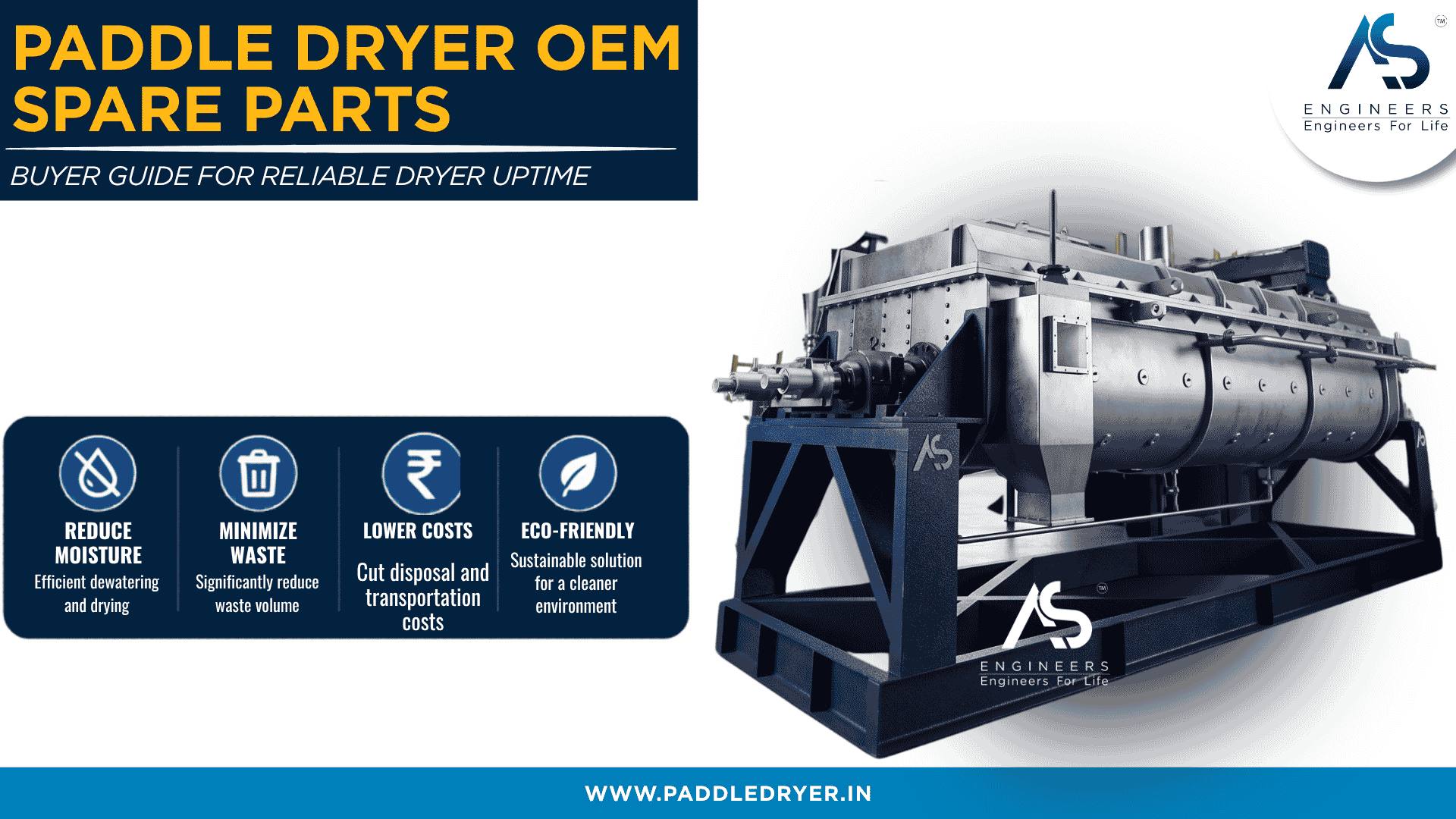
Why Paddle Dryer OEM Spare Parts Matter in Real Plant Operation
Paddle dryer OEM spare parts are critical because a paddle dryer works under heat, torque, moisture, sticky feed load, and continuous mechanical contact. Wrong-fit or low-grade spare parts can disturb shaft alignment, reduce heat transfer, increase vibration, and create repeated shutdowns. For plants running sludge, chemical cake, biomass, minerals, or sticky industrial by-products, OEM spare planning is not a purchase activity only, it is a reliability decision.
A paddle dryer is not a simple rotating vessel. In an indirect heat drying system, the hollow shafts, jacket, wedge paddles, seals, bearings, gearbox, drive, and discharge arrangement must work as one thermal-mechanical system. When one spare part is dimensionally incorrect or metallurgically weak, the fault can spread into the shaft, paddles, bearings, gearbox, and foundation.
That is why buyers should treat Paddle Dryer spare parts as engineered components, not generic inventory items. A replacement bearing, seal, paddle, or shaft component should match the dryer’s operating load, temperature range, feed behaviour, moisture profile, and material of construction.
Per AS Engineers, paddle dryers can handle wet, sticky, heat-sensitive, slurry, paste, cake, granular, and powder materials through indirect heat transfer from hollow shafts and jacket surfaces. This makes spare-part accuracy especially important because the machine is expected to manage mixing, heat transfer, self-cleaning action, and controlled moisture removal together.
Which Paddle Dryer OEM Spare Parts Should Buyers Track First?
The most important paddle dryer OEM spare parts to track are shafts, paddles, bearings, gearbox components, seals, couplings, rotary joints, scrapers, liners, discharge parts, and drive-side consumables. The right priority depends on the dryer age, application, operating hours, feed abrasiveness, and history of vibration or leakage. A practical spare strategy separates critical shutdown parts from planned-maintenance parts.
Critical shutdown parts are the parts that can stop production immediately. These usually include bearings, seals, coupling elements, gearbox-related parts, rotary joints, and electrical or drive-side items. Planned-maintenance parts include wear plates, paddles, scrapers, discharge aids, gaskets, fasteners, and inspection covers.
For sludge drying plants, the risk is often sticky buildup, uneven feed, corrosive vapour, and bearing stress. For chemical and mineral drying, the risk may be abrasion, corrosion, temperature cycling, or product contamination. For food, pharma, pigment, and specialty chemical applications, surface finish and material compatibility become more sensitive.
A useful first step is to review the dryer’s actual duty. Is it working on ETP sludge, STP sludge, textile sludge, gypsum, pigment, lithium hydroxide, starch, API intermediate, sodium sulphate, or another material? The spare-part list should not be copied blindly from another plant because drying behaviour changes with feed chemistry and moisture condition.
Plants comparing drying technologies can also study sludge drying and paddle dryer technology to understand why heat-transfer surfaces, agitation quality, and product movement directly affect maintenance needs.
What Goes Wrong When Non-OEM Spare Parts Are Used?
Non-OEM spare parts can look cheaper at purchase but become expensive when they cause vibration, leakage, poor drying, shaft stress, uneven clearance, or repeated breakdown. Paddle dryer parts work inside a loaded thermal system, so dimensional error and poor material selection can create plant-level losses. The biggest risk is not the part price, it is the shutdown cost and secondary damage.
A common buyer mistake is comparing spare parts only by visible shape. A paddle, bearing housing, seal, or shaft-related component may appear simple from the outside, but the functional requirement is more complex. It must fit the original design clearances, handle thermal expansion, resist process-side wear, and maintain mechanical balance.
Wrong spare parts can create five major problems.
First, the dryer may lose drying efficiency because paddles and heat-transfer surfaces no longer interact with the feed correctly. Second, shaft load may increase due to improper alignment or material buildup. Third, leakage may appear around seals or rotary joints. Fourth, gearbox and bearing life may drop because vibration is transferred through the drive train. Fifth, the dryer may require repeated stoppages, which damages operator confidence.
For plants handling sludge, the cost is not only maintenance. Wet sludge volume, storage, odour, transport, and disposal pressure can return quickly if the dryer is down. That is why spare-part decisions should be tied to uptime, disposal planning, and compliance continuity.
Paddle Dryer OEM Spare Parts Decision Table for Maintenance Teams
A good spare-parts decision table helps maintenance teams avoid panic buying. It separates parts by shutdown impact, inspection frequency, replacement urgency, and buyer action. The table below is designed for plant engineers, procurement teams, and maintenance heads who need a practical spare policy without inventing unsupported life-hour numbers.
| Spare Part Category | Shutdown Risk | Typical Warning Sign | Recommended Buyer Action |
|---|---|---|---|
| Shaft-related components | High | Vibration, abnormal noise, uneven rotation, heating | Use OEM inspection before replacement or retrofitment |
| Bearings and bearing housings | High | Temperature rise, noise, grease failure, vibration | Keep critical sizes planned in spare inventory |
| Gearbox and drive components | High | Jerky motion, torque fluctuation, oil leakage | Match OEM rating and alignment requirement |
| Seals, gaskets, rotary joints | High to Medium | Steam, oil, vapour, or process leakage | Replace with compatible material and correct fitment |
| Paddles and wear parts | Medium to High | Poor mixing, buildup, slower drying | Inspect during shutdown and replace before major distortion |
| Scrapers, liners, discharge parts | Medium | Product sticking, uneven discharge, local wear | Plan replacement based on application severity |
| Fasteners and covers | Low to Medium | Loosening, corrosion, access leakage | Maintain standard shutdown kit |
| Instrument and safety-related parts | Application-specific | Inconsistent readings or control issues | Verify with service team before bypassing or substituting |
This table is intentionally practical. It avoids false universal replacement intervals because paddle dryer spare life depends on feed, moisture, temperature, duty cycle, corrosion, abrasiveness, operator practice, and maintenance discipline.
How Should You Plan Paddle Dryer OEM Spare Parts Inventory?
Spare inventory should be planned in three levels: emergency spares, scheduled shutdown spares, and long-lead engineered spares. This prevents overstocking while still protecting plant uptime. The best plan is based on machine criticality, feed difficulty, maintenance history, and supplier response time.
Emergency spares are small but critical parts that stop leakage, vibration, or drive-side failure. These may include seals, gaskets, coupling elements, bearings, sensors, fasteners, and lubrication-related items. Scheduled shutdown spares are parts that are replaced during planned inspection, such as liners, wear plates, scrapers, selected paddles, and discharge components.
Long-lead engineered spares need more attention. Shafts, gearbox assemblies, specialized rotary joints, custom paddles, and application-specific components may require drawings, measurement, inspection, and manufacturing planning. Waiting until failure can make downtime longer than expected.
A better approach is to maintain a machine-wise spare history. Record what failed, when it failed, what symptom appeared first, and what operating condition existed before the failure. Over time, this creates a predictive spare plan instead of a reactive purchase list.
For buyers still validating dryer performance or new feed behaviour, AS Engineers also offers a Paddle Dryer Pilot Trial pathway. Pilot and process evaluation can help identify drying behaviour, discharge characteristics, and maintenance-sensitive zones before a buyer finalizes the larger system or upgrade.
When Is Repair Better Than Full Replacement?
Repair is better than full replacement when the main dryer body and system layout are still serviceable, but certain components have reached wear, alignment, or performance limits. Full replacement should be considered only when repair, retrofitment, and OEM spare support cannot restore safe, efficient operation. A proper inspection should come before any major capital decision.
Many plants assume that an old dryer must be replaced when it starts giving trouble. That is not always true. If the dryer shell, jacket, foundation, drive arrangement, and process layout are suitable, repair or retrofitment may restore useful operating life.
According to AS Engineers, its support scope includes shaft, gearbox, bearing replacement, system repair and upgrades, retrofitment solutions, OEM spare parts, on-site alignment, on-site balancing, AMC, training, and process optimization. That matters because paddle dryer repair is not only about changing a damaged part. It is also about checking why the part failed.
A shaft problem may be connected to alignment, feed shock, buildup, torque overload, bearing condition, or gearbox stress. A leakage problem may be connected to seals, thermal cycling, vapour load, or operating pressure condition. A drying-performance issue may be connected to heating medium, feed rate, paddle wear, or discharge restriction.
For equipment-specific support, buyers can review AS Engineers’ Paddle Dryer Services and Spare Parts pages before deciding whether to repair, retrofit, or replace.
What Should Procurement Ask Before Buying Paddle Dryer Spare Parts?
Procurement should ask for technical fitment, material compatibility, manufacturing reference, installation support, inspection scope, delivery clarity, and post-replacement performance responsibility. The lowest quote is not automatically the best quote if the part affects shaft alignment, heating performance, leakage control, or production uptime. Technical comparison should come before price comparison.
Before issuing a purchase order, ask these questions:
Is the spare part OEM-compatible with the installed dryer model? Is the material suitable for the feed, moisture, vapour, heating medium, and temperature? Does the supplier understand indirect heat transfer, hollow shaft operation, wedge paddle action, and self-cleaning paddle geometry? Will the spare require on-site alignment or balancing? Is the replacement part for emergency restoration, planned shutdown, or performance improvement?
Procurement should also ask whether the supplier can support inspection after installation. A spare part can be correct, but poor installation can still create failure. Bearings, gearbox components, seals, and shaft-related work should not be treated as ordinary mechanical fitting if the dryer is critical to the plant’s waste or production process.
If your plant uses sludge dryers for disposal cost control, a spare delay can affect the full waste-handling chain. Articles such as paddle sludge dryer for effective sludge treatment and paddle dryers versus belt dryers can help technical and purchase teams understand how dryer selection, operation, and maintenance affect lifecycle value.
Why AS Engineers Is Relevant for Paddle Dryer OEM Spare Parts
AS Engineers is relevant for paddle dryer OEM spare parts because the company combines paddle dryer manufacturing knowledge with after-sales service, retrofitment, shaft-related support, AMC, and on-site technical assistance. For buyers, this reduces the gap between spare supply and actual machine performance. The value is strongest when the dryer is critical to disposal cost, compliance, or continuous process operation.
AS Engineers is based in GIDC Vatva, Ahmedabad, Gujarat, India, and positions itself as “The Leading Name in Paddle Dryer Industry.” The company’s approved proof points include 25+ years of experience, 500+ clients, 1500+ projects, ISO 9001:2015 TUV India certification, CE certification, and Acmefil-backed engineering strength.
The company’s paddle dryer design knowledge covers standard dryer, dual zone dryer, and vacuum dryer variants. Buyers working with special feed conditions can also compare hollow paddle dryer technology with their existing dryer condition before planning replacement parts or retrofitment.
For technical teams, AS Engineers’ Paddle Dryer page and paddle dryer training and spare parts resource are useful next steps when the goal is not only buying a component, but restoring dryer uptime and operating confidence.
FAQs
1. What are paddle dryer OEM spare parts?
Paddle dryer OEM spare parts are original or OEM-compatible replacement components designed to match the dryer’s original mechanical, thermal, and process requirements. They may include shafts, paddles, bearings, gearbox parts, seals, rotary joints, scrapers, liners, couplings, and discharge components.
2. When should a plant replace paddle dryer spare parts?
A plant should replace spare parts when inspection shows wear, leakage, vibration, alignment issues, poor discharge, slower drying, abnormal noise, overheating, or repeated breakdown. Replacement should be planned during shutdown whenever possible, especially for critical parts such as bearings, seals, gearbox components, and shaft-related items.
3. Are OEM spare parts always better than local fabricated parts?
For critical components, OEM spare parts are usually safer because they are made to match the dryer’s design, fitment, material requirement, and operating load. Local fabricated parts may work for non-critical items, but they can create risk when the part affects shaft alignment, heat transfer, sealing, torque, or mechanical balance.
4. Can an old paddle dryer be repaired instead of replaced?
Yes, an old paddle dryer can often be repaired or retrofitted if the main body, foundation, heating system, and drive layout are still suitable. A technical inspection should confirm whether shaft replacement, gearbox work, bearing replacement, seal change, alignment, balancing, or process optimization can restore performance.
5. What information should I share before requesting paddle dryer spare parts?
Share the dryer model, installed application, feed material, operating temperature, heating medium, moisture range, failure symptoms, photos, drawings if available, part dimensions, and urgency. For shaft, gearbox, bearing, or seal issues, also share vibration, leakage, noise, temperature, and maintenance history.
Closing
If your paddle dryer is facing vibration, leakage, slow drying, bearing failure, shaft concern, or repeated shutdowns, do not start with random part replacement. Start with a technical inspection, identify the root cause, and match the spare part to the dryer’s actual duty. For OEM spare parts, retrofitment, AMC, or on-site service support, you can contact AS Engineers for paddle dryer spare support.

Karan Dargode leads operations and environmental health & safety at AS Engineers, an Ahmedabad-based manufacturer with over 25 years of experience in centrifugal blowers, industrial fans, paddle dryers, sludge dryers, and air pollution control equipment. He joined AS Engineers in July 2019 and has spent over six years building operational systems that support the company’s engineering and manufacturing work. His role spans business strategy execution, operational process design, EHS compliance, and policy development. Day to day, that means keeping manufacturing output consistent, ensuring workplace and environmental standards are met, and supporting the company’s growth across domestic and export markets. Education and Qualifications Karan holds a Bachelor of Engineering in Mechanical Engineering from Silver Oak College of Engineering and Technology, Ahmedabad, affiliated with Gujarat Technological University (GTU), completed in 2018. He later pursued a Post Graduate Diploma in Business Administration (PGDBA) with a focus on Operations Management from Symbiosis Centre for Distance Learning, Pune, strengthening his understanding of manufacturing strategy and industrial operations. What He Writes About The articles and posts on this site reflect what Karan works with directly. He covers: Paddle dryer selection, working principles, and industrial applications Sludge drying technology for ETP and CETP operators Centrifugal blower engineering and maintenance Industrial drying process optimization EHS compliance for industrial manufacturing units His writing is technical without being academic. The goal is straightforward: give plant engineers, ETP operators, and procurement managers the specific information they need to make good equipment decisions. At AS Engineers AS Engineers has manufactured industrial equipment since 1997, serving clients across chemicals, pharmaceuticals, food processing, wastewater treatment, and heavy industry. The Ahmedabad facility at GIDC Vatva handles design, fabrication, and testing in-house. Karan’s work at the operations level puts him directly involved with product delivery quality, production planning, and customer-facing timelines. If you have questions about any article on this site or want to discuss a specific application for blowers, dryers, or air pollution control equipment, you can reach the AS Engineers team through the contact page. Contact AS Engineers