
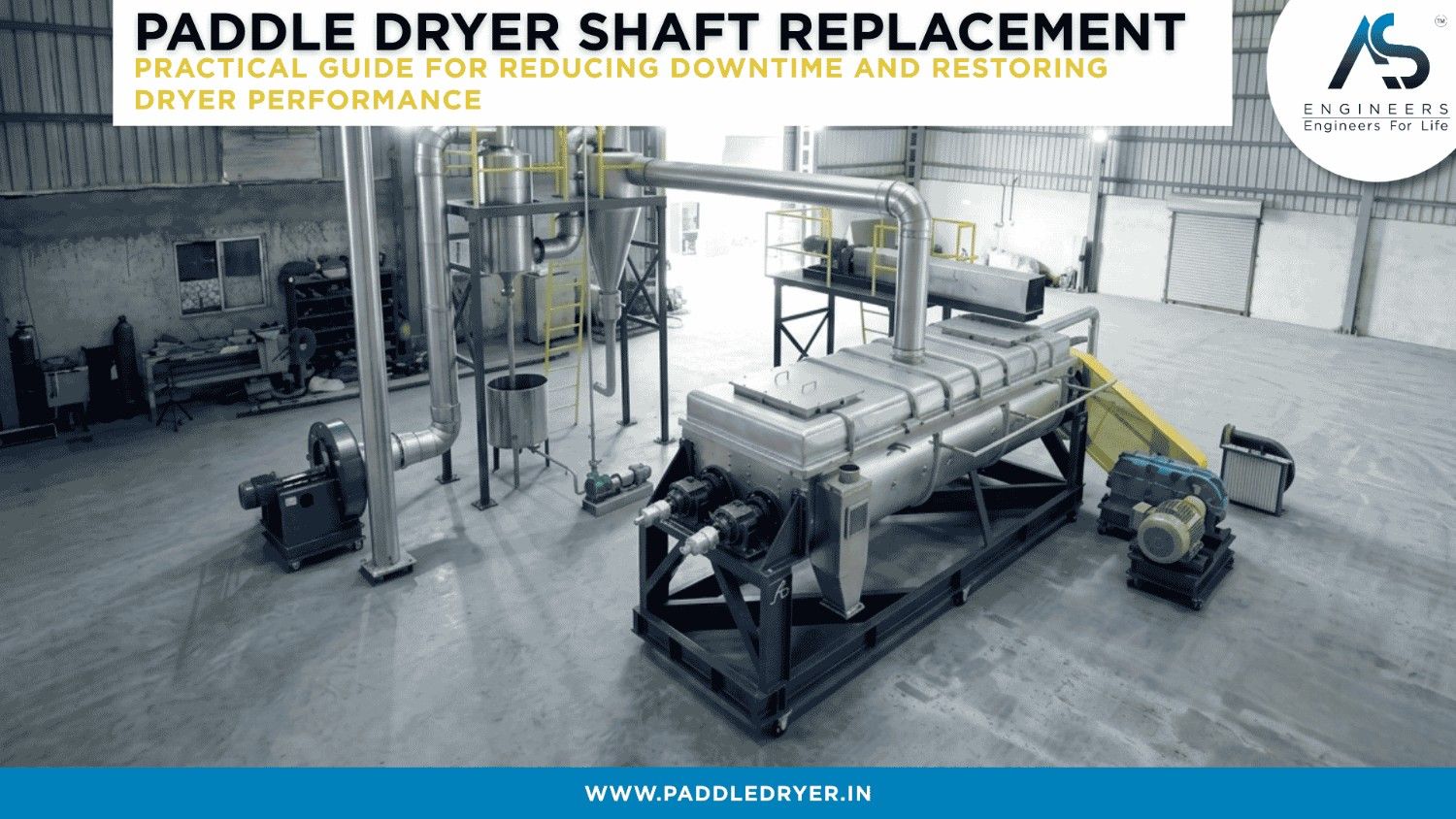
What Is Paddle Dryer Shaft Replacement?
Paddle dryer shaft replacement is the process of removing a worn, damaged, bent, cracked, or performance-compromised shaft assembly and installing a suitable replacement shaft to restore drying efficiency, mixing action, alignment, and mechanical reliability. In an industrial Paddle Dryer, the shaft is not a small spare part. It is one of the main heat-transfer and agitation components, especially in hollow shaft paddle dryers.
A paddle dryer shaft works under thermal load, mechanical torque, material resistance, and continuous rotation. In sludge, paste, filter cake, chemical, mineral, polymer, and waste drying applications, the shaft must handle sticky feed behavior, variable bulk density, uneven loading, and long operating hours.
That is why shaft replacement should never be treated as a quick workshop activity only. The better approach is to inspect the complete shaft system, including paddles, bearings, seals, gearbox coupling, drive alignment, jacket condition, dryer internals, and operating history.
For buyers comparing service options, the real question is not only “Can the shaft be replaced?” The stronger question is “Will the replacement solve the root cause, or will the same failure return after restart?”
When Does a Paddle Dryer Shaft Need Replacement?
A paddle dryer shaft normally needs replacement when mechanical repair cannot safely restore geometry, strength, alignment, heat-transfer reliability, or process performance. Visible damage is only one signal. Many shaft failures begin as vibration, uneven drying, abnormal sound, repeated bearing failure, torque fluctuation, or inconsistent discharge quality.
Common warning signs include shaft runout, rubbing marks, paddle damage, seal leakage, bearing heating, gearbox overload, irregular rotation, and poor mixing inside the dryer. In sludge drying, operators may also notice wet lumps, sticky accumulation, reduced throughput, or higher energy use because the material is no longer moving and shearing properly.
A shaft should be inspected urgently if the dryer has experienced foreign object entry, sudden stoppage under load, hard material buildup, bearing seizure, coupling failure, or repeated overload trips. In a hollow paddle dryer system, internal leakage or compromised heat-transfer pathways can also make replacement more practical than repeated patch repair.
The key point is simple: shaft replacement is justified when the part no longer supports safe rotation, stable heat transfer, and reliable material movement.
Why Do Paddle Dryer Shafts Fail?
Paddle dryer shaft failures usually come from a combination of mechanical stress, poor alignment, difficult feed behavior, inadequate maintenance, or incorrect operating conditions. The shaft may be strong, but it is still part of a complete thermal drying system. If the process or support system is wrong, the shaft absorbs the punishment.
Sticky sludge, abrasive material, high-viscosity paste, irregular feed lumps, and fluctuating moisture can increase torque demand. If the feed system sends uneven slugs instead of controlled flow, the shaft may face shock loading. This is especially relevant in paddle sludge dryer applications where material condition changes from wet and plastic to sheared and granular during drying.
Other common contributors include worn bearings, poor lubrication, misalignment between motor, gearbox, coupling, and shaft, loose foundation, improper startup after shutdown, and thermal expansion mismatch. In some plants, shaft issues are blamed on the shaft itself, while the real problem is a weak feeding method, incorrect discharge handling, or delayed bearing replacement.
A good service team does not replace the shaft blindly. It checks why the old shaft failed.
Should You Repair, Retrofit, or Replace the Shaft?
Not every shaft issue requires full replacement. Some cases can be repaired, some need retrofitment, and some demand complete replacement for safety and reliability. The decision depends on damage severity, shaft geometry, operating duty, material behavior, downtime tolerance, and whether the original design is still suitable for the process.
AS Engineers’ service portfolio includes shaft, gearbox, and bearing replacement, system repair and upgrades, retrofitment solutions, OEM spare parts, on-site alignment, on-site balancing, AMC, training, and process optimization. For plants that need original fitment and compatibility, AS Engineers spare parts support is more relevant than using a generic component with uncertain fit.
| Service decision | Best suited when | Buyer risk if chosen wrongly | Practical action |
|---|---|---|---|
| Shaft repair | Minor wear, local damage, repairable paddle issue | Repeated failure if shaft is bent or fatigued | Inspect runout, cracks, weld zones, and heat-transfer condition |
| Shaft retrofitment | Existing design is outdated or operating duty changed | Retrofit fails if dryer internals are ignored | Review feed, torque, paddles, seals, bearings, and process load |
| Full shaft replacement | Major bending, cracking, severe wear, unsafe rotation, repeated failures | Downtime and cost increase if root cause remains | Replace with compatible shaft and correct alignment |
| Complete dryer service | Shaft issue is linked with gearbox, bearings, seals, or process instability | New shaft may fail early | Combine replacement with mechanical and process audit |
This table matters because the cheapest first action is not always the lowest-cost lifetime action.
What Should Be Checked Before Shaft Replacement?
Before paddle dryer shaft replacement, the service team should check the dryer mechanically, thermally, and operationally. A shaft can fail because of a part defect, but it can also fail because the dryer is being forced to operate outside its practical process window. Both possibilities must be tested.
Start with mechanical checks: shaft runout, paddle wear, bearing condition, seal area, coupling alignment, gearbox health, foundation condition, drive load, and abnormal vibration. Then check process conditions: feed moisture, feed consistency, bulk density, stickiness, abrasive content, operating temperature, residence time, discharge behavior, and cleaning schedule.
For sludge plants, connect the shaft issue with the wider sludge drying technology and dewatering arrangement. A dryer receiving unstable wet cake from upstream equipment will always face more stress than a dryer receiving controlled feed. The article on sludge dewatering and drying is useful for understanding that upstream moisture control directly affects dryer load.
A replacement plan should also include lifting access, shutdown window, manpower, safety isolation, hot work precautions, coupling removal, spare readiness, trial rotation, load testing, and operator training after restart.
How Does OEM Shaft Replacement Reduce Downtime?
OEM shaft replacement reduces downtime by improving fitment accuracy, material compatibility, alignment reliability, and service accountability. A paddle dryer shaft is application-specific. Wrong dimensions, paddle geometry, sealing area, MOC selection, or balance can create fresh problems even if the shaft physically fits.
AS Engineers manufactures and services paddle dryers from GIDC Vatva, Ahmedabad, Gujarat, India, and positions itself as “The Leading Name in Paddle Dryer Industry.” The company’s paddle dryer design uses indirect heat transfer through hollow shafts and jacket, dual counter-rotating shafts, wedge-shaped paddles, self-cleaning action, and plug-flow movement for uniform drying. That design knowledge matters during shaft replacement because the shaft is part of the process, not only a rotating mechanical part.
For operational support, paddle dryer services can be considered when the buyer needs inspection, shaft replacement, alignment, balancing, repair, retrofitment, or maintenance planning. For buyers evaluating equipment design and service compatibility together, the AS Engineers paddle dryer product page gives useful product context.
The correct replacement approach should restore rotation, mixing, heat transfer, sealing, and discharge stability together.
What Mistakes Should Buyers Avoid During Shaft Replacement?
The biggest mistake is replacing the shaft without diagnosing the failure reason. A new shaft may run smoothly during no-load trial, then fail again under sticky, abrasive, or high-torque feed. This is common when plants treat shaft replacement as a spare purchase instead of a reliability project.
Avoid these buyer mistakes: selecting a generic fabricator without dryer process knowledge, ignoring bearing and gearbox condition, skipping alignment, not checking feed consistency, restarting at full load too quickly, and using non-OEM parts where dimensional accuracy is critical. Also avoid assuming that a shaft issue is only mechanical. In many drying plants, the root cause sits in feed handling, moisture fluctuation, discharge blockage, or poor cleaning discipline.
If your team is comparing technologies or planning future replacement strategy, the comparison of paddle dryers vs belt dryers helps clarify why shaft-based indirect drying has different maintenance logic from belt-based drying. For uncertain materials, a paddle dryer pilot trial can help confirm behavior before a new dryer purchase or major process change.
The safe rule is: replace the shaft only after you understand the duty it must survive.
How AS Engineers Supports Paddle Dryer Shaft Replacement
AS Engineers supports paddle dryer shaft replacement through OEM spare parts, field service, repair, retrofitment, alignment, balancing, AMC, training, and process optimization. This is important for plants where downtime affects disposal cost, production continuity, environmental compliance, or downstream material handling. A shaft replacement should bring the dryer back to reliable operation, not only back to rotation.
According to AS Engineers’ approved service information, the company provides repair services and OEM spare parts and has resolved shaft retrofitment issues. The service scope also includes shaft, gearbox, and bearing replacement, which is useful when a shaft issue is connected to the complete drive train.
For plants handling ETP sludge, STP sludge, chemical sludge, paper sludge, biosludge, filter cake, slurry, paste, minerals, catalysts, pigments, polymers, or food process residues, shaft condition directly affects drying quality. Stable shaft performance supports uniform agitation, better contact with heated surfaces, controlled residence time, and cleaner discharge.
AS Engineers is ISO 9001:2015 TUV India certified and CE Certified, with 25+ years of experience, 500+ clients, 1500+ projects, and 500+ dryers operational as verified company proof points. These credibility signals matter when the buyer is not just purchasing a shaft, but trusting a service partner with a critical thermal drying asset.
FAQs
1. How do I know if my paddle dryer shaft needs replacement?
You may need paddle dryer shaft replacement if you see abnormal vibration, repeated bearing failure, shaft runout, rubbing marks, paddle damage, seal leakage, gearbox overload, irregular drying, or unsafe rotation. A proper inspection is required before deciding between repair, retrofitment, and full replacement.
2. Can a paddle dryer shaft be repaired instead of replaced?
Yes, some shaft issues can be repaired if damage is local and the shaft geometry, strength, and balance can be restored safely. Full replacement is better when the shaft is bent, cracked, severely worn, thermally compromised, or repeatedly failing.
3. Should I use OEM spare parts for paddle dryer shaft replacement?
OEM spare parts are strongly preferred when fitment, alignment, sealing, paddle geometry, and process reliability matter. A generic shaft may reduce initial cost, but wrong design or dimensions can increase downtime and create repeated failures.
4. What should be inspected along with the shaft?
Inspect bearings, gearbox, coupling, seals, paddles, drive alignment, foundation, lubrication, feed system, discharge system, dryer internals, and operating conditions. A shaft problem often has a connected cause elsewhere in the dryer system.
5. Does AS Engineers provide paddle dryer shaft replacement service?
Yes. AS Engineers’ service portfolio includes shaft, gearbox, and bearing replacement, OEM spare parts, on-site alignment, on-site balancing, repair, retrofitment, AMC, training, and process optimization for paddle dryer systems.
Closing
Paddle dryer shaft replacement should be handled as a reliability decision, not only a spare-part purchase. If your dryer is facing repeated shaft, bearing, gearbox, alignment, vibration, or drying-performance issues, discuss the failure history and service requirement with AS Engineers Contact before deciding on repair, retrofitment, or complete shaft replacement.

Karan Dargode leads operations and environmental health & safety at AS Engineers, an Ahmedabad-based manufacturer with over 25 years of experience in centrifugal blowers, industrial fans, paddle dryers, sludge dryers, and air pollution control equipment. He joined AS Engineers in July 2019 and has spent over six years building operational systems that support the company’s engineering and manufacturing work. His role spans business strategy execution, operational process design, EHS compliance, and policy development. Day to day, that means keeping manufacturing output consistent, ensuring workplace and environmental standards are met, and supporting the company’s growth across domestic and export markets. Education and Qualifications Karan holds a Bachelor of Engineering in Mechanical Engineering from Silver Oak College of Engineering and Technology, Ahmedabad, affiliated with Gujarat Technological University (GTU), completed in 2018. He later pursued a Post Graduate Diploma in Business Administration (PGDBA) with a focus on Operations Management from Symbiosis Centre for Distance Learning, Pune, strengthening his understanding of manufacturing strategy and industrial operations. What He Writes About The articles and posts on this site reflect what Karan works with directly. He covers: Paddle dryer selection, working principles, and industrial applications Sludge drying technology for ETP and CETP operators Centrifugal blower engineering and maintenance Industrial drying process optimization EHS compliance for industrial manufacturing units His writing is technical without being academic. The goal is straightforward: give plant engineers, ETP operators, and procurement managers the specific information they need to make good equipment decisions. At AS Engineers AS Engineers has manufactured industrial equipment since 1997, serving clients across chemicals, pharmaceuticals, food processing, wastewater treatment, and heavy industry. The Ahmedabad facility at GIDC Vatva handles design, fabrication, and testing in-house. Karan’s work at the operations level puts him directly involved with product delivery quality, production planning, and customer-facing timelines. If you have questions about any article on this site or want to discuss a specific application for blowers, dryers, or air pollution control equipment, you can reach the AS Engineers team through the contact page. Contact AS Engineers