
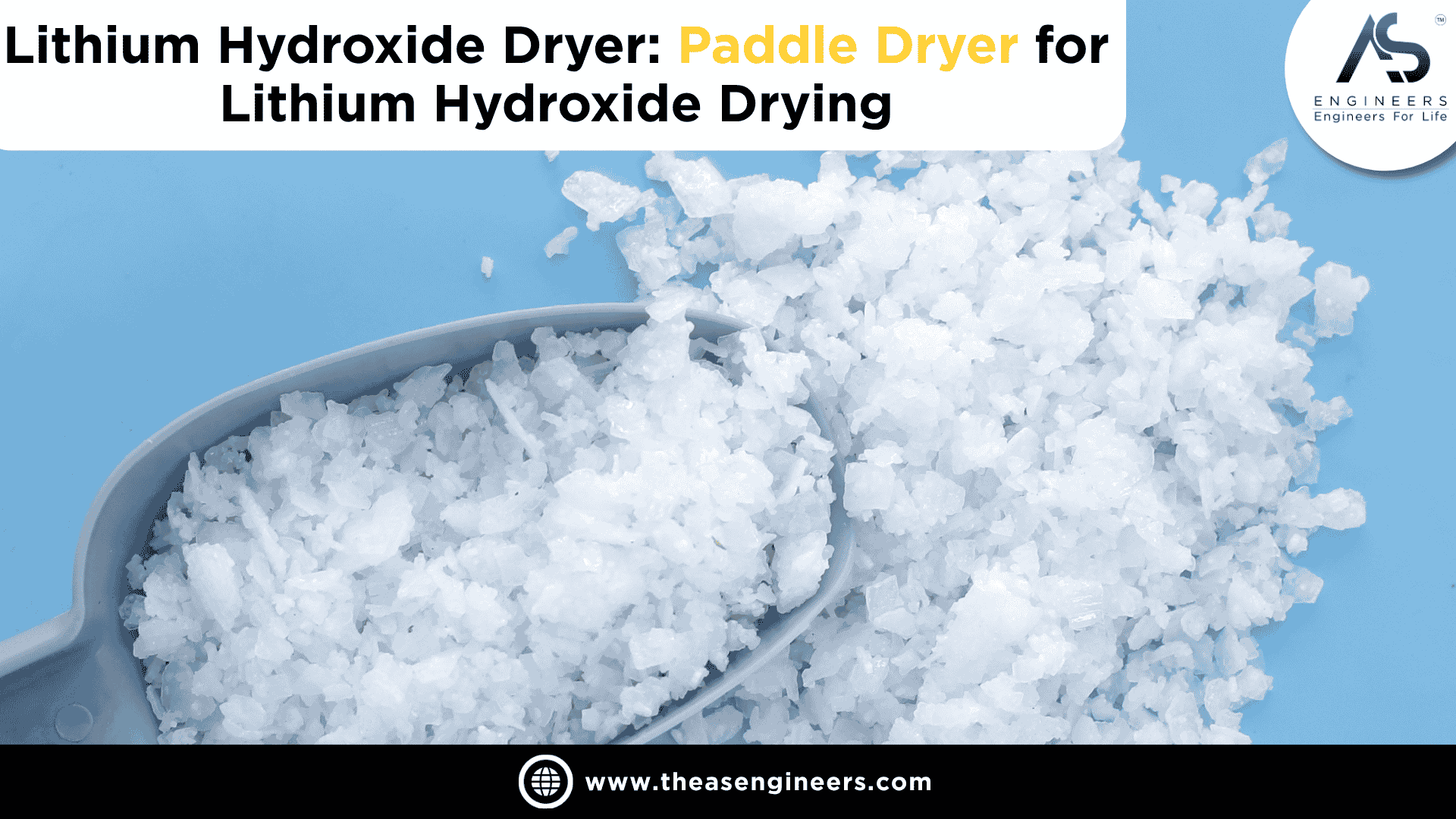
A lithium hydroxide dryer should remove moisture with controlled heat transfer, contained handling, consistent mixing, and validated material contact design. For many lithium hydroxide drying duties, a paddle dryer for lithium hydroxide drying is considered because it uses indirect heat through hollow shafts and a jacket, reducing direct gas contact with the product. The right dryer must be selected by testing feed moisture, target moisture, bulk behavior, dust load, material of construction, and downstream packing requirements.
What Is a Lithium Hydroxide Dryer?
A lithium hydroxide dryer is industrial drying equipment used to reduce moisture from lithium hydroxide feed before further processing, storage, or packaging. The goal is not only to dry the material, but to protect product quality, operator safety, and plant reliability. For battery-material and chemical buyers, dryer selection should start with process behavior, not catalogue capacity.
Lithium hydroxide drying can involve fine solids, chemical handling risks, moisture sensitivity, and strict downstream quality expectations. A general-purpose hot air dryer may not be suitable when the buyer needs better containment, indirect heating, and controlled residence time.
A paddle dryer is often evaluated for this duty because the material is agitated inside a heated trough while heat is transferred through the jacket and hollow shafts. The design supports mixing, shearing, and gradual movement from feed to discharge, which helps buyers manage difficult chemical drying applications without depending only on large volumes of hot air.
Why Use a Paddle Dryer for Lithium Hydroxide Drying?
A paddle dryer for lithium hydroxide drying is useful when the buyer needs indirect heat transfer, compact layout, continuous operation, and controlled material movement. The main advantage is that heat is supplied through metal surfaces, while the paddles mix and expose fresh material to the heated area. This can help reduce uneven drying and hot air dependency.
According to AS Engineers, their paddle dryer platform uses hollow shafts, a jacketed body, dual counter-rotating shafts, and wedge-shaped paddles for drying, heating, solvent stripping, cooling, roasting, and calcining applications. The company also lists lithium hydroxide under mining and metals material applications, which makes this a relevant process discussion for buyers comparing dryer technologies.
For chemical buyers, paddle dryers in chemical processing are usually selected after checking feed consistency, required outlet moisture, heating medium, and product handling behavior. If the lithium hydroxide feed is sticky, powdery, dusty, or variable, pilot testing becomes important before committing to final sizing.
How Does Indirect Paddle Drying Work for Lithium Hydroxide?
Indirect paddle drying works by transferring heat from steam, thermal oil, or another heating medium through the dryer’s heated surfaces into the product. The paddles continuously agitate the feed, expose new surface area, and push material forward. This creates a controlled drying path from wet feed to discharge.
AS Engineers’ paddle dryer design supports steam heating up to 14.06 kg/cm² and thermal oil heating up to 400°C as equipment capability. This does not mean every lithium hydroxide application should operate at those limits. The correct heating medium and operating temperature must be selected from product trials, product quality targets, and plant safety requirements.
The hollow paddle dryer technology is especially relevant when a buyer wants compact heat-transfer area inside a contained body. For lithium hydroxide, buyers should evaluate whether the dryer needs special material of construction, dust capture, controlled vapor removal, and product cooling before packing.
Lithium Hydroxide Dryer Buyer Decision Table
A lithium hydroxide dryer should be purchased only after technical qualification of feed behavior, product target, utilities, and discharge handling. A low-cost dryer that cannot control moisture, dust, or product movement can become expensive after installation. This table gives buyers a practical selection lens before sending a quotation request.
| Buyer Decision Point | What to Check | Safer Selection Direction |
|---|---|---|
| Feed condition | Slurry, wet cake, paste, granule, or powder | Requires testing |
| Target outlet moisture | Battery-grade or chemical-grade requirement | Product-specific |
| Heating medium | Steam, thermal oil, hot water, or other utility | Site-specific |
| Material contact parts | Corrosion, abrasion, contamination risk | MOC review required |
| Dust and vapor handling | Fines, vapors, and operator exposure | Enclosed system preferred |
| Residence time | Under-drying or over-drying risk | Application-specific |
| Discharge form | Powder flow, cooling, conveying, bagging | Must match packing line |
| Scale-up confidence | Lab data, pilot data, or only assumptions | Pilot trial preferred |
This is where paddle dryer technology should be evaluated as a full system, not as a standalone machine. Feeding, heating, vapor handling, discharge conveying, product cooling, and control philosophy all affect final performance.
What Should Buyers Verify Before Selecting a Lithium Hydroxide Dryer?
Buyers should verify feed moisture, target moisture, bulk density, flow behavior, temperature limits, dust behavior, and material compatibility before selecting a lithium hydroxide dryer. These details decide dryer size, heating surface, residence time, motor power, material of construction, and vapor-handling design. Without this data, capacity promises are weak.
The biggest mistake is asking only for “kg/hr capacity.” A dryer sized only on throughput may fail if the feed sticks, cakes, dusts heavily, corrodes contact parts, or needs a narrow outlet moisture band. Lithium hydroxide drying should be treated as a process-engineering decision.
Before final purchase, ask suppliers these questions:
Does the dryer support continuous lithium hydroxide drying?
What material of construction is recommended for contact parts?
How will moisture variation in feed be handled?
What dust collection or vapor handling is included?
Can the supplier prove performance through trial data?
How will the dried material be conveyed and packed?
For uncertain materials, a paddle dryer pilot trial is more useful than a theoretical proposal. AS Engineers offers a 50 kg/hr pilot trial machine at its facility or at the client’s site, with the trial fee waived upon order placement.
AS Engineers’ Relevance for Lithium Hydroxide Drying Projects
AS Engineers is relevant for lithium hydroxide dryer projects because its paddle dryer platform is built for industrial thermal processing, chemical drying, and difficult material handling. The company manufactures from GIDC Vatva, Ahmedabad, Gujarat, India, and positions itself as “The Leading Name in Paddle Dryer Industry.” For global buyers, the useful proof points are engineering experience, testing capability, and after-sales support.
According to AS Engineers, its paddle dryer can be supplied in standard, dual-zone, and vacuum designs, with material options including CS, SS304, SS316, Duplex Steel, and other alloy steels. The platform also supports atmospheric, vacuum, or pressurized operation depending on application need.
Buyers can review the AS Engineers industrial paddle dryer page for product-level context and the paddle dryer for chemical industry page for chemical drying relevance. For utility planning, the paddle dryer heating medium and fuel options resource is useful during early engineering discussion.
When Is a Paddle Dryer Not Enough by Itself?
A paddle dryer alone is not enough when the buyer ignores feeding, dust handling, vapor control, cooling, conveying, and packing. Lithium hydroxide drying should be engineered as a drying system, not only a dryer body. The process around the dryer decides whether the installation runs cleanly and consistently.
A complete system may need a screw feeder, sludge or cake feeding arrangement, heated dryer body, vapor extraction, cyclone, scrubber or bag filter, condenser where required, screw conveyor, silo, bucket elevator, or bagging arrangement. The final arrangement depends on product behavior and site requirements.
AS Engineers also provides paddle dryer services including repair, upgrades, alignment, balancing, OEM spare parts, AMC, and process optimization. This matters because chemical drying plants often need support after commissioning, especially when feed quality changes over time.
FAQs
1. Can a paddle dryer be used as a lithium hydroxide dryer?
Yes, a paddle dryer can be evaluated for lithium hydroxide drying when indirect heating, mixing, contained operation, and controlled residence time are required. Final suitability should be proven through feed testing and pilot trials.
2. What data is needed for a lithium hydroxide dryer quotation?
A serious quotation should include feed moisture, required outlet moisture, feed form, bulk density, temperature limits, expected throughput, operating hours, material of construction preference, and discharge handling requirements.
3. Is thermal oil or steam better for lithium hydroxide drying?
The better heating medium depends on temperature requirement, plant utility availability, safety design, operating cost, and product quality limits. AS Engineers’ paddle dryer platform supports both steam and thermal oil options, but final selection should be application-specific.
4. Why is pilot testing important for lithium hydroxide drying?
Pilot testing reduces scale-up risk by showing real drying behavior, residence time, sticking tendency, dust generation, discharge quality, and achievable outlet moisture. It is especially important when exact product behavior is not already proven.
5. What makes lithium hydroxide drying different from general sludge drying?
Lithium hydroxide drying is usually more product-quality focused, while sludge drying is often more disposal-cost focused. Buyers must pay closer attention to contamination risk, moisture specification, dust containment, material compatibility, and downstream packaging.
Closing
For lithium hydroxide drying, do not finalize the dryer only on capacity. Share your feed details, moisture target, product handling requirement, and utility availability so the drying system can be reviewed correctly. To discuss a lithium hydroxide dryer or arrange a pilot-trial-based evaluation, discuss lithium hydroxide drying requirements with AS Engineers.

Karan Dargode leads operations and environmental health & safety at AS Engineers, an Ahmedabad-based manufacturer with over 25 years of experience in centrifugal blowers, industrial fans, paddle dryers, sludge dryers, and air pollution control equipment. He joined AS Engineers in July 2019 and has spent over six years building operational systems that support the company’s engineering and manufacturing work. His role spans business strategy execution, operational process design, EHS compliance, and policy development. Day to day, that means keeping manufacturing output consistent, ensuring workplace and environmental standards are met, and supporting the company’s growth across domestic and export markets. Education and Qualifications Karan holds a Bachelor of Engineering in Mechanical Engineering from Silver Oak College of Engineering and Technology, Ahmedabad, affiliated with Gujarat Technological University (GTU), completed in 2018. He later pursued a Post Graduate Diploma in Business Administration (PGDBA) with a focus on Operations Management from Symbiosis Centre for Distance Learning, Pune, strengthening his understanding of manufacturing strategy and industrial operations. What He Writes About The articles and posts on this site reflect what Karan works with directly. He covers: Paddle dryer selection, working principles, and industrial applications Sludge drying technology for ETP and CETP operators Centrifugal blower engineering and maintenance Industrial drying process optimization EHS compliance for industrial manufacturing units His writing is technical without being academic. The goal is straightforward: give plant engineers, ETP operators, and procurement managers the specific information they need to make good equipment decisions. At AS Engineers AS Engineers has manufactured industrial equipment since 1997, serving clients across chemicals, pharmaceuticals, food processing, wastewater treatment, and heavy industry. The Ahmedabad facility at GIDC Vatva handles design, fabrication, and testing in-house. Karan’s work at the operations level puts him directly involved with product delivery quality, production planning, and customer-facing timelines. If you have questions about any article on this site or want to discuss a specific application for blowers, dryers, or air pollution control equipment, you can reach the AS Engineers team through the contact page. Contact AS Engineers