
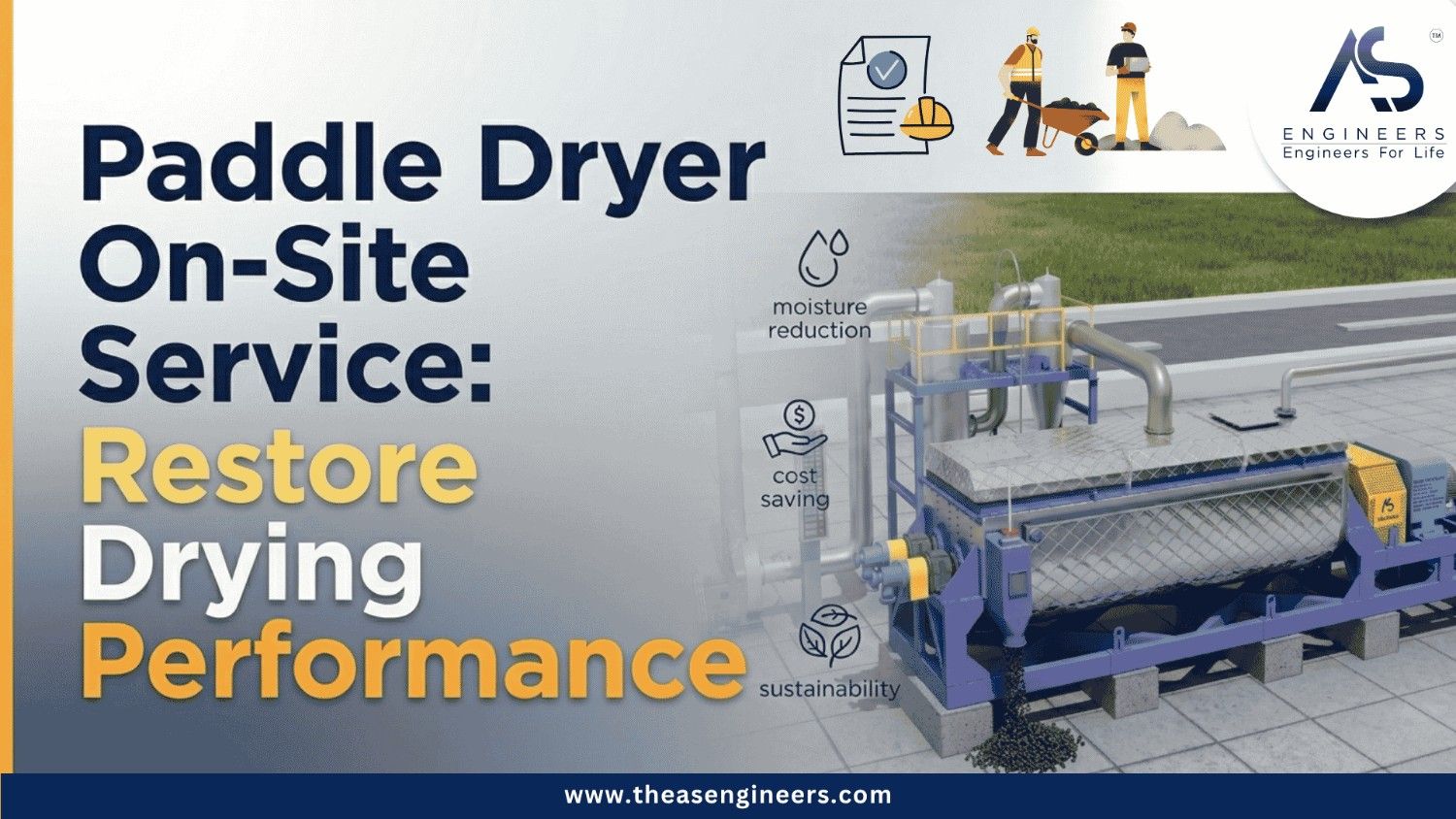
Why Paddle Dryer On-Site Service Matters After Installation
Paddle dryer on-site service is the field inspection, troubleshooting, repair, alignment, spare part replacement, operator training, and process correction done at the plant location. It helps plants restore drying performance without depending only on remote advice or trial-and-error maintenance.
A Paddle Dryer works under real plant conditions, not brochure conditions. Feed moisture changes, sludge stickiness changes, steam or thermic fluid quality changes, operators change, and discharge handling changes. Over time, even a correctly selected dryer can show lower throughput, uneven outlet moisture, abnormal noise, heating loss, bearing stress, gearbox load, or dust and vapor handling issues.
For ETP, STP, CETP, chemical, pharma, food, pigment, paper, and wastewater plants, the dryer is not just a machine. It is connected to disposal cost, compliance pressure, floor space, labor, fuel use, and production continuity. That is why on-site service should not be treated as a last emergency step. It should be part of the complete drying lifecycle.
What Does Paddle Dryer On-Site Service Include?
A proper service visit should check the dryer as a complete drying system, not only the visible mechanical problem. The field engineer should inspect mechanical condition, heating performance, feed behavior, vapor handling, discharge quality, safety risks, and operator practice.
According to AS Engineers’ service portfolio, paddle dryer support can include shaft, gearbox, and bearing replacement, system repair and upgrades, retro-fitment, OEM spare parts, on-site alignment, on-site balancing, AMC, operator training, and process optimization. Buyers evaluating AS Engineers paddle dryer services should discuss both the current fault and the operating history before planning the visit.
Common on-site service activities include checking shaft rotation, paddle condition, scraping or buildup zones, bearing temperature, gearbox vibration, leakage points, jacket heating, steam trap performance, thermic fluid circulation, feed consistency, vapor ducting, cyclone or scrubber condition, discharge flow, and panel interlocks.
This matters because one symptom can have several causes. Poor drying may look like a heater problem, but the actual issue may be uneven feed, wet sludge variation, worn paddles, poor vapor removal, excessive back-mixing, incorrect residence time, or poor discharge sealing.
When Should a Plant Call for On-Site Service?
A plant should call for paddle dryer on-site service when dryer output, safety, energy use, or mechanical reliability starts moving away from normal operating behavior. Waiting until a major breakdown usually increases shutdown time and repair cost.
The first warning sign is inconsistent final moisture. If the dryer was previously achieving acceptable dryness and now the outlet material is wet, sticky, lumpy, or uneven, the issue needs structured checking. Plants handling sludge can review sludge drying and paddle dryer technology to understand how feed moisture, heat transfer, residence time, and vapor removal work together.
Other warning signs include abnormal vibration, gearbox heating, bearing noise, shaft seal leakage, higher motor load, frequent jamming, poor discharge flow, unusual odor, vapor condensation, dust carryover, or visible material buildup inside the dryer.
For sludge applications, on-site service becomes more urgent when the dryer affects disposal schedules. Wet sludge storage creates space pressure, hygiene issues, odor problems, handling difficulty, and transport cost. If the dryer is linked to compliance or daily disposal planning, service delays can affect the whole ETP or STP operation.
Which Problems Can Be Solved at Site?
Many paddle dryer problems can be diagnosed at site because the service engineer can see the feed, operator practice, utility condition, and actual machine behavior together. This is usually better than judging only from photos or a phone call.
Mechanical problems may involve shaft wear, paddle damage, bearing issues, gearbox stress, seal leakage, coupling misalignment, uneven rotation, or vibration. Process problems may involve overfeeding, poor sludge consistency, low steam pressure, low thermic fluid temperature, vapor choking, insufficient scavenging, or wrong discharge handling.
For sticky sludge, paste, slurry, and filter cake applications, the service check should include feed preparation and upstream dewatering. A dryer cannot compensate forever for poor feed discipline. Buyers comparing sludge dewatering and drying should understand that dewatering reduces water load before the thermal dryer, while drying reduces final moisture for safer handling, disposal, or reuse.
Field service can also identify when a repair is not enough. In some cases, the correct answer is retro-fitment, upgraded spares, better feeding, improved vapor handling, revised control logic, or operator retraining.
How Should Buyers Prepare Before a Service Visit?
Good preparation makes paddle dryer on-site service faster and more accurate. The plant should share operating data, failure history, feed details, utility details, and photos before the engineer reaches site.
Useful information includes feed material type, inlet moisture range, target outlet moisture, daily operating hours, heating medium, steam pressure or thermic fluid temperature, motor load trend, gearbox and bearing observations, vibration history, discharge behavior, and recent maintenance work. For sludge applications, also share whether it is ETP sludge, STP sludge, paper sludge, textile sludge, chemical sludge, bio-sludge, or mixed sludge.
Keep the machine accessible. Arrange safe shutdown windows, cleaning access, lifting tools if needed, electrical isolation, maintenance manpower, and spare part records. Service quality drops when the engineer reaches site but the machine is hot, inaccessible, unsafe, or not ready for inspection.
For uncertain process changes, plants can also consider a paddle dryer pilot trial before major process commitments. AS Engineers has a 50 kg/hr pilot trial machine, and the trial can be used for feasibility assessment, issue identification, performance evaluation, and process optimization.
Service Decision Table for Plant Teams
The right service decision depends on the symptom, risk level, and production impact. Use this table to decide whether you need inspection, spares, retro-fitment, AMC, or process optimization.
| Site Condition | Likely Risk | Best Service Action | Buyer Decision Point |
|---|---|---|---|
| Outlet material is wetter than normal | High | Process audit plus heating and feed check | Confirm whether feed moisture or utility condition changed |
| Gearbox noise or heating | High | Mechanical inspection and possible repair | Do not continue until load and alignment are checked |
| Bearing temperature rising | High | Bearing, lubrication, and alignment check | Plan shutdown before secondary damage |
| Sticky buildup inside dryer | Medium to High | Feed, paddle, residence time, and cleaning review | Check whether material behavior has changed |
| Uneven discharge flow | Medium | Discharge, rotation, and product handling check | Review downstream conveyor or bagging restriction |
| Higher fuel or utility use | Medium | Heat transfer and vapor handling audit | Compare current operation with earlier baseline |
| Frequent emergency maintenance | High | AMC and root-cause service plan | Shift from reactive repair to planned maintenance |
| Old dryer facing new feed duty | Application-specific | Retro-fitment or process validation | Avoid assuming the old design fits the new material |
This table should not replace inspection. It helps plant engineers, procurement teams, and maintenance heads start the right discussion before ordering parts or scheduling shutdown.
Why OEM Spare Parts Are Critical During On-Site Service
OEM spare parts matter because paddle dryers depend on correct fitment, alignment, metallurgy, and operating compatibility. A low-quality replacement may run temporarily but create bigger damage in shaft, bearing, gearbox, seal, or heat-transfer performance.
Critical parts may include shafts, paddles, bearings, gearbox components, seals, couplings, rotary valves, conveyors, liners, gaskets, heating system accessories, and discharge-side components. When the dryer handles corrosive, abrasive, sticky, or high-temperature materials, material selection becomes even more important.
Plants should maintain a planned spare list instead of waiting for emergency failure. AS Engineers provides OEM paddle dryer spare parts and repair support, including shaft retrofitment solutions where required.
A strong spare strategy protects uptime. It also helps procurement avoid panic buying, wrong local substitutions, and long shutdowns caused by missing critical parts.
Can On-Site Service Improve Sludge Drying Cost?
Yes, on-site service can improve sludge drying cost when the issue is linked to heat transfer loss, poor feeding, wet feed variation, vapor restriction, material buildup, or wrong operating practice. It cannot change the basic physics of water removal, but it can reduce waste caused by poor operation.
For sludge plants, the financial impact is serious because drying affects volume, transport, storage, disposal, and reuse options. AS Engineers’ documented sludge example shows wet sludge reduction from 10 ton/day to 2 ton/day after drying, with disposal cost reducing from ₹1,00,000/day to ₹20,000/day where the disposal rate is ₹10,000/ton. Use this as an illustrative AS Engineers example, not as a universal guarantee.
Plants focused on ETP sludge management should not measure service only by repair cost. Measure it by avoided downtime, reduced wet sludge backlog, lower transport burden, improved hygiene, easier handling, and more stable outlet dryness.
Where the dried material has potential for fuel, cement, brick, fertilizer, or other approved reuse routes, stable drying also supports waste-to-value planning.
What Should an AMC Cover for Paddle Dryers?
A paddle dryer AMC should cover planned inspections, critical component checks, operating review, service reporting, preventive guidance, and spare planning. It should not be just an annual visit without measurable observations.
A practical AMC can include inspection of shaft, paddles, bearings, gearbox, seals, drive alignment, heating jacket, steam or thermic fluid circuit, feed system, discharge system, vapor handling, cyclone, scrubber, bag filter, and safety interlocks. Where the dryer is used in sludge applications, the AMC should also review feed variability, moisture target, odor, hygiene, and discharge handling.
Plants comparing dryer types should also study paddle dryers vs belt dryers because the maintenance style is different. Paddle dryers are compact indirect dryers, while belt dryers have different air handling, belt cleaning, and space requirements.
AMC is most useful for plants where downtime is expensive, operators rotate often, feed quality changes, or the dryer is linked to daily compliance and disposal commitments.
When Is Retro-Fitment Better Than Replacement?
Retro-fitment is better than full replacement when the dryer structure is usable but the duty, feed, spares, control logic, heating condition, or downstream handling needs correction. It can extend equipment life without immediately buying a new dryer.
Examples include adapting the dryer to a changed sludge type, improving discharge handling, replacing worn parts, correcting alignment issues, upgrading critical components, improving vapor-side equipment, or strengthening maintenance access. For some applications, hollow paddle dryer technology can help buyers understand why shaft, jacket, and paddle heat-transfer surfaces are central to performance.
Retro-fitment should not be used blindly. If the dryer is undersized, badly corroded, structurally compromised, or unsuitable for the new process duty, replacement may be safer.
The correct decision needs inspection, operating data, and honest discussion between plant engineering, maintenance, EHS, and procurement teams.
FAQs
1. What is paddle dryer on-site service?
Paddle dryer on-site service is technical support performed at the plant location to inspect, repair, align, troubleshoot, optimize, or maintain a paddle dryer system. It may include mechanical checks, process checks, spare replacement, operator guidance, and AMC planning.
2. When should we call for paddle dryer service?
Call for service when outlet moisture becomes inconsistent, vibration increases, gearbox or bearing temperature rises, discharge flow becomes unstable, material buildup increases, or drying cost suddenly changes. These signs should be checked before they become major shutdown failures.
3. Does on-site service include spare parts replacement?
Yes, it can include spare parts replacement when the issue requires it. For best reliability, use OEM spares for shafts, bearings, gearbox parts, seals, paddles, and other critical components because wrong-fit parts can create secondary damage.
4. Can service improve dryer performance without buying a new machine?
Yes, if the problem is caused by maintenance gaps, utility issues, feed variation, vapor restriction, worn parts, alignment error, or operating practice. If the dryer is fundamentally undersized or unsuitable for the application, replacement or major retro-fitment may be required.
5. Is paddle dryer rental available for testing or temporary needs?
AS Engineers lists paddle dryer rental service as available. Buyers should discuss the material, capacity need, site conditions, and duration before assuming rental suitability.
Closing
A paddle dryer is a long-term asset, but its performance depends on correct operation, timely service, and the right spares. If your dryer is showing uneven moisture, noise, high load, frequent jamming, or rising disposal pressure, arrange a structured inspection instead of guessing the cause. To discuss service, repair, AMC, spare parts, or site support, contact AS Engineers with your feed details, operating data, and current symptoms.

Karan Dargode leads operations and environmental health & safety at AS Engineers, an Ahmedabad-based manufacturer with over 25 years of experience in centrifugal blowers, industrial fans, paddle dryers, sludge dryers, and air pollution control equipment. He joined AS Engineers in July 2019 and has spent over six years building operational systems that support the company’s engineering and manufacturing work. His role spans business strategy execution, operational process design, EHS compliance, and policy development. Day to day, that means keeping manufacturing output consistent, ensuring workplace and environmental standards are met, and supporting the company’s growth across domestic and export markets. Education and Qualifications Karan holds a Bachelor of Engineering in Mechanical Engineering from Silver Oak College of Engineering and Technology, Ahmedabad, affiliated with Gujarat Technological University (GTU), completed in 2018. He later pursued a Post Graduate Diploma in Business Administration (PGDBA) with a focus on Operations Management from Symbiosis Centre for Distance Learning, Pune, strengthening his understanding of manufacturing strategy and industrial operations. What He Writes About The articles and posts on this site reflect what Karan works with directly. He covers: Paddle dryer selection, working principles, and industrial applications Sludge drying technology for ETP and CETP operators Centrifugal blower engineering and maintenance Industrial drying process optimization EHS compliance for industrial manufacturing units His writing is technical without being academic. The goal is straightforward: give plant engineers, ETP operators, and procurement managers the specific information they need to make good equipment decisions. At AS Engineers AS Engineers has manufactured industrial equipment since 1997, serving clients across chemicals, pharmaceuticals, food processing, wastewater treatment, and heavy industry. The Ahmedabad facility at GIDC Vatva handles design, fabrication, and testing in-house. Karan’s work at the operations level puts him directly involved with product delivery quality, production planning, and customer-facing timelines. If you have questions about any article on this site or want to discuss a specific application for blowers, dryers, or air pollution control equipment, you can reach the AS Engineers team through the contact page. Contact AS Engineers