
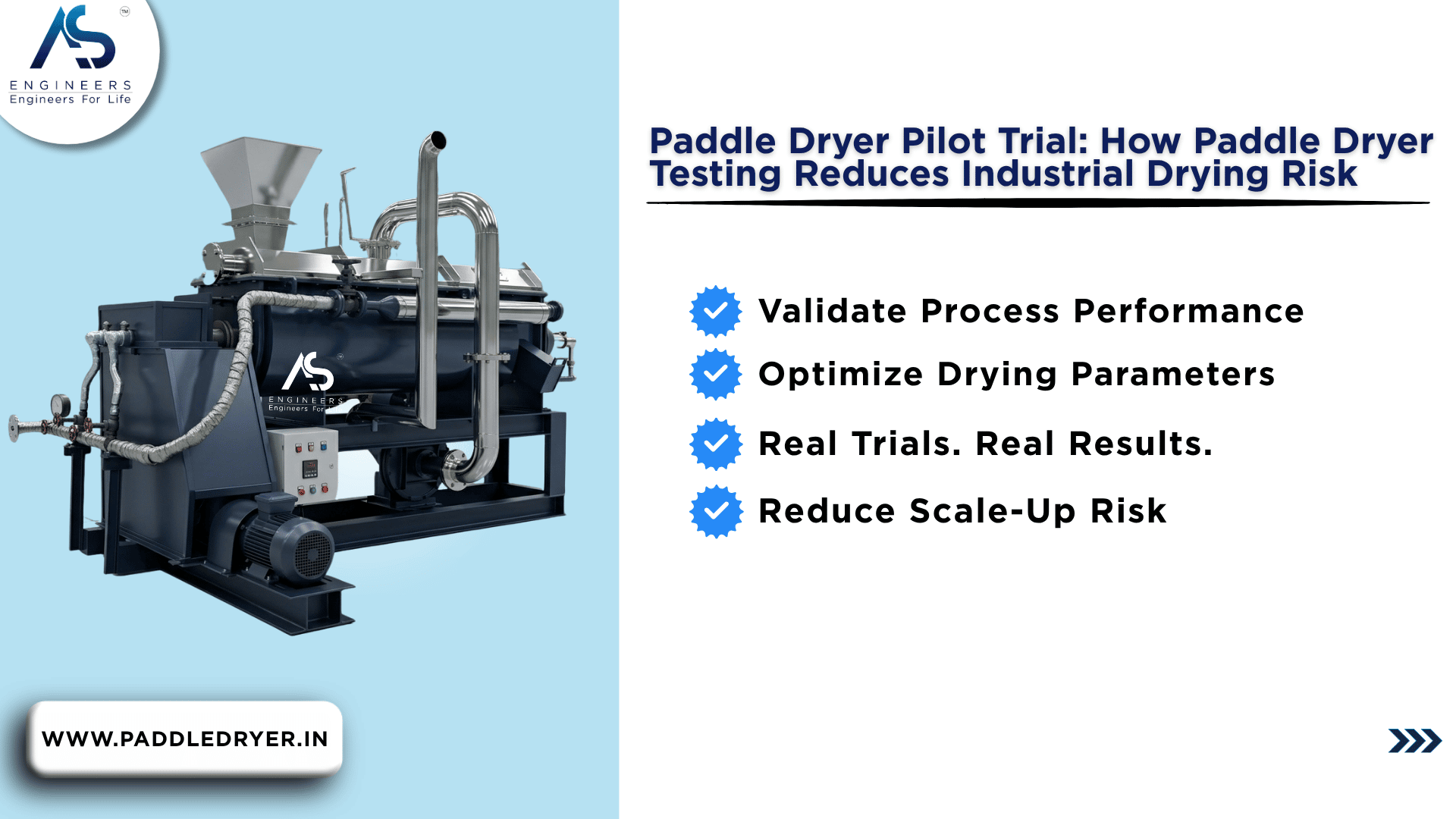
Paddle Dryer Pilot Trial: Why Testing Comes Before Confident Buying
A paddle dryer pilot trial helps buyers test real feed material before committing to a full-scale drying system. For sludge, paste, cake, powder, granules, or heat-sensitive material, paddle dryer testing gives practical answers about drying behaviour, discharge quality, moisture reduction, handling, vapour load, and scale-up risk.
Many industrial buyers compare dryer brochures, but drying success depends on the material. Two sludges with the same moisture percentage can behave differently because of stickiness, bound moisture, fibre, salt, oil, solvents, particle size, or biological content. That is why a pilot trial is not just a demonstration. It is a technical decision tool.
AS Engineers offers a 50 kg/hr pilot trial machine for demonstrations at AS Engineers’ works or at the client’s site, with a minimal paid basis and fee waiver upon order placement. Buyers evaluating an industrial paddle dryer can use this trial stage to move from assumption to evidence.
What Does Paddle Dryer Testing Prove Before Commercial Installation?
Paddle dryer testing proves whether the selected drying approach can handle the buyer’s actual material under practical operating conditions. It shows how the feed changes inside the dryer, how easily it discharges, and whether the target moisture level is realistic. It also helps the buyer understand utilities, odour, vapour, fines, and downstream handling needs.
The most important proof is not only final dryness. A good test observes the complete material transition. In a paddle dryer, material may move from plastic or sticky form to a sheared phase and then to a more granular or manageable dried product. This change affects power requirement, heat transfer, discharge design, and product handling.
For sludge buyers, this is especially important. Wet sludge may look simple in a sample bag, but during heating it may foam, stick, smear, cake, release odour, or generate fines. A proper sludge drying guide helps explain the thermal drying logic, but pilot testing confirms the material-specific behaviour.
Why Real Feed Behaviour Matters More Than Generic Dryer Claims
Real feed behaviour matters because drying equipment does not process moisture alone. It processes a complete material system. Moisture type, solids composition, stickiness, heat sensitivity, salt content, oil content, and particle structure can change the actual performance of any dryer.
A buyer may ask, “Can this dryer achieve high dryness?” The better question is, “Can this dryer achieve the required dryness for my material while maintaining safe discharge, stable operation, and acceptable utility cost?” That is where paddle dryer testing becomes valuable.
AS Engineers’ paddle dryer technology uses indirect heat transfer through hollow shafts and jacketed surfaces. The design supports steam, thermic fluid, atmospheric operation, vacuum operation, and pressurized conditions depending on the application. Buyers can also review the paddle dryer working principle to understand how agitation, heat transfer, and self-cleaning paddle action affect drying.
What Should Buyers Measure During a Paddle Dryer Pilot Trial?
A pilot trial should measure more than inlet and outlet moisture. It should capture process behaviour, drying quality, handling condition, vapour management, operational stability, and scale-up indicators. This prevents weak decisions based only on a visually dry sample.
| Trial Checkpoint | What to Observe | Buyer Decision It Supports | Risk Reduced |
|---|---|---|---|
| Feed consistency | Slurry, paste, cake, powder, granule, lumps | Feeding method and pre-conditioning need | Poor feeding design |
| Stickiness phase | Smearing, coating, lumping, self-cleaning response | Paddle geometry and residence time review | Build-up and choking |
| Moisture reduction | Initial moisture vs target outlet moisture | Feasibility of required dryness | Wrong performance expectation |
| Discharge quality | Granular, powdery, lumpy, dusty, sticky | Conveyor, bagging, silo, or disposal method | Downstream handling failure |
| Heat sensitivity | Colour, odour, degradation, product quality | Steam, thermic fluid, or vacuum selection | Product damage |
| Vapour and odour | Water vapour, solvent vapour, smell, fines | Scrubber, condenser, cyclone, chimney need | Emission control gap |
| Energy response | Heating medium requirement and drying difficulty | Utility planning | Underestimated running cost |
| Maintenance warning signs | Abrasion, sticking, fines, corrosive behaviour | MOC and surface finish choice | Premature wear |
This table should be used as a buyer-side discussion checklist. Exact values are application-specific and should be validated through testing, not guessed from a generic range.
How AS Engineers Uses Pilot Trials for Practical Dryer Selection
AS Engineers uses pilot trials to evaluate performance, identify issues, optimize the process, and assess feasibility before a commercial order. This is useful for plants where disposal cost, compliance pressure, material variability, or capex approval risk is high. The trial can support both technical teams and purchase teams with practical evidence.
The paddle dryer pilot trial is especially useful when the buyer is unsure about final moisture, sticky-phase handling, heating medium, emissions, or discharge quality. It can also help compare whether a standard dryer, dual zone dryer, or vacuum dryer is more suitable.
For buyers who want temporary operation, demonstration, or commercial flexibility, AS Engineers also lists a Paddle Dryer Rental Service. Rental and pilot testing are not the same decision, but both can help buyers reduce uncertainty before long-term system commitment.
Which Materials Need Paddle Dryer Testing Most?
Paddle dryer testing is most valuable for materials that are sticky, variable, heat-sensitive, solvent-bearing, corrosive, abrasive, or difficult to discharge. It is also important where final dried output may become fuel, fertilizer input, cement feed, brick material, or a disposal-reduction product.
ETP sludge, STP sludge, CETP sludge, paper sludge, bio-sludge, chemical cake, pigments, dyes, pharma intermediates, food residues, minerals, polymers, and metal powders often need validation. A buyer managing ETP sludge management should not depend only on moisture percentage. The sludge source, treatment chemistry, filter press output, and disposal route all matter.
For waste teams, the paddle sludge dryer selection should also consider whether the dried product will be handled manually, conveyed, bagged, stored, sold, incinerated, or sent to a co-processing route. A pilot trial helps confirm that the dried output is actually manageable.
What Mistakes Should Buyers Avoid During Paddle Dryer Testing?
Buyers often weaken pilot testing by sending an unrepresentative sample. A clean, one-time sample may not show seasonal variation, process upset, chemical dosing change, or worst-case moisture condition. A useful pilot trial should reflect normal and difficult feed behaviour as closely as possible.
Another mistake is judging only by appearance. A dried sample may look acceptable, but it may still contain excess bound moisture, generate dust, absorb moisture again, or create handling problems. Final evaluation should include moisture, texture, temperature sensitivity, dusting, odour, and storage behaviour.
Buyers should also avoid testing without a clear target. Before the trial, define the required outlet moisture, disposal route, heating medium preference, available utilities, emission expectations, and site constraints. For technology comparison, reviewing paddle dryers vs belt dryers can also help buyers understand why compact indirect drying may be preferred for certain sticky or high-moisture materials.
How Pilot Results Convert Into Final Paddle Dryer Design
Pilot results help convert raw material behaviour into engineering decisions. The trial can influence dryer type, heat transfer area, residence time, feeding system, discharge system, heating medium, pollution control system, material of construction, and automation level. This is where testing becomes directly useful for quotation and project planning.
AS Engineers’ paddle dryer systems can include feeding equipment, dryer body, heating system, scavenging arrangement, pollution control equipment, solvent recovery or discharge setup, and dried product handling. Depending on the application, buyers may also need cyclone separator, scrubber, bag filter, condenser, screw conveyor, silo, or bagging system.
For sticky or difficult materials, buyers may review hollow paddle dryers because indirect heat through hollow shafts and jacketed surfaces is central to the technology. For after-sales planning, Paddle Dryer Services and paddle dryer training and spare parts are also important after the machine is selected.
When Is a Paddle Dryer Pilot Trial Worth the Time?
A pilot trial is worth the time when drying failure would be expensive. If the material is new, sticky, variable, hazardous, solvent-bearing, or linked to compliance, testing should be treated as part of responsible procurement. It is also worth doing when the buyer needs internal approval from plant, EHS, finance, and management teams.
For global buyers, pilot testing reduces communication gaps between plant reality and supplier assumptions. It gives practical evidence for material handling, process feasibility, utility planning, and final equipment scope. That is more reliable than buying only from a datasheet.
AS Engineers, based in GIDC Vatva, Ahmedabad, Gujarat, India, positions itself as “The Leading Name in Paddle Dryer Industry” and brings 25+ years of experience, ISO 9001:2015 TUV India certification, CE certification, and a dedicated paddle dryer focus. For serious industrial buyers, the pilot trial is the correct stage to ask hard questions before approving full-scale drying equipment.
FAQs
1. Is a paddle dryer pilot trial the same as a laboratory moisture test?
No. A laboratory moisture test tells you how much moisture is present, but a paddle dryer pilot trial shows how the real material behaves during drying. It helps evaluate stickiness, discharge, heat response, vapour load, dried texture, and practical handling.
2. Can paddle dryer testing be done at the buyer’s site?
Yes, AS Engineers states that pilot trials can be conducted at AS Engineers’ facility or at the client’s site, depending on practical feasibility. Site testing may be useful when material movement, odour, utility connection, or confidentiality is important.
3. What material should be sent for pilot dryer testing?
The sample should represent actual plant feed, not only the best-looking batch. Buyers should include normal operating material and, where possible, difficult material with high moisture, stickiness, or process variation.
4. Does a successful pilot trial guarantee commercial dryer performance?
A pilot trial reduces risk but should not be treated as a blind guarantee. Commercial performance still depends on correct scale-up, feeding design, utilities, installation, controls, operation, maintenance, and variation in feed material.
5. Is paddle dryer testing useful for sludge disposal cost reduction?
Yes. Testing helps confirm whether wet sludge can be dried into a lower-volume, easier-to-handle output. This supports decisions related to transport cost, disposal route, storage space, hygiene, compliance, and possible waste-to-value use.
Before approving a commercial dryer, test the real material. A paddle dryer pilot trial helps plant engineers, EHS teams, consultants, and procurement teams make a safer drying decision based on feed behaviour, outlet quality, and process evidence. To discuss pilot testing, rental options, or a project-specific drying requirement, connect with AS Engineers for a practical technical review.

Karan Dargode leads operations and environmental health & safety at AS Engineers, an Ahmedabad-based manufacturer with over 25 years of experience in centrifugal blowers, industrial fans, paddle dryers, sludge dryers, and air pollution control equipment. He joined AS Engineers in July 2019 and has spent over six years building operational systems that support the company’s engineering and manufacturing work. His role spans business strategy execution, operational process design, EHS compliance, and policy development. Day to day, that means keeping manufacturing output consistent, ensuring workplace and environmental standards are met, and supporting the company’s growth across domestic and export markets. Education and Qualifications Karan holds a Bachelor of Engineering in Mechanical Engineering from Silver Oak College of Engineering and Technology, Ahmedabad, affiliated with Gujarat Technological University (GTU), completed in 2018. He later pursued a Post Graduate Diploma in Business Administration (PGDBA) with a focus on Operations Management from Symbiosis Centre for Distance Learning, Pune, strengthening his understanding of manufacturing strategy and industrial operations. What He Writes About The articles and posts on this site reflect what Karan works with directly. He covers: Paddle dryer selection, working principles, and industrial applications Sludge drying technology for ETP and CETP operators Centrifugal blower engineering and maintenance Industrial drying process optimization EHS compliance for industrial manufacturing units His writing is technical without being academic. The goal is straightforward: give plant engineers, ETP operators, and procurement managers the specific information they need to make good equipment decisions. At AS Engineers AS Engineers has manufactured industrial equipment since 1997, serving clients across chemicals, pharmaceuticals, food processing, wastewater treatment, and heavy industry. The Ahmedabad facility at GIDC Vatva handles design, fabrication, and testing in-house. Karan’s work at the operations level puts him directly involved with product delivery quality, production planning, and customer-facing timelines. If you have questions about any article on this site or want to discuss a specific application for blowers, dryers, or air pollution control equipment, you can reach the AS Engineers team through the contact page. Contact AS Engineers