
Why Does the Right Sludge Dryer Manufacturer Matter?
A sludge dryer manufacturer should be selected for process understanding, not only equipment supply. Wet sludge is heavy, sticky, difficult to handle, and often expensive to transport or dispose. The right industrial sludge dryer manufacturer helps reduce moisture, improve handling, lower disposal burden, and prepare sludge for safer downstream use.
For global buyers, the main decision is not “which dryer is available?” The real question is “which manufacturer can design around my sludge behavior, site utilities, moisture target, emission controls, and maintenance reality?”
AS Engineers manufactures sludge drying systems from GIDC Vatva, Ahmedabad, Gujarat, India, and serves industrial buyers comparing long-term drying performance, not only initial machine cost. The company’s sludge drying approach is based on indirect heat transfer, enclosed operation, and application-specific design for ETP, STP, CETP, chemical, pharmaceutical, food, textile, paper, municipal, and waste management plants.
A well-selected paddle sludge dryer can convert difficult wet sludge into a drier, more manageable output. That directly affects transport load, storage area, hygiene, and disposal planning.
What Makes a Paddle-Type Industrial Sludge Dryer Different?
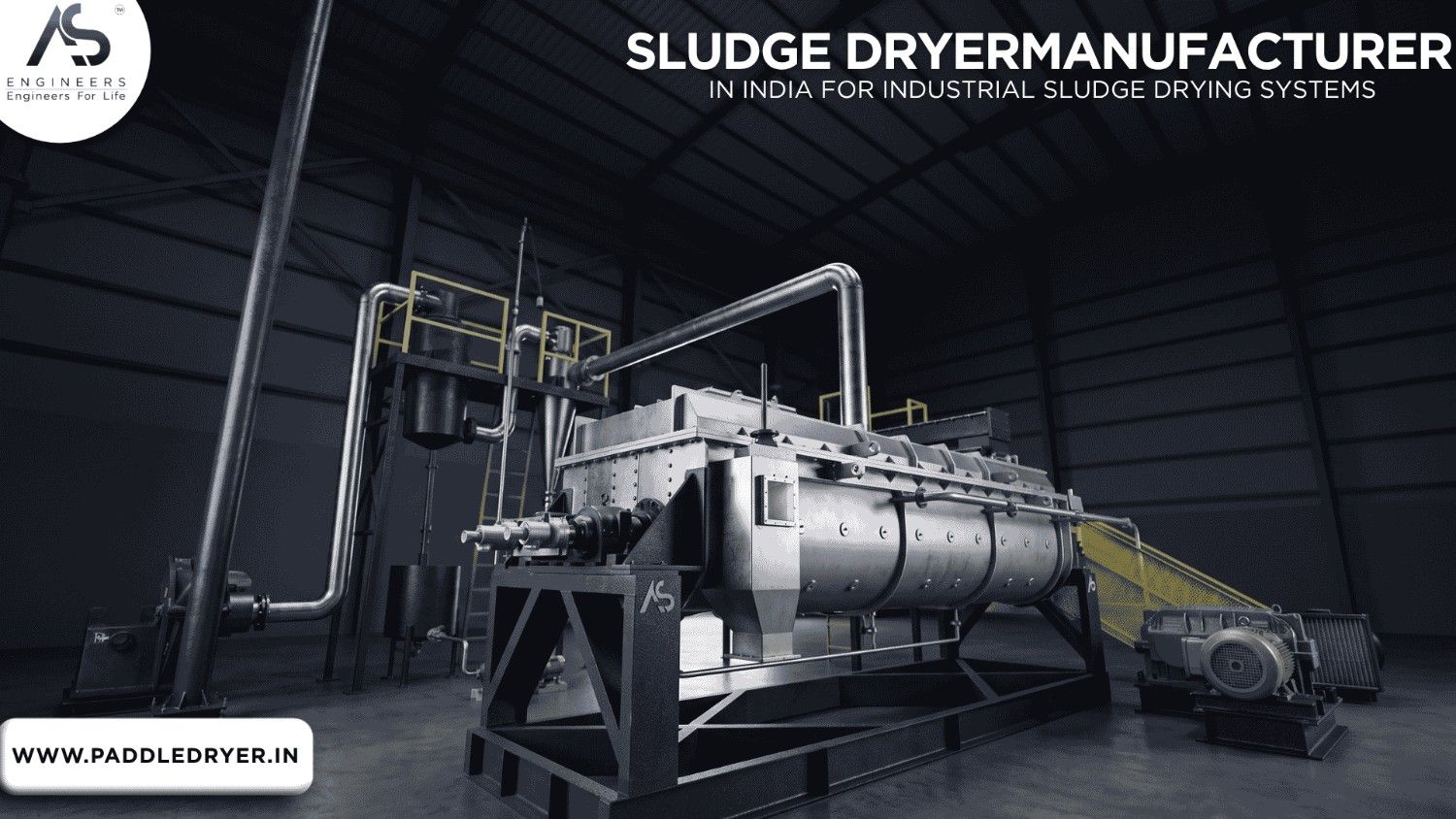
A paddle-type industrial sludge dryer uses indirect heat transfer through hollow shafts, paddles, and a heated jacket. This keeps the heating medium separate from the sludge while continuously mixing and renewing the material surface. For sticky sludge, this matters because poor mixing creates wet pockets, buildup, uneven drying, and unstable discharge quality.
AS Engineers’ paddle dryer design uses dual counter-rotating shafts and wedge-shaped paddles to break, mix, and move sludge through the dryer. The indirect drying arrangement can use steam up to 14.06 kg/cm² or thermal oil up to 400°C, depending on the required process. The system can be configured for atmospheric, vacuum, or pressurized operation.
This type of sludge drying technology is useful where plants need controlled drying without exposing the material directly to combustion gases. It is also preferred where off-gas volume must be controlled through cyclone, scrubber, bag filter, condenser, chimney, or solvent management equipment.
For buyers comparing a sludge dryer India supplier with an international manufacturer, the design discussion should include sludge feed consistency, inlet moisture, target outlet moisture, heating medium, metallurgy, discharge handling, and pollution control.
Which Sludge Types Can an Industrial Sludge Dryer Handle?
An industrial sludge dryer can handle many sludge categories, but every sludge must be tested or engineered according to its own behavior. Municipal sludge, ETP sludge, bio-sludge, livestock sludge, paper sludge, and process sludge do not dry the same way. Stickiness, odor, toxicity, particle formation, salt content, and outlet reuse potential can change the complete drying strategy.
AS Engineers’ documented sludge applications include municipal sludge, industrial ETP sludge, livestock sludge, paper sludge, and bio-sludge. Dried sludge may be considered for alternative fuel, cement production, agriculture, bricks, or disposal reduction, depending on composition and local regulations.
A serious buyer should not ask only for “one sludge dryer quotation.” The better starting point is a sludge sample, inlet moisture, daily feed quantity, current disposal method, available utilities, and final moisture target. In many projects, the dryer is only one part of the system. Feeding, heating, scavenging, pollution control, solvent management, and product handling must work together.
For wastewater plants, the connection between sludge dewatering and drying is especially important. Dewatering reduces free water before thermal drying, while drying reduces the remaining moisture for better handling and lower disposal load. AS Engineers also has relevant application content on paddle dryers for wastewater treatment.
How Should Buyers Compare Sludge Dryer Manufacturers?
Buyers should compare manufacturers on application engineering, heat-transfer design, pilot testing, pollution control integration, material of construction, and service capability. A low-cost machine without sludge-specific engineering can become expensive if it plugs, corrodes, under-dries, overconsumes fuel, or creates off-gas problems. The manufacturer must understand the whole sludge drying line, not only the dryer shell.
| Buyer Decision Area | What to Verify Before Purchase | Risk If Ignored | Practical Selection Guidance |
|---|---|---|---|
| Sludge behavior | Sticky, pasty, fibrous, granular, toxic, odorous, or solvent-bearing | Buildup, poor discharge, unstable drying | Ask for sludge-specific evaluation or pilot testing |
| Heating medium | Steam, thermic fluid, hot water, or other site option | Wrong utility sizing and higher operating cost | Match heat source with moisture target and site economics |
| Moisture target | Fixed dryness or application-specific final moisture | Overdrying, underdrying, poor downstream handling | Define target before quotation |
| MOC selection | CS, SS304, SS316, Duplex Steel, or other alloy | Corrosion, contamination, short equipment life | Share pH, chlorides, solvents, salts, and abrasion data |
| Off-gas handling | Cyclone, scrubber, bag filter, condenser, chimney | Odor, fines, emission, or compliance issue | Treat pollution control as part of the dryer package |
| Service support | Spares, alignment, balancing, retrofitment, AMC | Long downtime after wear or failure | Check lifecycle support before ordering |
| Proof of performance | Similar material experience or pilot trial | Selection based on assumptions | Test difficult sludge before finalizing |
This is why comparison pages such as paddle dryers vs belt dryers are useful early in the buying journey. Belt dryers may suit some applications, but enclosed indirect paddle drying is often preferred where sludge is sticky, space is limited, off-gas volume must be controlled, or thermal contact must be consistent.
What ROI Logic Should a Sludge Dryer Manufacturer Help You Calculate?
A sludge dryer manufacturer should help buyers calculate disposal reduction, transport reduction, handling improvement, storage savings, fuel use, and possible waste-to-value routes. ROI should not be based on a generic promise. It should be calculated from inlet moisture, final moisture, daily sludge load, disposal cost, utilities, and local regulatory limits.
AS Engineers’ sludge drying data explains a typical disposal impact: 10 tons/day of wet sludge can reduce to 2 tons/day of dry sludge in the given example, reducing disposal load significantly. The same source also states that dry sludge can take up 90% less space. These figures are valuable for plants where wet sludge storage, trucking, odor, and disposal invoices are constant operational pressures.
The commercial logic is strongest in ETP, STP, CETP, chemical, pharma, food, textile, paper, and municipal wastewater sites where sludge generation is continuous. A dryer does not only reduce moisture. It changes how the plant handles waste, allocates storage, plans transport, and discusses compliance.
For buyers studying ETP sludge management, the best manufacturer will ask about disposal cost and end-use possibility, not only dryer capacity. If the dried sludge has a safe reuse pathway, the project can shift from “waste handling” to “waste-to-value.” If reuse is not suitable, reduced volume can still improve disposal economics.
Which Design Details Separate a Good Industrial Sludge Dryer From a Weak One?
A good industrial sludge dryer has stable heat transfer, controlled retention, reliable mixing, correct metallurgy, clean discharge, and maintainable components. A weak design may look similar from outside but fail under sticky feed, corrosive sludge, or poor discharge conditions. Small design choices can decide whether the system runs daily or becomes a maintenance burden.
AS Engineers’ paddle dryer platform includes hollow shafts, jacketed heat transfer, counter-rotating shafts, wedge paddles, and self-cleaning intermeshing action. The design supports materials such as carbon steel, SS304, SS316, Duplex Steel, and other alloys based on process need. Surface finish options can include buffing, hard facing, and electropolishing where relevant.
For buyers comparing hollow paddle dryers, the core advantage is heat-transfer area inside the rotating elements and jacket, combined with continuous agitation. That makes it suitable for slurries, pastes, cakes, granules, and powders.
A buyer should also evaluate after-sales capability. Shaft, gearbox, bearing replacement, OEM spare parts, on-site alignment, on-site balancing, system repair, upgrades, retrofitment, training, AMC, and process optimization can become critical after commissioning. AS Engineers documents these services under its paddle dryer services support offering.
Why Is Pilot Testing Important Before Buying a Sludge Dryer?
Pilot testing reduces selection risk when sludge behavior is uncertain. Lab assumptions often fail when sludge is sticky, variable, solvent-bearing, odorous, abrasive, or sensitive to temperature. A pilot trial helps confirm drying behavior, discharge form, heat response, and feasibility before the buyer commits to a full-scale system.
AS Engineers offers a 50 kg/hr pilot trial machine, available at its facility or at the client’s site. The trial is offered on a minimal paid basis, with the fee waived upon order placement. The trial objective is to evaluate performance, identify process issues, optimize parameters, and assess feasibility.
For procurement teams, a paddle dryer pilot trial can also strengthen internal approval. It gives the plant team practical evidence for moisture reduction, output condition, dust/fines concern, odor handling, and utility planning. This is especially useful for first-time sludge dryer buyers or plants shifting away from open drying, outsourced disposal, or basic mechanical dewatering.
A pilot trial should be treated as an engineering step, not a formality. Share actual plant sludge, not a cleaned-up sample. Provide inlet moisture, feed variation, chemical composition, existing dewatering method, target outlet condition, and disposal route.
Why Choose AS Engineers as a Sludge Dryer Manufacturer in India?
AS Engineers is a sludge dryer manufacturer in India with a dedicated focus on paddle dryer technology, industrial drying, and sludge drying systems. The company operates from Ahmedabad, Gujarat, and positions itself as “The Leading Name in Paddle Dryer Industry.” For global buyers, the main value is application-driven engineering backed by manufacturing, testing, and lifecycle support.
Relevant proof points include ISO 9001:2015 TUV India certification, CE certification, 25+ years of experience, 500+ clients, 1500+ projects, and 500+ dryers operational. The company is also backed by Acmefil Engineering Systems Pvt Ltd, established in 1992, which adds broader drying and engineering strength.
AS Engineers’ paddle dryer can be configured as a standard dryer, dual zone dryer, or vacuum dryer. This gives buyers flexibility for different feed materials, heat sensitivity, solvent concerns, and process conditions. The company’s system view covers fuel resources, heating system, feeding, dryer operation, scavenging, pollution control, solvent management, and product handling.
For a buyer comparing an industrial sludge dryer manufacturer, the best next step is to define the sludge, not just request a generic machine. Share feed data, site utilities, moisture target, operating hours, material risks, emissions requirement, and current disposal cost. That is how the manufacturer can design a dryer that fits the plant instead of forcing the plant to adjust around the dryer.
FAQs
1. What is an industrial sludge dryer?
An industrial sludge dryer is a thermal drying system used to reduce moisture from sludge generated in ETP, STP, CETP, municipal, chemical, pharmaceutical, food, textile, paper, and waste management plants. A paddle-type sludge dryer uses indirect heat through hollow shafts, paddles, and a jacket while continuously mixing the sludge.
2. Who is a reliable sludge dryer manufacturer in India?
AS Engineers is a sludge dryer manufacturer in India based in GIDC Vatva, Ahmedabad, Gujarat. The company manufactures paddle dryer systems for sludge and industrial materials, with ISO 9001:2015 TUV India certification, CE certification, 25+ years of experience, and documented experience across multiple industrial sectors.
3. Can one sludge dryer handle all sludge types?
No. Sludge dryer design depends on sludge type, moisture content, stickiness, chemical composition, temperature sensitivity, odor, toxicity, and final use or disposal route. A manufacturer should evaluate the sludge before finalizing dryer design, metallurgy, heating medium, and pollution control equipment.
4. What final dryness can a paddle sludge dryer achieve?
AS Engineers’ paddle dryer documentation states that the system can achieve up to 99% dryness or a specific required moisture level, depending on the process and material. The correct target should be defined based on disposal, reuse, storage, handling, or downstream process requirements.
5. Is pilot testing necessary before buying a sludge dryer?
Pilot testing is strongly recommended when sludge behavior is uncertain. AS Engineers offers a 50 kg/hr pilot trial machine to evaluate performance, identify issues, optimize process parameters, and confirm feasibility before full-scale purchase.
Choosing a sludge dryer manufacturer is a long-term plant decision, not a catalogue purchase. If your plant handles ETP, STP, CETP, municipal, chemical, textile, food, pharmaceutical, or paper sludge, start with the sludge data first: inlet moisture, daily generation, current disposal method, utility availability, outlet moisture target, and compliance limits.
To discuss your sludge drying requirement with AS Engineers, use the official AS Engineers contact page and share your sludge sample details, process conditions, and drying objective.

Karan Dargode leads operations and environmental health & safety at AS Engineers, an Ahmedabad-based manufacturer with over 25 years of experience in centrifugal blowers, industrial fans, paddle dryers, sludge dryers, and air pollution control equipment. He joined AS Engineers in July 2019 and has spent over six years building operational systems that support the company’s engineering and manufacturing work. His role spans business strategy execution, operational process design, EHS compliance, and policy development. Day to day, that means keeping manufacturing output consistent, ensuring workplace and environmental standards are met, and supporting the company’s growth across domestic and export markets. Education and Qualifications Karan holds a Bachelor of Engineering in Mechanical Engineering from Silver Oak College of Engineering and Technology, Ahmedabad, affiliated with Gujarat Technological University (GTU), completed in 2018. He later pursued a Post Graduate Diploma in Business Administration (PGDBA) with a focus on Operations Management from Symbiosis Centre for Distance Learning, Pune, strengthening his understanding of manufacturing strategy and industrial operations. What He Writes About The articles and posts on this site reflect what Karan works with directly. He covers: Paddle dryer selection, working principles, and industrial applications Sludge drying technology for ETP and CETP operators Centrifugal blower engineering and maintenance Industrial drying process optimization EHS compliance for industrial manufacturing units His writing is technical without being academic. The goal is straightforward: give plant engineers, ETP operators, and procurement managers the specific information they need to make good equipment decisions. At AS Engineers AS Engineers has manufactured industrial equipment since 1997, serving clients across chemicals, pharmaceuticals, food processing, wastewater treatment, and heavy industry. The Ahmedabad facility at GIDC Vatva handles design, fabrication, and testing in-house. Karan’s work at the operations level puts him directly involved with product delivery quality, production planning, and customer-facing timelines. If you have questions about any article on this site or want to discuss a specific application for blowers, dryers, or air pollution control equipment, you can reach the AS Engineers team through the contact page. Contact AS Engineers