
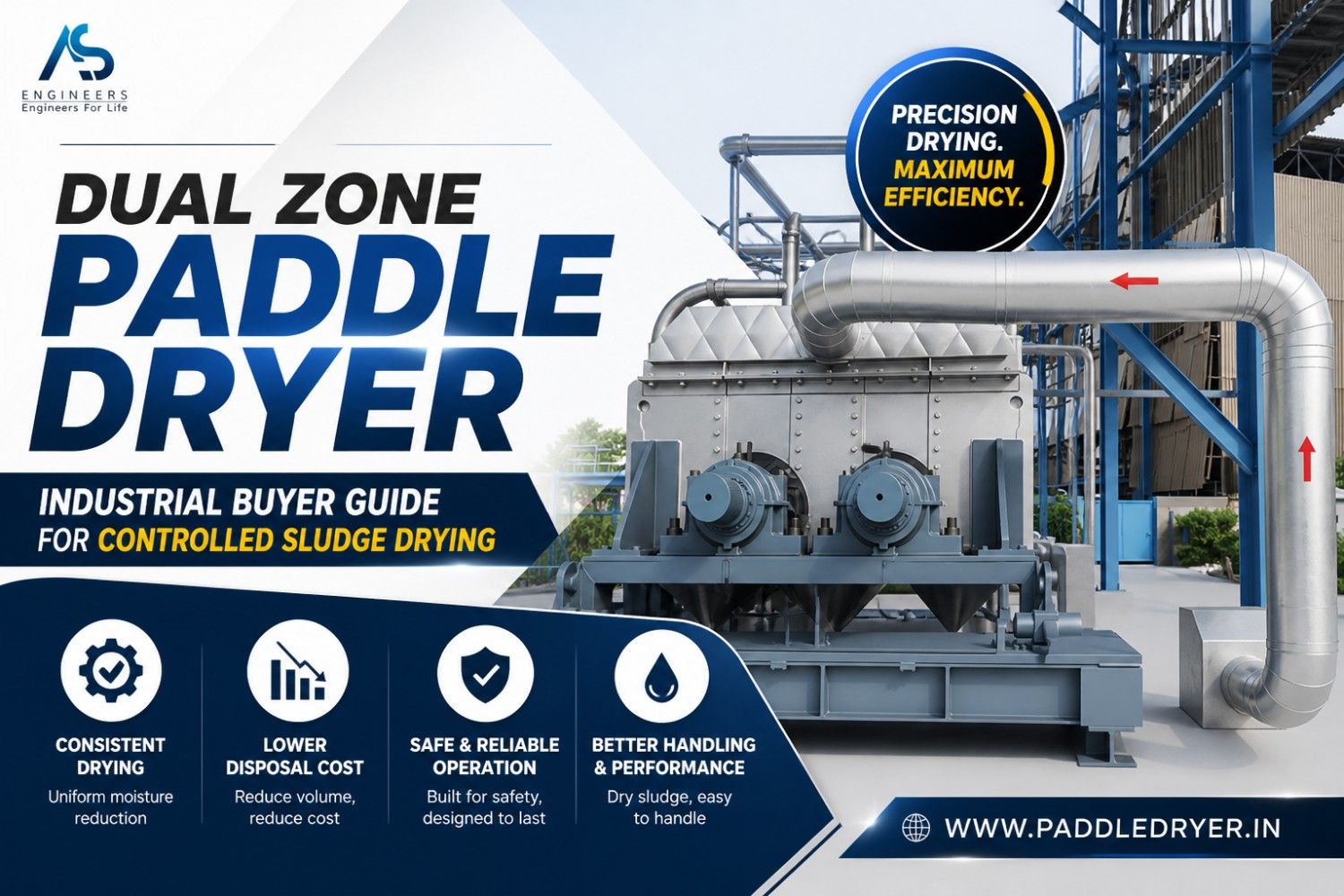
What Is a Dual Zone Paddle Dryer?
A dual zone paddle dryer is a paddle dryer configuration used when a process needs controlled drying behavior across the material path. Instead of treating the full dryer length as one uniform process area, buyers evaluate the feed-side and discharge-side drying needs more carefully.
In practical terms, the purpose is not only to remove moisture. The real goal is stable heat transfer, controlled material movement, safer discharge moisture, and lower handling risk after drying.
AS Engineers lists Dual Zone Dryer as one of its paddle dryer design variants, along with standard dryer and vacuum dryer configurations. The same core paddle dryer principles remain important: indirect heat transfer through hollow shafts and jacket, dual counter-rotating shafts, wedge-shaped paddles, agitation, plug-flow behavior, and a self-cleaning paddle action.
For buyers comparing an industrial paddle dryer for sludge, chemicals, minerals, food, pharma, pigments, or waste management, the dual-zone discussion should begin with feed behavior. Sticky, plastic, paste-like, or high-moisture material may behave very differently at the inlet compared with the semi-dry or granular material near discharge.
How Does a Dual Zone Paddle Dryer Work in an Industrial Drying Line?
A dual zone paddle dryer works as part of a complete drying system, not as a standalone shell. Feeding, heating, vapor handling, pollution control, solvent management, and dried product handling all affect the final result.
According to AS Engineers, paddle dryers use hollow shafts and jacketed heat transfer surfaces to dry materials indirectly. This is useful when the buyer wants controlled drying with lower off-gas volume compared with direct hot-air drying.
A typical paddle drying line may include a wet material silo, screw feeder, belt conveyor, sludge pump, heating system, paddle dryer, scavenging system, cyclone, scrubber, condenser, chimney, discharge conveyor, silo, or bagging system. In a dual-zone configuration, the buyer should review how each section supports moisture removal, material movement, vapor release, and discharge quality.
For sludge drying, the dryer must handle the transition from wet cake or paste to a drier, more manageable product. This is why the sludge drying guide for paddle dryer technology is useful before finalizing equipment selection.
Where Does Dual-Zone Control Matter Most?
Dual-zone control matters most when material behavior changes strongly during drying. Wet sludge, chemical cake, filter press cake, bio-sludge, pigments, and sticky pastes can move through different physical stages before becoming dry enough for conveying or disposal.
AS Engineers describes the paddle drying process as moving material through a plastic, shearing, and granular phase. That phase change is one reason buyers should not select a dryer only from inlet moisture and outlet moisture targets.
In the first zone, the dryer often has to manage wet feed, stickiness, lump formation, and vapor load. In the later zone, the focus can shift toward final moisture, discharge consistency, dust/fines control, product cooling needs, and safe handling.
This is especially relevant for ETP, STP, and CETP operators looking at sludge dewatering and drying. Dewatering reduces free water, but thermal drying decides how much volume, weight, odor, and disposal burden remain.
Dual Zone Paddle Dryer Selection Table for Buyers
A dual zone paddle dryer should be selected around process risk, not only equipment name. The right question is whether the material needs different drying attention across the feed, middle, and discharge behavior.
The table below gives buyers a practical screening view before asking for a technical quotation.
| Buyer Decision Point | Why It Matters in Dual-Zone Drying | Selection Signal | Risk If Ignored |
|---|---|---|---|
| Feed moisture variation | High variation changes heat load and residence behavior | Requires testing | Unstable outlet moisture |
| Stickiness at inlet | Wet sludge or paste may build up if not handled correctly | High importance | Fouling, torque load, poor movement |
| Final moisture target | Dryness requirement affects residence time and heat duty | Application-specific | Overdrying or underdrying |
| Heating medium | Steam or thermal oil selection affects temperature range | Depends on site utility | Wrong utility planning |
| Vapor handling | Evaporated water or solvent must be managed safely | High importance | Condensation, odor, emission issues |
| Material of construction | Corrosive or abrasive feed needs suitable MOC | Application-specific | Shorter equipment life |
| Discharge handling | Dry product may be granular, dusty, or reusable | Medium to high | Poor bagging or conveying |
| Pilot trial need | Uncertain feed behavior needs validation | Requires testing | Wrong dryer sizing or expectations |
AS Engineers supports indirect heating with steam up to 14.06 kg/cm² or thermal oil up to 400°C, depending on the application. For buyers comparing indirect drying with other options, paddle dryers vs belt dryers is a useful comparison point.
What Should You Verify Before Buying a Dual Zone Paddle Dryer?
Before buying a dual zone paddle dryer, verify the feed sample, inlet moisture, target outlet moisture, heating medium, MOC, vapor load, discharge method, and operating pressure. Do not finalize the dryer only from a keyword or equipment category.
The most expensive mistake is assuming that all sludge or all wet cake behaves the same. In real plants, two materials with the same moisture percentage can have completely different stickiness, odor, particle behavior, and drying response.
Ask these questions before final selection: Is the feed pumpable or conveyable? Does it form lumps? Does it contain solvents or only water? Is the dried output going for disposal, fuel, cement, bricks, fertilizer, or reuse? Is the site prepared for cyclone, scrubber, condenser, chimney, or bagging equipment?
A pilot test is often the safest step when feed behavior is uncertain. AS Engineers offers a 50 kg/hr pilot trial machine at its works or at the client’s site, with the trial cost waived upon order placement. Buyers can review the paddle dryer pilot trial option before committing to full-scale equipment.
Why Is Dual-Zone Drying Important for Sludge and Waste-to-Value Projects?
Dual-zone drying is important for sludge because sludge is rarely a simple material. It can be wet, sticky, odorous, biologically active, chemically variable, and difficult to transport in its original form.
For ETP and STP operators, drying is not only a process step. It affects disposal cost, hygiene, compliance, transport weight, storage area, and whether the dried output can move toward value recovery.
According to AS Engineers, wet sludge management creates cost pressure through transport, labor, handling, smell, storage, and stricter disposal requirements. Paddle dryer use can reduce sludge volume and make the dried material easier to handle.
The waste-to-value angle becomes stronger when dried sludge can be evaluated for alternative fuel, cement production, agriculture, or brick manufacturing, depending on composition and regulatory acceptance. For a wider waste management context, see ETP sludge management and paddle sludge dryer for effective sludge treatment.
How Should Buyers Compare Dual Zone, Standard, Hollow, and Vacuum Paddle Dryers?
Buyers should compare dryer types based on material behavior, operating pressure, heat sensitivity, solvent presence, and required outlet condition. A dual zone paddle dryer is not automatically better for every project.
A standard dryer may be suitable for many straightforward drying duties. A vacuum dryer may be needed when lower-temperature drying, solvent recovery, or sensitive material handling is critical. A hollow paddle dryer discussion focuses on heat transfer through hollow shafts and paddles, which is central to indirect drying performance.
The best comparison starts with the material, not the machine label. Review feed condition, moisture range, temperature limits, corrosiveness, abrasiveness, solvent content, desired output, and downstream handling before deciding the dryer configuration.
For related reading, buyers can review hollow paddle dryer technology and AS Engineers’ guide on different types of paddle dryers.
Why Consider AS Engineers for a Dual Zone Paddle Dryer?
AS Engineers is based in GIDC Vatva, Ahmedabad, Gujarat, India, and works in paddle dryer and sludge dryer manufacturing for industrial buyers. The company positions itself as “The Leading Name in Paddle Dryer Industry” and follows the brand line “Engineers For Life.”
The credibility case is strongest when buyers need application review, pilot testing, dryer selection, and post-installation support instead of only a machine supply quote.
AS Engineers’ verified strengths include 25+ years of experience, ISO 9001:2015 certification by TUV India, CE certification, 500+ clients, 1500+ projects, and 500+ operational dryers. The company’s paddle dryer platform supports drying, solvent stripping, heating, calcining, roasting, and cooling across multiple industrial materials.
For utility planning, review AS Engineers’ guide on paddle dryer heating medium and fuel options. For equipment support after installation, see paddle dryer services and the AS Engineers paddle dryer product page.
FAQs
1. What is a dual zone paddle dryer used for?
A dual zone paddle dryer is used when the drying process needs better control across different stages of material behavior. It is relevant for sludge, wet cake, sticky paste, chemical solids, pigments, minerals, and similar industrial materials where inlet behavior and discharge behavior are not the same.
2. Is a dual zone paddle dryer suitable for ETP sludge?
Yes, it can be considered for ETP sludge when the sludge has high moisture, sticky behavior, disposal cost pressure, or difficult handling characteristics. Final suitability should be checked through feed analysis and, where needed, pilot testing.
3. Does a dual zone paddle dryer use direct or indirect heating?
A paddle dryer from AS Engineers uses indirect heat transfer through hollow shafts and a jacket. Heating can be planned with steam or thermal oil depending on the process requirement and site utility.
4. Can the same dryer recover solvent?
Paddle dryers can support solvent stripping and enclosed operation, but solvent recovery depends on the material, solvent type, vapor handling design, condenser arrangement, and safety requirements. Buyers should confirm this during technical evaluation.
5. Should I request a pilot trial before buying?
Yes, request a pilot trial when the feed is sticky, variable, heat-sensitive, solvent-bearing, or difficult to classify. Pilot testing helps confirm drying behavior, discharge quality, process risks, and practical equipment expectations.
A dual zone paddle dryer should be selected through material behavior, moisture target, heating medium, vapor management, and discharge handling, not only by equipment name. Share your feed sample details, inlet and outlet moisture targets, utility availability, and disposal or reuse goal with AS Engineers for a practical technical review.
To discuss a dual zone paddle dryer requirement, connect with AS Engineers for paddle dryer consultation.

Karan Dargode leads operations and environmental health & safety at AS Engineers, an Ahmedabad-based manufacturer with over 25 years of experience in centrifugal blowers, industrial fans, paddle dryers, sludge dryers, and air pollution control equipment. He joined AS Engineers in July 2019 and has spent over six years building operational systems that support the company’s engineering and manufacturing work. His role spans business strategy execution, operational process design, EHS compliance, and policy development. Day to day, that means keeping manufacturing output consistent, ensuring workplace and environmental standards are met, and supporting the company’s growth across domestic and export markets. Education and Qualifications Karan holds a Bachelor of Engineering in Mechanical Engineering from Silver Oak College of Engineering and Technology, Ahmedabad, affiliated with Gujarat Technological University (GTU), completed in 2018. He later pursued a Post Graduate Diploma in Business Administration (PGDBA) with a focus on Operations Management from Symbiosis Centre for Distance Learning, Pune, strengthening his understanding of manufacturing strategy and industrial operations. What He Writes About The articles and posts on this site reflect what Karan works with directly. He covers: Paddle dryer selection, working principles, and industrial applications Sludge drying technology for ETP and CETP operators Centrifugal blower engineering and maintenance Industrial drying process optimization EHS compliance for industrial manufacturing units His writing is technical without being academic. The goal is straightforward: give plant engineers, ETP operators, and procurement managers the specific information they need to make good equipment decisions. At AS Engineers AS Engineers has manufactured industrial equipment since 1997, serving clients across chemicals, pharmaceuticals, food processing, wastewater treatment, and heavy industry. The Ahmedabad facility at GIDC Vatva handles design, fabrication, and testing in-house. Karan’s work at the operations level puts him directly involved with product delivery quality, production planning, and customer-facing timelines. If you have questions about any article on this site or want to discuss a specific application for blowers, dryers, or air pollution control equipment, you can reach the AS Engineers team through the contact page. Contact AS Engineers