
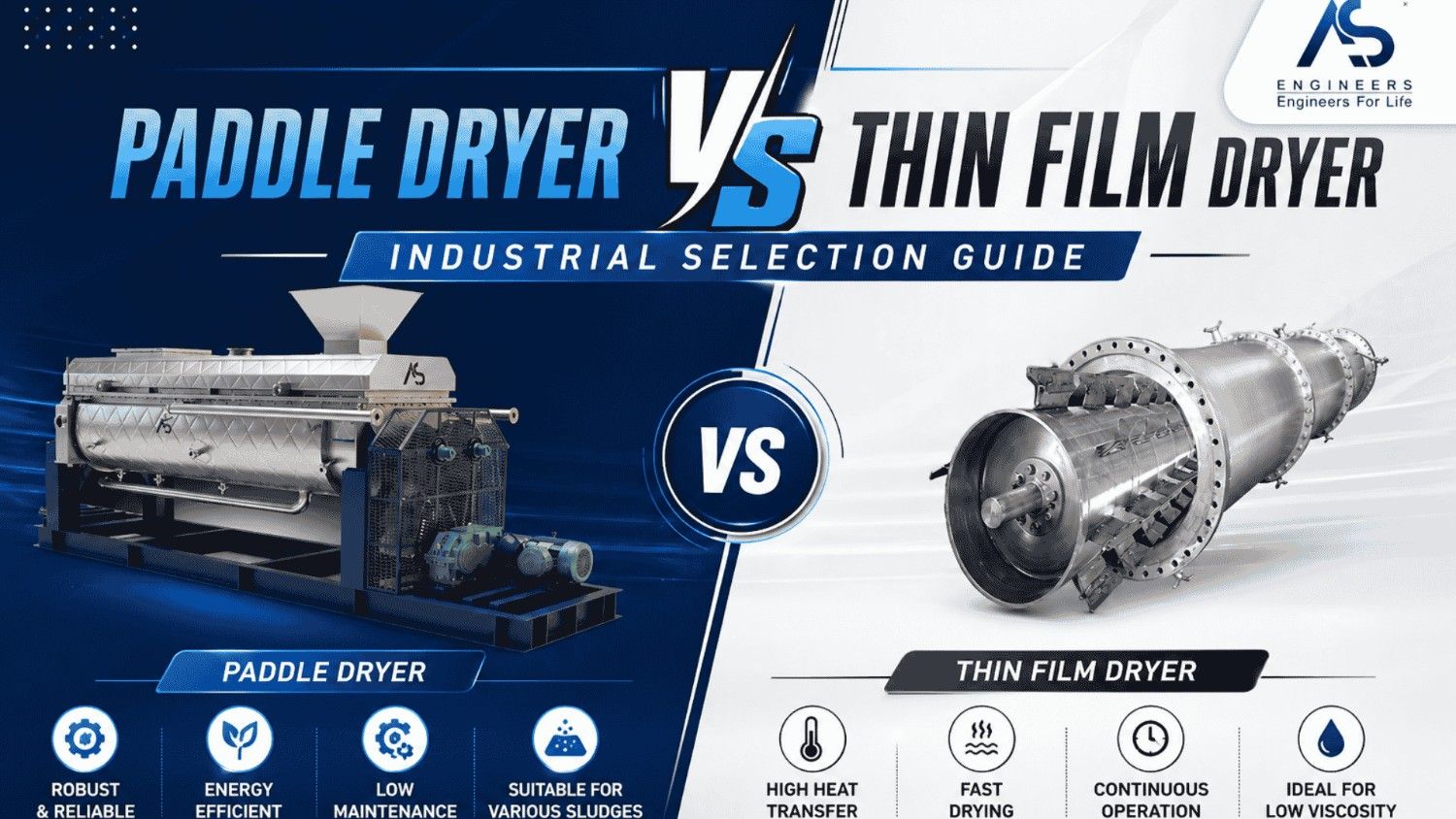
Paddle Dryer vs Thin Film Dryer: The Direct Answer for Buyers
Paddle dryer vs thin film dryer selection depends mainly on feed behavior, required residence time, stickiness, solvent handling, and final product form. A paddle dryer is usually better for sludge, filter cake, sticky paste, wet solids, granules, and powders where mixing and controlled residence time are important. A thin film dryer is usually better for pumpable liquids, viscous concentrates, heat-sensitive materials, and evaporation duties where a very thin product layer must be continuously renewed.
For ETP, STP, CETP, biosolids, chemical sludge, pharmaceutical waste, and sticky industrial residues, buyers often start with paddle dryer evaluation because the equipment is built around indirect heating, agitation, self-cleaning paddles, and stable solid handling. Thin film dryers can be excellent machines, but they do not solve every sludge or paste problem better than a paddle dryer.
What Is the Core Difference Between a Paddle Dryer and Thin Film Dryer?
The core difference is how each machine moves material across the heated surface. A paddle dryer uses hollow shafts, jacketed heat transfer, and rotating paddles to mix and advance material through the dryer. A thin film dryer spreads feed into a thin layer on a heated wall using a rotor or wiping mechanism.
In a paddle dryer, the material bed stays inside the trough for controlled drying. This suits materials that pass through sticky, plastic, shearing, and granular phases. In a thin film dryer, the process depends on keeping the material as a film, which suits many liquids and viscous concentrates but can become difficult when solids, lumps, scaling, or non-flowing cakes dominate.
For buyers studying indirect drying, hollow paddle dryer technology is useful because it explains why shaft, jacket, and paddle heat transfer matter in industrial drying.
How Each Dryer Handles Sludge, Paste, Slurry, and Wet Solids
Feed behavior should decide the technology before price comparison starts. Paddle dryers are strong when the feed is wet, sticky, semi-solid, or difficult to convey after dewatering. Thin film dryers are strong when the feed can be pumped and spread consistently as a controlled film.
Industrial sludge and filter cake rarely behave like clean liquid. They may contain grit, fiber, polymer, salts, fines, organic matter, or unstable moisture distribution. A paddle dryer can tolerate this changing behavior better because the paddles break, turn, and expose the material to heated surfaces. That is why sludge drying using paddle dryer technology is often considered where disposal cost, handling, and moisture reduction are the real business problem.
Thin film dryers can be valuable in chemical concentration, solvent evaporation, crystallization-supporting duties, and heat-sensitive viscous products. But for sludge cake from a filter press, centrifuge, belt press, or screw press, the first practical question is whether the feed can form a stable film. If not, a paddle dryer becomes the safer evaluation path.
Buyer Decision Table: Paddle Dryer vs Thin Film Dryer
This table is designed for early-stage technical screening, not final equipment sizing. Actual selection should be confirmed by material testing because moisture, viscosity, solids percentage, abrasiveness, solvent type, and discharge target can change the answer.
| Buyer Decision Factor | Paddle Dryer | Thin Film Dryer | Practical Selection Signal |
|---|---|---|---|
| Best feed behavior | Sludge, filter cake, paste, slurry, granules, powders | Pumpable liquids, viscous concentrates, thin films | Start with actual feed rheology |
| Stickiness tolerance | High | Medium to application-specific | Paddle dryer suits sticky phase changes better |
| Residence time control | Medium to high | Usually short | Use paddle dryer when drying needs longer controlled exposure |
| Heat-sensitive material | Suitable with correct design, vacuum option if required | Often suitable due to short residence time | Test if product quality is critical |
| Solids handling | Strong | Depends on solids and scaling behavior | High solids usually favor paddle dryer |
| Off-gas volume | Low in indirect systems | Application-specific | Smaller vapor handling can reduce downstream load |
| Maintenance focus | Shafts, paddles, bearings, gearbox, seals | Rotor, wipers, heated wall, seals | Maintenance skill availability matters |
| Sludge disposal reduction | Strong fit | Depends on feed pumpability | Paddle dryer is often preferred for dewatered sludge |
| Pilot testing need | Required for serious buying | Required for serious buying | Never finalize only from brochure data |
Why Paddle Dryers Are Often Safer for Sludge Drying
Paddle dryers are often safer for sludge drying because sludge changes form during drying. It may start wet and sticky, become plastic, pass through a shearing phase, and finally discharge as a drier solid. A dryer that cannot handle this transition can suffer buildup, uneven drying, or discharge trouble.
According to AS Engineers, its paddle dryer uses hollow shafts and jacketed indirect heating, dual counter-rotating shafts, wedge-shaped paddles, and a plug-flow mechanism. The design supports drying, solvent stripping, heating, calcining, roasting, and cooling, depending on the application. For sludge buyers, that matters because the same drying system must manage feed, vapor, fines, discharge, and hygiene.
AS Engineers’ paddle dryer can be configured for atmospheric, vacuum, or pressurized operation, with steam heating up to 14.06 kg/cm² or thermal oil up to 400°C, depending on project design. The equipment can be made in CS, SS304, SS316, Duplex Steel, and other alloys based on process and corrosion requirements. Buyers comparing vendors should review the AS Engineers paddle dryer page when evaluating design scope.
Where Thin Film Dryers Can Be the Better Choice
A thin film dryer can be the better choice when the process needs rapid heat transfer through a constantly renewed thin layer. This is common in some evaporation, concentration, solvent removal, and heat-sensitive viscous liquid duties. It is not automatically better or worse than a paddle dryer, it is better for a different material behavior.
If the feed is pumpable, has predictable viscosity, forms a consistent film, and requires short residence time, thin film drying can be technically attractive. It may also suit duties where high surface renewal is more important than bulk solids agitation. However, if the feed has high non-flowing solids, hard lumps, heavy scaling tendency, or a discharge that must become granular or dry cake, buyers should be cautious.
For industrial buyers comparing several thermal routes, sludge drying methods can help frame the decision beyond one machine name.
When Should You Choose a Paddle Dryer Over a Thin Film Dryer?
Choose a paddle dryer when the material is not simply a liquid evaporation problem. If the feed is sludge cake, sticky paste, semi-solid waste, dewatered residue, or wet powder, the paddle dryer’s mixing and self-cleaning action often gives better operating confidence. It is especially relevant when the goal is disposal cost reduction, safer handling, or waste-to-value conversion.
A paddle dryer becomes a strong choice when the buyer needs lower off-gas volume, indirect heating, enclosed processing, solvent recovery options, and stable discharge handling. In sludge applications, AS Engineers’ data shows a typical example where 10 tons/day wet sludge can become 2 tons/day dry sludge, reducing disposal burden significantly when the process conditions match. The exact savings depend on disposal rates, fuel, moisture, and final dryness target.
For plants handling ETP or STP sludge, the paddle sludge dryer selection guide is relevant because it connects dryer selection with sludge treatment objectives.
What Mistakes Buyers Make During Dryer Comparison
Many buyers compare paddle dryer vs thin film dryer only by heat transfer area, motor power, or quoted price. That is risky because drying failure usually comes from material behavior, not from the equipment name. A lower-priced dryer can become expensive if it plugs, scales, over-dries, under-dries, or requires frequent shutdown cleaning.
The biggest mistake is sending only a moisture percentage to the vendor. Moisture percentage is not enough. A serious RFQ should include feed source, initial moisture, final moisture target, hourly feed rate, viscosity or cake behavior, bulk density, corrosive components, solvent type, temperature limit, particle size, abrasiveness, upstream dewatering method, and desired discharge handling.
Another mistake is ignoring downstream systems. A dryer is not only a heated shell. Feeding, scavenging air, ID fan, cyclone, scrubber, condenser, bag filter, screw conveyor, silo, or bagging system may decide whether the plant runs cleanly. AS Engineers supports pollution control equipment such as cyclone, scrubber, and bag filter, which can be critical in complete drying systems.
What Role Does Pilot Testing Play Before Final Selection?
Pilot testing reduces risk because it shows how the actual material behaves under heat, agitation, vapor release, and discharge conditions. For paddle dryer vs thin film dryer decisions, testing can reveal stickiness, scaling, drying curve, odor, solvent release, dusting, product form, and cleaning needs. This is often more valuable than theoretical comparison.
Per AS Engineers, a 50 kg/hr pilot trial machine is available at its facility or at the client’s site on a minimal paid basis, with the fee waived upon order placement. Pilot testing is useful for performance evaluation, issue identification, process optimization, and feasibility assessment. Buyers can review the paddle dryer pilot trial option before freezing equipment.
For maintenance planning after installation, AS Engineers also provides paddle dryer services and OEM spare parts, which matters when uptime is part of the purchase decision.
Practical Recommendation for Industrial Buyers
The best dryer is the one that matches feed behavior, final moisture target, compliance need, and plant operating reality. A paddle dryer is usually the stronger starting point for sludge, filter cake, sticky paste, and wet solids. A thin film dryer is usually stronger for pumpable viscous liquids, evaporation duties, and short-residence heat-sensitive applications.
For buyers comparing sludge technologies, paddle dryers vs belt dryers can add another useful comparison angle. If your application is specifically wastewater or industrial sludge, review AS Engineers as a sludge dryer manufacturer and ask for a material-based evaluation rather than a generic machine quotation.
FAQs
1. Is a paddle dryer better than a thin film dryer?
A paddle dryer is better for sludge, sticky paste, filter cake, wet powder, and high-solids material that needs agitation and controlled residence time. A thin film dryer is better for many pumpable viscous liquids and short-residence evaporation duties. The right choice depends on material testing.
2. Can a thin film dryer dry sludge?
A thin film dryer may handle some pumpable sludge-like feeds, but dewatered sludge cake is often difficult because it may not form a stable film. If the sludge is sticky, lumpy, fibrous, or high in solids, a paddle dryer is usually a safer evaluation path.
3. Which dryer is better for solvent recovery?
Both technologies can support solvent-related duties when properly engineered. A paddle dryer offers an enclosed indirect drying route with solvent recovery options, while thin film drying can be useful for evaporation and stripping applications. Solvent type, boiling point, vapor load, safety class, and condensation system must be reviewed.
4. Which dryer has lower maintenance?
Neither machine has universally lower maintenance. Paddle dryer maintenance focuses on shafts, paddles, bearings, gearbox, seals, and discharge systems. Thin film dryer maintenance focuses on rotor, wipers, heated wall condition, seals, and scaling control. Feed behavior usually decides the real maintenance burden.
5. Should I ask for a pilot trial before buying?
Yes. A pilot trial is strongly recommended when the feed is sticky, variable, heat-sensitive, solvent-bearing, or expensive to dispose of. Testing confirms drying behavior, discharge quality, utility demand, vapor handling, and cleaning risk before the capital purchase.
If you are comparing paddle dryer vs thin film dryer for sludge, slurry, paste, filter cake, or industrial waste drying, do not finalize the equipment only from catalog data. Share your feed details, moisture target, plant constraints, and disposal objective with AS Engineers for a practical selection discussion through AS Engineers Contact.

Karan Dargode leads operations and environmental health & safety at AS Engineers, an Ahmedabad-based manufacturer with over 25 years of experience in centrifugal blowers, industrial fans, paddle dryers, sludge dryers, and air pollution control equipment. He joined AS Engineers in July 2019 and has spent over six years building operational systems that support the company’s engineering and manufacturing work. His role spans business strategy execution, operational process design, EHS compliance, and policy development. Day to day, that means keeping manufacturing output consistent, ensuring workplace and environmental standards are met, and supporting the company’s growth across domestic and export markets. Education and Qualifications Karan holds a Bachelor of Engineering in Mechanical Engineering from Silver Oak College of Engineering and Technology, Ahmedabad, affiliated with Gujarat Technological University (GTU), completed in 2018. He later pursued a Post Graduate Diploma in Business Administration (PGDBA) with a focus on Operations Management from Symbiosis Centre for Distance Learning, Pune, strengthening his understanding of manufacturing strategy and industrial operations. What He Writes About The articles and posts on this site reflect what Karan works with directly. He covers: Paddle dryer selection, working principles, and industrial applications Sludge drying technology for ETP and CETP operators Centrifugal blower engineering and maintenance Industrial drying process optimization EHS compliance for industrial manufacturing units His writing is technical without being academic. The goal is straightforward: give plant engineers, ETP operators, and procurement managers the specific information they need to make good equipment decisions. At AS Engineers AS Engineers has manufactured industrial equipment since 1997, serving clients across chemicals, pharmaceuticals, food processing, wastewater treatment, and heavy industry. The Ahmedabad facility at GIDC Vatva handles design, fabrication, and testing in-house. Karan’s work at the operations level puts him directly involved with product delivery quality, production planning, and customer-facing timelines. If you have questions about any article on this site or want to discuss a specific application for blowers, dryers, or air pollution control equipment, you can reach the AS Engineers team through the contact page. Contact AS Engineers