In short
The parts of a complete paddle dryer system, from fuel and heating to feeding, pollution control, solvent handling and product handling, and what to specify.
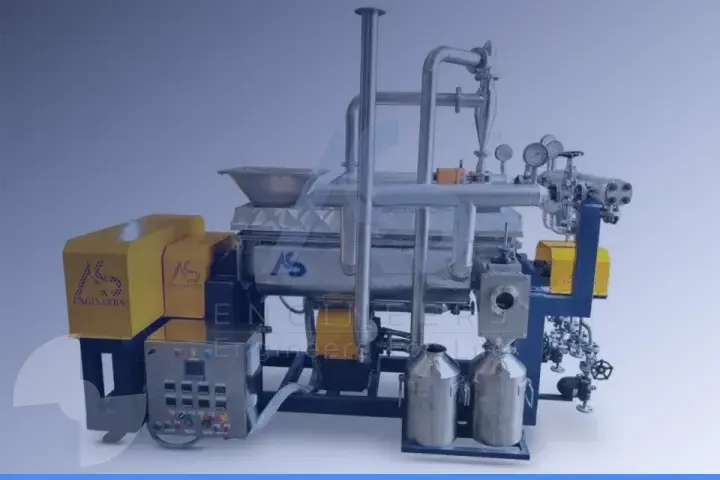
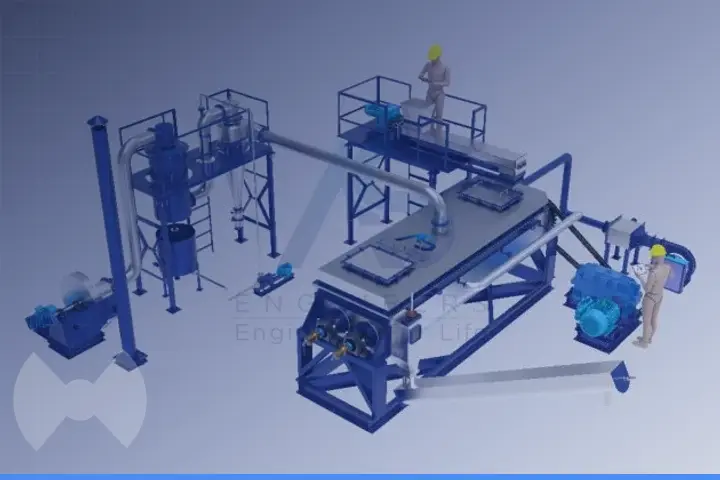
When buyers search for a paddle dryer system, they usually mean more than the machine. The dryer body is the visible part, but a working installation also needs a heat source, a feeder, an air and exhaust path, pollution control and a way to take the dried product away. Leave one out, or size it badly, and the best dryer will underperform.
This page walks through the full system as AS Engineers builds it, so you know what to ask for and what to check.
The system in eight parts
| Part | What it does | Options AS Engineers lists |
|---|---|---|
| 1. Fuel | Supplies the heat source | Natural gas, wood, coal, LDO, electricity, briquettes |
| 2. Heating system | Makes the heating medium | Steam boiler, thermic fluid heater, hot water generator |
| 3. Feeding system | Delivers wet material evenly | Wet material silo with screw feeder, belt conveyor system, sludge pump |
| 4. Paddle dryer | Dries the material | Standard, dual zone and vacuum dryers |
| 5. Scavenging system | Carries vapour out of the dryer | FD blower with finned heat exchanger, heat-traced cover |
| 6. Pollution control | Removes fines and solvent from the vapour | Cyclone, scrubber, bag filter |
| 7. Solvent handling | Condenses and recovers solvent, moves exhaust out | Condenser with solvent tank, ID blower, chimney |
| 8. Product handling | Takes dried product away | Screw conveyor, bucket elevator, silo, bagging systems, truck loading |
Fuel and heating: choose from what you already have
The heating system turns fuel into steam, thermic fluid or hot water. The best choice is usually the one your plant already runs. A site with a boiler can use steam, and AS Engineers states a steam range up to 14.06 kg/cm². A site that needs higher temperatures, or has no steam, can use thermic fluid, stated up to 400°C. Hot water suits low-temperature or heat-sensitive duty.
For sludge from 80% down to 20% moisture, AS Engineers’ fuel guidance is that 1 kg of wood dries about 5 kg of sludge, 1 kg of coal about 8.25 kg, 1 Nm³ of gas about 22.5 kg and 1 kg of LDO about 21 kg. Use that to compare fuel costs before you decide.
Feeding: where many problems start
The dryer cannot do much if the feed arrives in lumps or surges. Match the feeder to the material:
- A screw feeder under a wet material silo suits cake and pastes.
- A sludge pump suits sludge that flows.
- A belt conveyor suits cake delivered from a filter press.
The dryer itself
Three configurations cover most duties. A standard dryer suits most sludge and wet cake. A dual zone dryer has two temperature zones, useful when material needs different conditions at the start and end of drying. A vacuum dryer lowers the drying temperature for heat-sensitive material and helps with solvent recovery. For how the machine works inside, read how a paddle dryer works.
Scavenging, pollution control and solvent handling
Evaporated water leaves the dryer as vapour, and it can carry fines and, in some duties, solvent. The scavenging system moves that vapour out with an FD blower and a heat exchanger, and a heat-traced cover helps stop condensation inside the dryer. Then:
- A cyclone removes coarse fines.
- A scrubber or bag filter cleans what remains.
- A condenser with a solvent tank recovers solvent where there is any.
- An ID blower and chimney discharge the cleaned exhaust.
Because indirect heating gives low off-gas volume, this train is smaller than it would be for a hot-air dryer. AS Engineers makes cyclone separators, scrubbers and bag filters and blowers, so these parts can be designed together with the dryer.
Product handling
The dried product leaves by screw conveyor, bucket elevator or into a silo. Bagging can be semi-automatic or fully automatic, and a truck loading arrangement suits dried sludge going for disposal or reuse. Match this to where the product goes next. Dried sludge, for example, can be used as an alternative fuel where its calorific value allows, in brick making, in cement production or in agriculture, subject to local rules.
What to specify when you ask for a quote
- The material, current moisture and target moisture
- Throughput per hour and operating hours
- Fuel and utilities available on site
- Whether solvent is present in the vapour
- Space and layout limits
- Where the dried product goes
- Your pollution control and emission requirements
Test the whole line, not just the dryer
A pilot trial on AS Engineers’ 25 kg/hr paddle dryer shows how your material dries and what the vapour contains, which sets the design of everything downstream. Trials run at the works or at your site, for a nominal fee waived on order. Request a pilot trial or ask for a quotation.
Related reading: paddle dryer selection criteria, paddle dryer manufacturer in India and sludge drying with a paddle dryer. More products and services are at theasengineers.com.
- B.E. Mechanical · GTU (2018)
- PGDBA, Operations · Symbiosis
- With AS Engineers since 2019
- Writes on paddle dryers, sludge drying & blowers
Karan Dargode leads operations and environmental health & safety at AS Engineers, an Ahmedabad-based manufacturer with over 25 years of experience in centrifugal blowers, industrial fans, paddle dryers, sludge dryers, and air pollution control equipment. He joined AS Engineers in July 2019 and has spent over six years building operational systems that support the company's engineering and manufacturing work.