In short
How a paddle dryer works: indirect heating through hollow shafts, self-cleaning paddles, the sticky phase of sludge, and what drives fuel use.
A paddle dryer dries wet material by pressing it against hot metal and turning it over slowly. The heat comes through the metal, so the material never touches the heating medium. That single choice explains where paddle dryers work well and where they don’t.
The short version
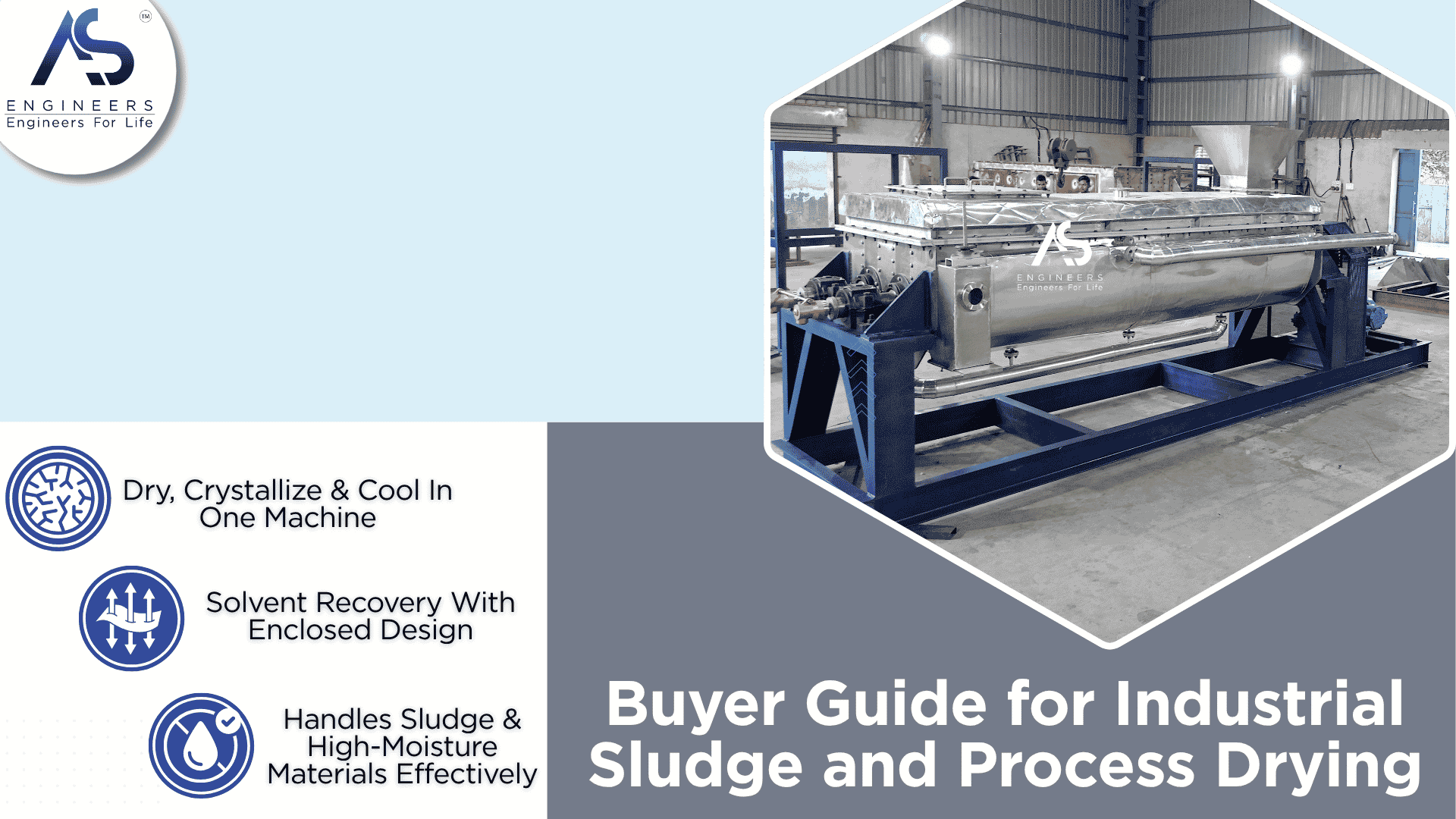
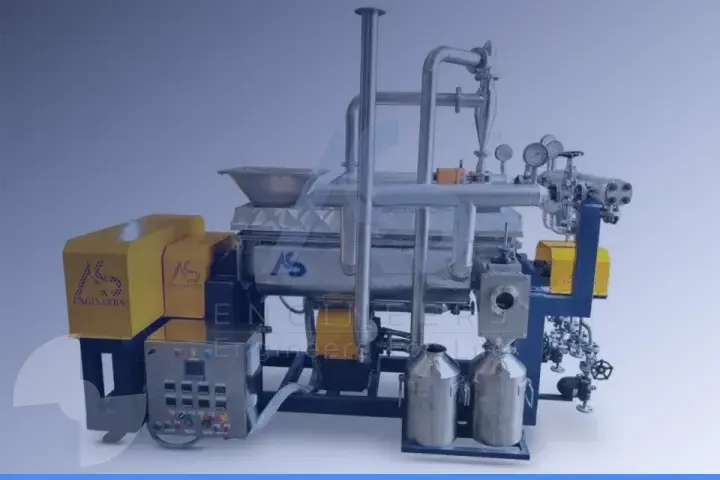
Two parallel shafts fitted with wedge-shaped paddles turn in opposite directions inside a jacketed trough. A heating medium, which can be steam, thermic fluid or hot water, runs through the jacket and through the hollow shafts. Wet feed enters at one end, is mixed and carried forward, loses water as vapour, and leaves at the other end as a drier solid. The vapour goes to a separate treatment train.
What is inside the machine
- The trough and jacket. A long shell whose walls are a heating surface.
- Two hollow shafts. They carry the paddles and the heating medium, so the shafts heat the material too.
- Wedge-shaped paddles. AS Engineers’ paddles intermesh without touching, which keeps the heated surfaces clear of build-up and avoids metal-to-metal wear.
- The drive. A high-torque, low-speed drive. Peak torque, not average load, sets its size, because sticky material drives the peak.
- Vertical shaft removal. The shaft assemblies can be lifted out vertically, which simplifies service.
- Vapour outlet. Vapour and fines leave through the dome to the off-gas system.
How heat moves
Heat reaches the material mostly by conduction, where wet solids touch the hot jacket, shafts and paddles. The mixing keeps replacing the layer at the metal with fresh, wetter material. Because the heat travels through metal and not in a large stream of hot gas, the off-gas volume stays low. Off-gas is mostly the water you evaporated, so the treatment equipment is smaller than for a hot-air dryer.
The AS Engineers design runs a plug flow, so material moves from inlet to outlet without back-mixing. That keeps the dried product uniform.
What happens to sludge as it dries
Dewatered sludge does not dry at a steady pace. Published research on continuous paddle dryers describes three stages: pasty, sticky and granular (HAL study).
- Pasty. The sludge is wet and soft and spreads over the heated surfaces.
- Sticky. In a middle moisture range the sludge turns tacky and resists shear. It clings to paddles and walls, torque rises and heat transfer drops.
- Granular. Once enough water is gone, the material breaks into crumbs that flow and dry easily.
The sticky stage is where machines fail. Self-cleaning, intermeshing paddles and a high-torque drive are there to carry material through it. One laboratory comparison found a paddle dryer coped better with the sludge viscosity zone than a disc dryer (Atlantis Press study). That is a small lab result on one sludge, not a promise for yours.
Operating range
These are the design limits AS Engineers states for its dryers:
| Parameter | Range |
|---|---|
| Heating by steam | Up to 14.06 kg/cm² |
| Heating by thermic fluid | Up to 400°C |
| Final dryness | Up to 99%, or held at a target moisture |
| Operating pressure | Atmospheric, vacuum or pressurised |
| Materials of construction | Carbon steel, SS304, SS316, duplex steel and other alloys |
| Feed forms | Slurries, pastes, cakes, granules, powders |
| Configurations | Standard, dual zone and vacuum |
What decides capacity and fuel use
Capacity is not a catalogue number. It depends on the water to remove, the heat transfer area in the jacket, shafts and paddles, the temperature of the heating medium against the material, residence time, and how sticky, abrasive or heat sensitive the material is.
Published work on sludge paddle dryers points to feed rate and wall temperature as the main drivers of final moisture, with stirring speed mattering much less (Energies, 2023). That is a pointer, not a design rule.
A worked example
Take 1,000 kg of wet sludge at 80% moisture. It holds 200 kg of dry solids. Dried to 20% moisture, the same solids sit in 250 kg of product. The dryer removes 750 kg of water and the load falls from 1,000 kg to 250 kg, a 75% cut in weight. Drying to higher dryness removes more.
AS Engineers’ own guidance for drying sludge from 80% to 20% moisture gives this fuel equivalence: 1 kg of wood dries about 5 kg of sludge, 1 kg of coal about 8.25 kg, 1 Nm³ of gas about 22.5 kg and 1 kg of LDO about 21 kg.
Steam, thermic fluid or hot water
| Heating medium | Where it fits | Watch for |
|---|---|---|
| Steam | Sites with a boiler and moderate temperatures | Condensate handling, jacket pressure rating |
| Thermic fluid | Higher temperatures, or no steam on site | Oil quality testing, expansion and safety systems |
| Hot water | Low temperatures, heat-sensitive material, waste heat | Lower evaporation rate per unit area |
The choice follows the utilities you already have and the temperature your material can take. See steam vs thermal oil paddle dryers. Fuel for the boiler or heater can be natural gas, wood, coal, LDO, electricity or briquettes.
A paddle dryer is a system
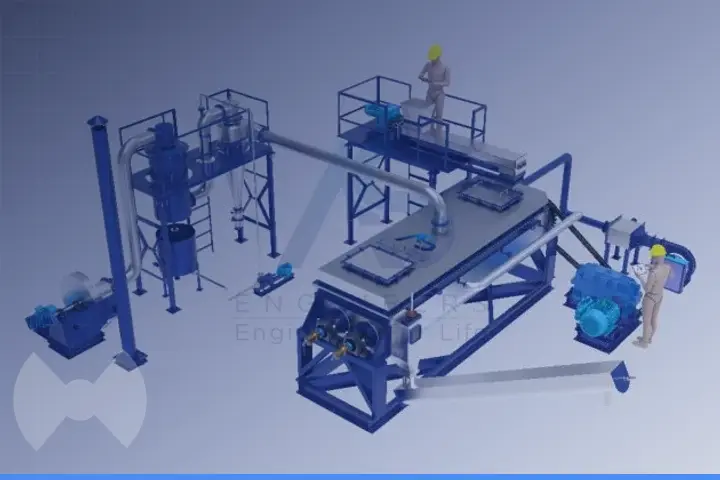
The dryer body is one of eight parts of an AS Engineers installation:
- Fuel. Gas, wood, coal, LDO, electricity or briquettes.
- Heating system. Steam boiler, thermic fluid heater or hot water generator.
- Feeding. Wet material silo with a screw feeder, sludge pump or belt conveyor.
- The paddle dryer. Standard, dual zone or vacuum.
- Scavenging. An FD blower pushes filtered, heated air through a finned heat exchanger into the dryer, with a heat-traced cover.
- Pollution control. Cyclone, scrubber and bag filter.
- Solvent handling. Condenser and solvent tank, with an ID blower and chimney.
- Product handling. Screw conveyor, bucket elevator, silo, bagging or truck loading.
Where it works, and where to be careful
It works well for dewatered ETP, STP and CETP sludge, bio-sludge, oil and chemical sludge, filter cake, pastes and slurries. AS Engineers also lists gypsum, manganese dioxide, copper concentrate, lithium hydroxide, aluminium hydroxide, sodium chloride, ammonium nitrate, pigments, TiO₂, PET chips, polymer resins, starch, spent grain, DDGS, rice bran and fish meal.
Be careful with very abrasive minerals, which wear paddles and liners, and with strongly heat-sensitive products, which may need vacuum or lower temperatures. Oily and solvent-bearing material needs an enclosed design with solvent recovery. A free-flowing powder that dries easily in hot air may be cheaper to dry another way.
Beyond drying, the same machine can heat, calcine, strip solvents, crystallise, react or cool. For wider comparisons see paddle dryer vs rotary dryer and paddle dryer vs thin film dryer.
What happens to the dried sludge
Four uses are listed: alternative fuel if the calorific value is high enough, bricks, cement production and agriculture. Which one is legal and practical depends on the sludge type and local rules.
Questions we hear before a trial
Does stirring speed control drying rate? Much less than most buyers expect. Heat transfer area, wall temperature and feed rate matter more.
Can it handle sticky sludge? That is what it is built for, but “sticky” covers a wide range. Test your own sample.
How dry can it get? Up to 99% dryness on AS Engineers’ stated range, or held at a target moisture. The right target is the one your disposal or reuse route needs, not the lowest possible.
Can I rent or retrofit? AS Engineers offers paddle dryers on rent, plus repair, OEM spares and shaft retrofitting.
Test before you buy
AS Engineers runs pilot trials on a 25 kg/hr paddle dryer, at its works or at your site. The trial checks drying performance, material behaviour, moisture reduction and whether the process is feasible before full-scale investment. It is offered for a nominal fee, waived when you place an order. Send a sample with your current and target moisture.
- B.E. Mechanical · GTU (2018)
- PGDBA, Operations · Symbiosis
- With AS Engineers since 2019
- Writes on paddle dryers, sludge drying & blowers
Karan Dargode leads operations and environmental health & safety at AS Engineers, an Ahmedabad-based manufacturer with over 25 years of experience in centrifugal blowers, industrial fans, paddle dryers, sludge dryers, and air pollution control equipment. He joined AS Engineers in July 2019 and has spent over six years building operational systems that support the company's engineering and manufacturing work.